
Non-FictionHealth & WellnessTrauma Surgery
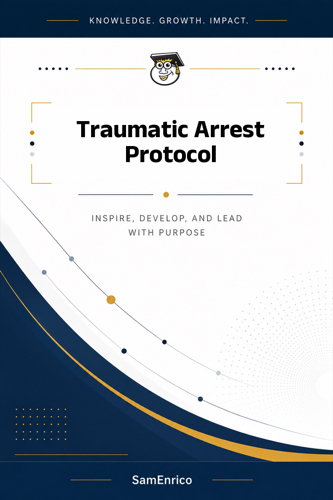
Traumatic Arrest Protocol eBook
Covers when to start CPR after blunt trauma, penet
Covers when to start CPR after blunt trauma, penetrating injury, and exsanguination.
Formats
Free sample
Chapter 1: The Code Blue Lie--–- The paramedics arrived at 23:47. A twenty-eight-year-old male, one stab wound to the left anterior chest, approximately 3 centimeters lateral to the sternum at the fifth intercostal space. He was supine on a convenience store floor, pupils mid-range and sluggish, skin the color of wet marble. No pulse. No respirations.
The cardiac monitor showed a wide-complex rhythm at 42 beats per minute—pulseless electrical activity, PEA.They did exactly what they were trained to do.The senior paramedic called for high-quality chest compressions at a rate of 100 to 120 per minute, depth of at least two inches, full recoil. A second provider established intravenous access and pushed 1 milligram of epinephrine. A third placed a supraglottic airway and ventilated at ten breaths per minute. The algorithm was followed perfectly. The code was clean, efficient, textbook.Twelve minutes later, in the emergency department resuscitation bay, the trauma surgeon cracked the patient's chest.
The pericardium was bulging, tense with blood. She opened it vertically, avoiding the phrenic nerve, and evacuated 300 milliliters of clot. Then she saw the problem. The right ventricle had a 1.5-centimeter through-and-through laceration. It was actively bleeding, but that was not what killed him.
What killed him was that the chest compressions had turned a slow, contained cardiac bleed into a high-pressure, high-volume exsanguination. The compressions increased intrathoracic pressure, which increased the rate of bleeding from the ventricular wound, which further reduced preload, which made the compressions even less effective, which led to more epinephrine, which increased afterload, which increased the bleeding rate again. A perfect feedback loop of iatrogenic harm.The surgeon cross-clamped the aorta, put a finger over the hole, and sutured it closed. By then, twenty-three minutes had passed since the arrest. The patient never regained neurological function.
He was declared brain dead forty-eight hours later.The paramedics followed the algorithm. The algorithm was wrong.The Algorithm That Kills This chapter dismantles the most dangerous assumption in all of emergency medicine: that the cardiac arrest algorithms designed for medical patients apply equally to trauma patients. They do not. Worse, they actively kill when applied to the wrong mechanism.Medical cardiac arrest—the kind caused by myocardial infarction, primary arrhythmia, or cardiomyopathy—is fundamentally a problem of the pump. The heart's electrical system fails, or the muscle fails to contract in a coordinated way, or the coronary arteries fail to deliver oxygen to the myocardium.
In medical arrest, the heart is the enemy. It is the source of the problem. Chest compressions, defibrillation, and epinephrine are aimed at restarting or supporting that failing pump.Traumatic cardiac arrest is different. In trauma, the heart is almost never the primary problem. The heart is an innocent bystander.
It stops beating because something else failed first. That something else falls into exactly three categories: failure of volume (exsanguination), failure of the container (tension pneumothorax or cardiac tamponade), or failure of oxygenation (airway obstruction or severe lung injury). The heart itself may be structurally normal. It may have perfect electrical activity. But it cannot pump what is not there, and it cannot pump into a space that is compressed.The paramedics in the opening case did not understand this distinction.
They treated a tamponade-associated PEA arrest as if it were a medical PEA arrest. They performed compressions, which increased intrathoracic pressure and accelerated bleeding from the ventricular wound. They gave epinephrine, which increased afterload and further increased bleeding. They intubated, which increased mean intrathoracic pressure and reduced venous return. Every intervention was correct for a medical arrest.
Every intervention was wrong for this patient.The data are unforgiving. A 2023 systematic review of out-of-hospital traumatic cardiac arrest including over 45,000 patients found a survival-to-discharge rate of 3.7 percent for penetrating injury and 0.8 percent for blunt injury when standard ACLS protocols were followed. A 2021 study from the Resuscitation Outcomes Consortium found that among blunt traumatic arrest patients who received prehospital CPR, exactly zero survived with good neurological outcome if the arrest was not witnessed by EMS. Zero. The largest trauma registry analysis ever conducted, published in 2024, found that the single strongest predictor of survival in traumatic arrest was not the speed of CPR initiation or the quality of compressions—it was the time from arrest to surgical hemorrhage control.
CPR did not appear in the final regression model at all.The conclusion is inescapable. We have been doing it wrong.The Pump, The Tank, and The Pipe To understand why the algorithm fails, we must first understand the physiology of traumatic arrest. This book introduces a simple mental model that will govern every decision from this point forward: the pump, the tank, and the pipe.The pump is the heart. In medical cardiac arrest, the pump fails. In traumatic arrest, the pump almost never fails first.
It can be injured—cardiac contusion from blunt trauma, laceration from penetrating trauma—but even in those cases, the pump fails because of a structural problem in the container, not an electrical problem in the muscle. A cardiac tamponade does not cause the heart to stop because the heart muscle is damaged. It causes the heart to stop because blood in the pericardial space prevents ventricular filling. The pump is fine. The container is the problem.The tank is the intravascular volume.
The average adult has approximately 5 liters of blood. Lose 40 percent, and the heart cannot generate enough preload to maintain cardiac output. Lose 50 percent, and the heart stops. This is exsanguination. The tank is empty.
No amount of chest compressions will generate output from an empty tank. No amount of epinephrine will constrict vessels that have collapsed below their critical closing pressure. The only solution is to fill the tank—and more importantly, to stop the leak.The pipe is the vasculature. In tension pneumothorax, the pipe is compressed from the outside. Intrathoracic pressure exceeds venous pressure, and blood cannot return to the heart.
The tank is full, but the pipe is pinched closed. In cardiac tamponade, the pipe is compressed from the inside. Blood in the pericardial space prevents the heart from filling. The pump is intact. The tank is full.
But the pipe is blocked.Every traumatic arrest fits into one or more of these categories. The job of the resuscitation team is not to perform high-quality CPR. The job is to identify which category applies and fix it. CPR is almost never the fix. In exsanguination, CPR makes the leak worse.
In tamponade, CPR increases the rate of bleeding into the pericardium. In tension pneumothorax, CPR does nothing to relieve the pressure. Only in the rare case of primary cardiac contusion without tamponade—a diagnosis that is almost impossible to make during an arrest—might CPR have a role as a bridging therapy.The paramedics in the opening case treated a container problem (tamponade) as if it were a pump problem. They did not perform the one intervention that could have saved the patient: a resuscitative thoracotomy to relieve the tamponade and cross-clamp the aorta. But that procedure requires a surgeon and an operating room or a sufficiently equipped emergency department.
The paramedics had neither. And so they did the only thing they were trained to do, and the patient died.This is not a…
This is the end of the free sample. Get the eBook to keep going. Buy now
About this book
Details
- Author
- Avery Consuelo
- Publisher
- SamEnrico
- Language
- English
- Genre
- Non-Fiction, Health & Wellness, Trauma Surgery
- Released
- 2026-06-05
- Pages (approx.)
- 140
- Available as
- eBook, Audiobook

Read better in the ZLOADR app
Your eBooks on your phone or tablet. Sign in with your SamEnrico account and start reading.
More by Avery Consuelo
 Emotion Labeling Vocabulary BuilderAvery Consuelo$11.99
 Step Four Moral Inventory GuideAvery Consuelo$11.99
 Body Scan for PTSD GuideAvery Consuelo$11.99
 The Golden Notes of the Nile: Black Composers Who Shaped the Classical WorldAvery Consuelo$11.99
 Bench JewelerAvery Consuelo$11.99
 How to Produce a Blow TorchAvery Consuelo$11.99
 SA Business Credit Age GuideAvery Consuelo$12.99
You may also like
 Hong Kong Handover 1997Dunn Johnnie$11.99
 Zumba For Postnatal Recovery CourseNeal Christian$11.99
 Zumba for BeginnersLadner Nikia$11.99
 YouTube Comment Mining GuideHumes Pandora$12.99
 Worry Box MeditationCarlin Rudy$11.99
 Workplace Stress MeditationNguyen Lynn$11.99
 Workplace Stress and Sleep RepairHawley Ivory$11.99
 Workplace Perfectionism CureDelaney Jeffry$11.99
 Workplace Injustice Anger GuideWallen Isabelle$11.99
 Work Addiction and Burnout LinkGreenwood Ester$11.99
 Women in Yoga and WellnessBeattie Galina$11.99
 Women in Stand Up ComedyChun Evangeline$11.99