
Non-FictionHealth & WellnessTrauma Surgery
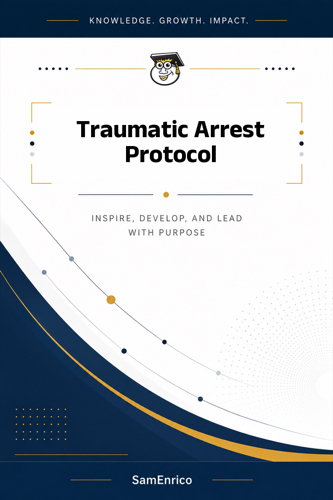
Traumatic Arrest Protocol Audiobook
Covers when to start CPR after blunt trauma, penet
Covers when to start CPR after blunt trauma, penetrating injury, and exsanguination.
Formats
Free sample
Chapter 1: The Code Blue Lie--–- The paramedics arrived at 23:47. A twenty-eight-year-old male, one stab wound to the left anterior chest, approximately 3 centimeters lateral to the sternum at the fifth intercostal space. He was supine on a convenience store floor, pupils mid-range and sluggish, skin the color of wet marble. No pulse. No respirations.
The cardiac monitor showed a wide-complex rhythm at 42 beats per minute—pulseless electrical activity, PEA.They did exactly what they were trained to do.The senior paramedic called for high-quality chest compressions at a rate of 100 to 120 per minute, depth of at least two inches, full recoil. A second provider established intravenous access and pushed 1 milligram of epinephrine. A third placed a supraglottic airway and ventilated at ten breaths per minute. The algorithm was followed perfectly. The code was clean, efficient, textbook.Twelve minutes later, in the emergency department resuscitation bay, the trauma surgeon cracked the patient's chest.
The pericardium was bulging, tense with blood. She opened it vertically, avoiding the phrenic nerve, and evacuated 300 milliliters of clot. Then she saw the problem. The right ventricle had a 1.5-centimeter through-and-through laceration. It was actively bleeding, but that was not what killed him.
What killed him was that the chest compressions had turned a slow, contained cardiac bleed into a high-pressure, high-volume exsanguination. The compressions increased intrathoracic pressure, which increased the rate of bleeding from the ventricular wound, which further reduced preload, which made the compressions even less effective, which led to more epinephrine, which increased afterload, which increased the bleeding rate again. A perfect feedback loop of iatrogenic harm.The surgeon cross-clamped the aorta, put a finger over the hole, and sutured it closed. By then, twenty-three minutes had passed since the arrest. The patient never regained neurological function.
He was declared brain dead forty-eight hours later.The paramedics followed the algorithm. The algorithm was wrong.The Algorithm That Kills This chapter dismantles the most dangerous assumption in all of emergency medicine: that the cardiac arrest algorithms designed for medical patients apply equally to trauma patients. They do not. Worse, they actively kill when applied to the wrong mechanism.Medical cardiac arrest—the kind caused by myocardial infarction, primary arrhythmia, or cardiomyopathy—is fundamentally a problem of the pump. The heart's electrical system fails, or the muscle fails to contract in a coordinated way, or the coronary arteries fail to deliver oxygen to the myocardium.
In medical arrest, the heart is the enemy. It is the source of the problem. Chest compressions, defibrillation, and epinephrine…
This is the end of the free sample. Get the Audiobook to keep going. Buy now
About this book
Details
- Author
- Avery Consuelo
- Publisher
- SamEnrico
- Language
- English
- Genre
- Non-Fiction, Health & Wellness, Trauma Surgery
- Released
- 2026-06-05
- Pages (approx.)
- 140
- Available as
- eBook, Audiobook

Listen in the VoxFlicks app
Audiobooks and audio dramas wherever you go. Sign in with your SamEnrico account and press play.
More by Avery Consuelo
 Emotion Labeling Vocabulary BuilderAvery Consuelo$11.99
 Step Four Moral Inventory GuideAvery Consuelo$11.99
 Body Scan for PTSD GuideAvery Consuelo$11.99
 The Golden Notes of the Nile: Black Composers Who Shaped the Classical WorldAvery Consuelo$11.99
 Bench JewelerAvery Consuelo$11.99
 How to Produce a Blow TorchAvery Consuelo$11.99
 SA Business Credit Age GuideAvery Consuelo$12.99
You may also like
 Hong Kong Handover 1997Dunn Johnnie$11.99
 Zumba For Postnatal Recovery CourseNeal Christian$11.99
 Zumba for BeginnersLadner Nikia$11.99
 YouTube Comment Mining GuideHumes Pandora$12.99
 Worry Box MeditationCarlin Rudy$11.99
 Workplace Stress MeditationNguyen Lynn$11.99
 Workplace Stress and Sleep RepairHawley Ivory$11.99
 Workplace Perfectionism CureDelaney Jeffry$11.99
 Workplace Injustice Anger GuideWallen Isabelle$11.99
 Work Addiction and Burnout LinkGreenwood Ester$11.99
 Women in Yoga and WellnessBeattie Galina$11.99
 Women in Stand Up ComedyChun Evangeline$11.99