
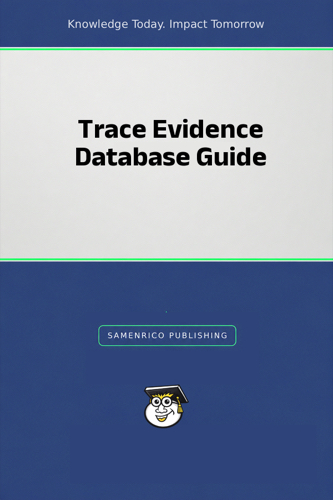
Non-FictionTrue CrimeForensic Databases
Trace Evidence Database Guide eBook
Use comparative databases for hair, fiber, and gla
Use comparative databases for hair, fiber, and glass evidence matching.
Formats
Free sample
Chapter 1: Every Contact Leaves a Trace...--–- The young woman’s body was found just after dawn, lying in a drainage ditch off County Road 12. She had been missing for forty-seven hours. The medical examiner would later determine the cause of death as blunt force trauma to the skull, but on that cold October morning, the only visible evidence was what clung to her clothing: a single strand of hair not her own, three microscopic fibers of an unknown blue fabric, and a fragment of glass no larger than a grain of sand. The detective on the scene, a twenty-year veteran named Elena Vasquez, stared at these particles and felt the familiar weight of responsibility. Somewhere in that invisible world—too small for the naked eye to resolve—lay the identity of a killer.
The question was not whether the evidence existed. Locard had settled that nearly a century ago. The question was whether the tools existed to find it.This is the promise and the problem of trace evidence. Every contact leaves a trace, but a trace is useless if it cannot be seen, measured, compared, and interpreted. For most of forensic history, that interpretation relied on a single human eye looking through a single microscope, comparing two samples side by side, and offering an opinion.
That opinion was often wrong. In the 1990s and early 2000s, the Federal Bureau of Investigation would discover that its own hair examiners had given flawed testimony in over 95 percent of the trials they reviewed—testimony that sent innocent men and women to prison for decades. The problem was not bad science. The problem was incomplete science. The microscopes were accurate.
The examiners were trained. But without a statistical framework and without comparative databases, an honest examiner could not know whether the hair on a victim’s jacket was rare or common. They could only say it looked similar. And similar, as the wrongfully convicted would testify, is not the same as true.This book exists because that era is ending. Over the past fifteen years, forensic laboratories across North America and Europe have begun building, populating, and querying comparative databases for the three most common forms of trace evidence: hair, fiber, and glass.
These databases are not futuristic fantasies. They are operational tools used daily in major crime labs. They contain thousands of reference samples—hair from known individuals, fibers from clothing manufacturers, glass fragments from automobiles and buildings—and they allow examiners to ask a question that was once impossible: How many samples in the database share these exact characteristics? The answer to that question transforms trace evidence from an art into a science. A hair is no longer “consistent with the suspect’s hair.” It is “consistent with the suspect’s hair, and this combination of microscopic characteristics appears in only three of the twelve thousand hairs in the reference database.” That is not certainty, but it is evidence.
And evidence, properly understood, is all that justice requires.The Man Who Saw What Others Missed To understand where we are going, we must first understand where we began. Edmond Locard was not a detective in the conventional sense. He was a French physician and criminologist who, in 1910, convinced the Lyon police department to give him two attic rooms and a staff of one. From these cramped quarters, he built the world’s first forensic laboratory. Locard’s insight was deceptively simple: when two objects come into contact, they exchange material.
A criminal cannot enter a room, commit an act, and depart without leaving something behind or taking something away. That something might be hair, skin cells, clothing fibers, soil, glass fragments, paint chips, or any of the thousands of microscopic particles that populate the everyday world. Locard called these “silent witnesses,” and he believed they were more reliable than any human eyewitness.Locard’s principle—“Every contact leaves a trace”—has been called the single most important concept in forensic science. But it is also the most frequently misunderstood. Locard did not mean that every contact leaves a detectable trace.
He did not mean that every trace can be matched to a source. He meant, more modestly and more accurately, that the potential for transfer always exists. Whether that potential becomes actual evidence depends on the nature of the surfaces, the force of the contact, the persistence of the transferred material, and the sensitivity of the detection methods. A silk blouse brushed against a brick wall may transfer no detectable fibers. A wool sweater brushed against the same wall may transfer dozens.
A gloved hand touching a glass window may leave no fingerprints but may transfer glass fragments invisible to the naked eye. Locard understood that the absence of visible evidence is not the absence of evidence. It is merely the limit of our perception.This is why databases matter. For most of the twentieth century, forensic examiners operated within Locard’s framework but without Locard’s tools. They had microscopes.
They had training. They had reference collections of hair and fibers that they built themselves, often from samples taken from colleagues and family members. But they did not have population data. They did not know, with any empirical confidence, how common or rare a given hair characteristic was in the general population. When an examiner testified that a hair was “consistent with” the defendant’s hair, the jury heard certainty.
The examiner meant only that the hair shared certain class characteristics. The gap between what examiners knew and what juries believed would become the scandal that reshaped forensic science.The Reckoning: When Similar Was Not Enough In 2012, the FBI and the Innocence Project jointly announced a review of thousands of cases in which FBI hair examiners had testified. The results were devastating. Of the 268 trials reviewed, examiners had given scientifically invalid testimony in 257 cases—a rate of 96 percent. In 33 of those cases, defendants had been sentenced to death.
Fourteen had already been executed. The most common error was claiming that a hair could be “matched” to a specific individual, a claim that microscopic hair analysis has never been able to support. Other errors included overstating the statistical significance of similarities, failing to acknowledge limitations of the method, and using language that implied certainty where none existed.Consider the case of Kirk Odom. In 1981, a woman in Washington, D.C., was sexually assaulted and robbed. A single hair was found on her nightgown.
An FBI hair examiner testified that the hair was “microscopically similar” to Odom’s hair and that such similarities were “consistent with” Odom being the source. The jury convicted him. Odom spent 33 years in prison before DNA testing—testing that did not exist at the time of his trial—proved that the hair was not his. He was exonerated in 2014. The hair that had sent him to prison belonged to someone else entirely, someone never identified.
The microscope had not lied. The examiner had not lied. But both had been asked to do something that science could not do: individualize a hair based solely on microscopic comparison.This history is not included here to shame forensic examiners, who did their best with the tools available. It is…
This is the end of the free sample. Get the eBook to keep going. Buy now
About this book
Details
- Author
- Morales Susan
- Publisher
- SamEnrico
- Language
- English
- Genre
- Non-Fiction, True Crime, Forensic Databases
- Released
- 2026-06-07
- Pages (approx.)
- 147
- Available as
- eBook, Audiobook

Read better in the ZLOADR app
Your eBooks on your phone or tablet. Sign in with your SamEnrico account and start reading.
More by Morales Susan
 Immigrant Printing Shop To Marketing FirmMorales Susan$11.99
 Artist's Block RecoveryMorales Susan$11.99
 Empathic Listening Skills HandbookMorales Susan$11.99
 RED S Prevention GuideMorales Susan$11.99
 Legal Profession MentorshipMorales Susan$11.99
 Coppola Dynasty - Sofia CoppolaMorales Susan$11.99
 The Shame SpiralMorales Susan$11.99
 Assertiveness For PastorsMorales Susan$11.99
 The Forgotten Voyages: How Japanese Explorers Redefined the Pacific (1905-1915)Morales Susan$11.99
 The Unlikely Alliance: How a Pop Star and a Dictator Shaped Cold War DiplomacyMorales Susan$11.99
 The Djinn’s Last Vessel: A Marid’s Bargain in the Sands of TimeMorales Susan$11.99
 The Mineral Guide to RutherfordineMorales Susan$11.99
You may also like
 Hong Kong Handover 1997Dunn Johnnie$11.99
 Zumba For Postnatal Recovery CourseNeal Christian$11.99
 Zumba for BeginnersLadner Nikia$11.99
 YouTube Comment Mining GuideHumes Pandora$12.99
 Worry Box MeditationCarlin Rudy$11.99
 Workplace Stress MeditationNguyen Lynn$11.99
 Workplace Stress and Sleep RepairHawley Ivory$11.99
 Workplace Perfectionism CureDelaney Jeffry$11.99
 Workplace Injustice Anger GuideWallen Isabelle$11.99
 Work Addiction and Burnout LinkGreenwood Ester$11.99
 Women in Yoga and WellnessBeattie Galina$11.99
 Women in Stand Up ComedyChun Evangeline$11.99