
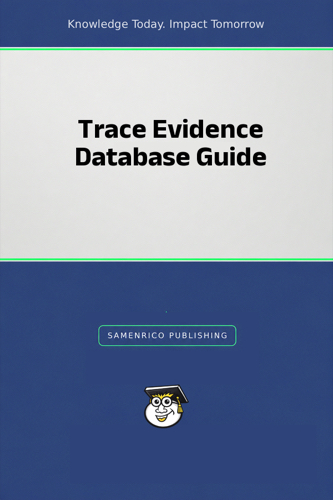
Non-FictionTrue CrimeForensic Databases
Trace Evidence Database Guide
Use comparative databases for hair, fiber, and gla
Use comparative databases for hair, fiber, and glass evidence matching.
Formats
About this book
Free sample
Chapter 1: Every Contact Leaves a Trace...--–- The young woman’s body was found just after dawn, lying in a drainage ditch off County Road 12. She had been missing for forty-seven hours. The medical examiner would later determine the cause of death as blunt force trauma to the skull, but on that cold October morning, the only visible evidence was what clung to her clothing: a single strand of hair not her own, three microscopic fibers of an unknown blue fabric, and a fragment of glass no larger than a grain of sand. The detective on the scene, a twenty-year veteran named Elena Vasquez, stared at these particles and felt the familiar weight of responsibility. Somewhere in that invisible world—too small for the naked eye to resolve—lay the identity of a killer.
The question was not whether the evidence existed. Locard had settled that nearly a century ago. The question was whether the tools existed to find it.This is the promise and the problem of trace evidence. Every contact leaves a trace, but a trace is useless if it cannot be seen, measured, compared, and interpreted. For most of forensic history, that interpretation relied on a single human eye looking through a single microscope, comparing two samples side by side, and offering an opinion.
That opinion was often wrong. In the 1990s and early 2000s, the Federal Bureau of Investigation would discover that its own hair examiners had given flawed testimony in over 95 percent of the trials they reviewed—testimony that sent innocent men and women to prison for decades. The problem was not bad science. The problem was incomplete science. The microscopes were accurate.
The examiners were trained. But without a statistical framework and without comparative databases, an honest examiner could not know whether the hair on a victim’s jacket was rare or common. They could only say it looked similar. And similar, as the wrongfully convicted would testify, is not the same as true.This book exists because that era is ending. Over the past fifteen years, forensic laboratories across North America and Europe have…
This is the end of the free sample. Get the eBook to keep going. Buy now
Contents
- Chapter 1
- Chapter 2
- Chapter 3
- Chapter 4
- Chapter 5
- Chapter 6
- Chapter 7
- Chapter 8
- Chapter 9
- Chapter 10
- Chapter 11
- Chapter 12
Details
- Author
- Morales Susan
- Publisher
- SamEnrico
- Language
- English
- Genre
- Non-Fiction, True Crime, Forensic Databases
- Released
- 2026-06-07
- Pages (approx.)
- 147
- Available as
- eBook, Audiobook

Read better in the ZLOADR app
Your eBooks on your phone or tablet. Sign in with your SamEnrico account and start reading.
More by Morales Susan
 Immigrant Printing Shop To Marketing FirmMorales Susan$11.99
 Artist's Block RecoveryMorales Susan$11.99
 Empathic Listening Skills HandbookMorales Susan$11.99
 RED S Prevention GuideMorales Susan$11.99
 Legal Profession MentorshipMorales Susan$11.99
 Coppola Dynasty - Sofia CoppolaMorales Susan$11.99
 The Shame SpiralMorales Susan$11.99
 Assertiveness For PastorsMorales Susan$11.99
 The Forgotten Voyages: How Japanese Explorers Redefined the Pacific (1905-1915)Morales Susan$11.99
 The Unlikely Alliance: How a Pop Star and a Dictator Shaped Cold War DiplomacyMorales Susan$11.99
 The Djinn’s Last Vessel: A Marid’s Bargain in the Sands of TimeMorales Susan$11.99
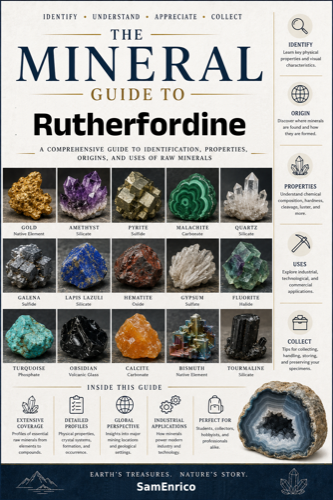 The Mineral Guide to RutherfordineMorales Susan$11.99
You may also like
 Hong Kong Handover 1997Dunn Johnnie$11.99
 Zumba For Postnatal Recovery CourseNeal Christian$11.99
 Zumba for BeginnersLadner Nikia$11.99
 YouTube Comment Mining GuideHumes Pandora$12.99
 Worry Box MeditationCarlin Rudy$11.99
 Workplace Stress MeditationNguyen Lynn$11.99
 Workplace Stress and Sleep RepairHawley Ivory$11.99
 Workplace Perfectionism CureDelaney Jeffry$11.99
 Workplace Injustice Anger GuideWallen Isabelle$11.99
 Work Addiction and Burnout LinkGreenwood Ester$11.99
 Women in Yoga and WellnessBeattie Galina$11.99
 Women in Stand Up ComedyChun Evangeline$11.99