
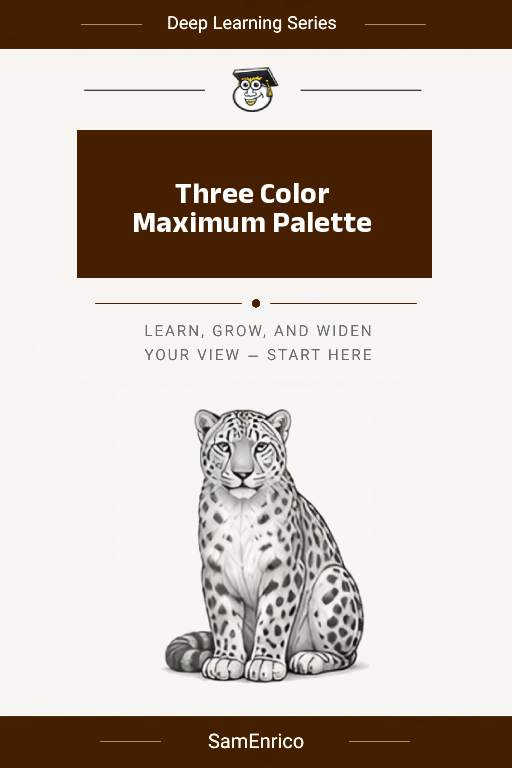
Non-FictionProfessional's Cheat SheetColor TheoryPalette Limits
Three Color Maximum Palette eBook
Pick one brand color, one accent, and one neutral
Pick one brand color, one accent, and one neutral gray for all your slides and charts.
Formats
Free sample
Chapter 1: The Rainbow Curse--–- The email arrived at 11:47 PM on a Sunday. Maria, a senior vice president at a mid-sized financial services firm, had spent fourteen hours preparing her deck for Monday morning's board presentation. She had included everything: quarterly trends, regional breakdowns, competitor analysis, risk assessments, and a twelve-page forecast with supporting data visualizations. She had used her company's official brand palette—all seven colors—plus a few extras she thought made the charts "pop." Her pie chart had six slices, each a different shade of purple, blue, green, yellow, orange, and red. Her line graph had four lines in four colors.
Her bar chart had eight bars in eight colors. She was proud of her work. It looked comprehensive. It looked professional. It looked, she thought, like a million dollars.The board met at 8:00 AM.
By 8:15 AM, the CEO stopped paying attention. By 8:30 AM, two board members were checking their phones. By 8:45 AM, when Maria reached her most important slide—the one showing a 22 percent projected growth in their core market—the CFO interrupted her and asked, "Which line is our actual revenue again?" Maria pointed to the bright orange line on a chart that also contained a yellow line, a green line, a blue line, a purple line, and a gray line. The CFO squinted. The CEO sighed.
The meeting ended early. Maria's proposal was tabled indefinitely.She had used every color available to her. And because she had used every color, she had communicated nothing.This book exists because Maria's story happens thousands of times every single day. In boardrooms, in classrooms, in pitch meetings, in conference calls, in government hearings, in nonprofit galas, in startup demo days—the same tragedy unfolds. A well-intentioned presenter creates a slide deck.
They have access to millions of colors through their presentation software. They use as many as they can fit. And their audience, overwhelmed by visual noise, remembers almost nothing.The problem is not the data. The problem is not the presenter's expertise. The problem is not even the design software.
The problem is a fundamental misunderstanding of how the human brain processes color. And the solution is simpler than you think.This chapter introduces the core problem that the Three Color Maximum Palette solves: the cognitive disaster of what we call the Rainbow Curse. You will learn why more colors actually mean less comprehension, how the brain's working memory creates a hard limit on visual categories, and why the most effective presentations in the world—from Apple keynotes to TED Talks to Fortune 500 board decks—consistently use no more than three colors. By the end of this chapter, you will never look at a rainbow-colored chart the same way again.The Science of Visual Overload Let us begin with a simple experiment. I am going to describe two slides.
I want you to predict which one you would remember better twenty-four hours later.Slide A contains a bar chart with six bars. Each bar is a different color: red, orange, yellow, green, blue, and purple. The bars represent six product lines. The tallest bar, representing Product D, is bright red. The shortest bar, representing Product A, is purple.Slide B contains a bar chart with six bars.
Five of the bars are identical shades of light gray. One bar—the tallest one, representing Product D—is bright red.Which chart would you remember?If you are like most people, you instinctively believe that more color equals more memorable. After all, Slide A is more vibrant. It is more visually interesting. It uses the full spectrum.
Surely the brain would find that more engaging.The science says the opposite is true.In a landmark study on visual working memory published in the Journal of Experimental Psychology, researchers found that the average human brain can hold only three to four distinct visual categories in active working memory at any given moment. When presented with six or more distinct colors, the brain does not simply "remember more." Instead, it shifts cognitive resources away from comprehension and toward categorization. The brain stops asking "What does this mean?" and starts asking "Which group does this belong to?" This shift is not trivial. It costs the audience roughly 40 percent of their ability to recall specific data points twenty-four hours later.This phenomenon is called extraneous cognitive load. It is the mental effort required to process information that is not directly relevant to understanding the content.
In the context of color, any color that does not serve a specific communicative purpose becomes extraneous. It becomes noise. And noise, no matter how pretty, degrades signal.Consider the difference between a six-color rainbow chart and a three-color Maximum Palette chart. In the rainbow chart, the audience must perform the following mental operations for each bar: (1) perceive the color, (2) match the color to a legend, (3) retrieve the legend's label from memory, (4) associate that label with the bar's height, (5) hold all previous comparisons in working memory, and (6) build a ranking or comparison. This is six operations per bar.
For six bars, that is thirty-six mental operations. Most audiences give up after the third bar.In the three-color Maximum Palette chart—five gray bars and one accent bar—the audience performs only three mental operations total: (1) see the gray bars as "the rest," (2) see the accent bar as "the important one," (3) register that bar's value. That is it. The brain does not need to consult a legend. It does not need to remember which color corresponds to which category.
It simply sees: important versus not important.This is not a minor efficiency gain. This is the difference between an audience that understands your point and an audience that smiles politely while retaining nothing.The 70 Percent Faster Design Fact The Rainbow Curse does not only harm your audience. It also harms you, the presenter and designer. One of the most surprising findings from research on design workflows is that unlimited color choices actually slow down decision-making dramatically.In a study of professional presentation designers conducted by the Presentation Guild, researchers tracked the time designers spent on color selection across different palette constraints. Designers given unlimited access to color (no palette restrictions, full software capabilities) spent an average of forty-seven minutes per deck just on color decisions.
This included selecting initial colors, adjusting them, discarding them, selecting new ones, and reconciling inconsistencies across slides.Designers given a fixed three-color palette (brand, accent, gray) spent an average of six minutes per deck on color decisions. That is a reduction of over 87 percent.The reason is what psychologists call choice paralysis. When faced with unlimited options, the human brain experiences anxiety, indecision, and a persistent fear of making the "wrong" choice. This is the same phenomenon that causes shoppers to walk away from a shelf with twenty-four varieties of jam but buy from a shelf with six varieties. More options do not lead to better choices.
They lead to fewer choices and more regret.In the context of presentation design, choice paralysis manifests as endless tweaking. A designer with unlimited colors will spend hours asking themselves: "Should this header be navy or royal blue? Should this callout box be red or orange? Should…
This is the end of the free sample. Get the eBook to keep going. Buy now
About this book
Details
- Author
- Weber Mitchell
- Publisher
- SamEnrico
- Language
- English
- Genre
- Non-Fiction, Professional's Cheat Sheet, Color Theory, Palette Limits
- Released
- 2026-05-29
- Pages (approx.)
- 137
- Available as
- eBook, Audiobook

Read better in the ZLOADR app
Your eBooks on your phone or tablet. Sign in with your SamEnrico account and start reading.
More by Weber Mitchell
 Metta Phrases Guided JournalWeber Mitchell$11.99
 The MBSR for IBS ReliefWeber Mitchell$11.99
 Price Fixing Penalty MatrixWeber Mitchell$11.99
 Patellar Tendonitis PreventionWeber Mitchell$11.99
 The Blame CycleWeber Mitchell$11.99
 Building a Personal Board of DirectorsWeber Mitchell$11.99
 Sludge Reduction GuideWeber Mitchell$11.99
 Forensic Hair Comparison GuideWeber Mitchell$11.99
 Divorce Child Self EsteemWeber Mitchell$11.99
 Enki’s Great Deeds: The God Who Shaped the WorldWeber Mitchell$11.99
 White Lightning: The Meth Kingpin Who Outsmarted the DEAWeber Mitchell$11.99
 The Mammoth Deception: How Ancient Hunters Fooled the Ice Age GiantsWeber Mitchell$11.99
You may also like
 Hong Kong Handover 1997Dunn Johnnie$11.99
 Zumba For Postnatal Recovery CourseNeal Christian$11.99
 Zumba for BeginnersLadner Nikia$11.99
 YouTube Comment Mining GuideHumes Pandora$12.99
 Worry Box MeditationCarlin Rudy$11.99
 Workplace Stress MeditationNguyen Lynn$11.99
 Workplace Stress and Sleep RepairHawley Ivory$11.99
 Workplace Perfectionism CureDelaney Jeffry$11.99
 Workplace Injustice Anger GuideWallen Isabelle$11.99
 Work Addiction and Burnout LinkGreenwood Ester$11.99
 Women in Yoga and WellnessBeattie Galina$11.99
 Women in Stand Up ComedyChun Evangeline$11.99