
Non-FictionTrue CrimeHair Analysis
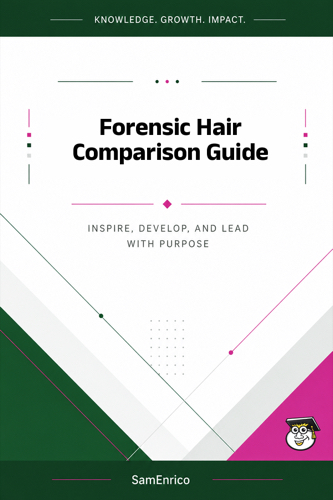
Forensic Hair Comparison Guide
Distinguish human from animal hair and identify ra
Distinguish human from animal hair and identify racial characteristics.
Formats
About this book
Free sample
Chapter 1: The Strand That Changed Everything--–- On a humid July morning in 1981, a 23-year-old woman was assaulted in her Washington, D.C. apartment. She survived. She described her attacker. She cooperated with police.
And when forensic analysts found a single strand of hair on her nightgown, they compared it to hair from a suspect named Kirk Odom. Under a comparison light microscope, the hairs appeared indistinguishable. The analyst testified that the hair was “consistent with” Odom’s. The jury convicted him. He spent 33 years in prison for a crime he did not commit.
In 2012, DNA testing proved the hair belonged to someone else entirely. Odom walked free, but the question haunted forensic science long after his release: how many other Kirk Odoms were still behind bars, convicted on the strength of a single strand of hair and an expert’s confident but statistically unsupported opinion?The answer, as the forensic community would later learn, was far too many.The story of Kirk Odom is not an outlier. It is a warning. Between the 1970s and the late 1990s, microscopic hair comparison was treated as a gold standard of trace evidence. Examiners would mount two hairs—one from a crime scene, one from a suspect—on separate slides, align them under a comparison microscope, and declare them “matched” if the color, diameter, medullary pattern, and cuticle scale appearance seemed similar.
The word “similar” was subjective. The error rate was unknown. The statistical foundation was nonexistent. And yet, hair comparison testimony helped send thousands of people to prison.The 2009 National Academy of Sciences report changed everything. It did not mince words.
It declared that forensic hair comparison lacked “the necessary scientific validation” and that examiners had “no basis for making definitive source attributions.” The report was a fire alarm in a building that had been smoldering for decades. It forced the forensic community to confront an uncomfortable truth: classical hair microscopy, as practiced for nearly a century, was not science as the legal system defines it. It was pattern recognition dressed in a lab coat.This book is the response to that…
This is the end of the free sample. Get the eBook to keep going. Buy now
Contents
- Chapter 1
- Chapter 2
- Chapter 3
- Chapter 4
- Chapter 5
- Chapter 6
- Chapter 7
- Chapter 8
- Chapter 9
- Chapter 10
- Chapter 11
- Chapter 12
Details
- Author
- Weber Mitchell
- Publisher
- SamEnrico
- Language
- English
- Genre
- Non-Fiction, True Crime, Hair Analysis
- Released
- 2026-06-06
- Pages (approx.)
- 160
- Available as
- eBook, Audiobook

Read better in the ZLOADR app
Your eBooks on your phone or tablet. Sign in with your SamEnrico account and start reading.
More by Weber Mitchell
 Metta Phrases Guided JournalWeber Mitchell$11.99
 The MBSR for IBS ReliefWeber Mitchell$11.99
 Price Fixing Penalty MatrixWeber Mitchell$11.99
 Patellar Tendonitis PreventionWeber Mitchell$11.99
 The Blame CycleWeber Mitchell$11.99
 Building a Personal Board of DirectorsWeber Mitchell$11.99
 Sludge Reduction GuideWeber Mitchell$11.99
 Divorce Child Self EsteemWeber Mitchell$11.99
 Enki’s Great Deeds: The God Who Shaped the WorldWeber Mitchell$11.99
 White Lightning: The Meth Kingpin Who Outsmarted the DEAWeber Mitchell$11.99
 The Mammoth Deception: How Ancient Hunters Fooled the Ice Age GiantsWeber Mitchell$11.99
 Growing LudwigiaWeber Mitchell$11.99
You may also like
 Hong Kong Handover 1997Dunn Johnnie$11.99
 Zumba For Postnatal Recovery CourseNeal Christian$11.99
 Zumba for BeginnersLadner Nikia$11.99
 YouTube Comment Mining GuideHumes Pandora$12.99
 Worry Box MeditationCarlin Rudy$11.99
 Workplace Stress MeditationNguyen Lynn$11.99
 Workplace Stress and Sleep RepairHawley Ivory$11.99
 Workplace Perfectionism CureDelaney Jeffry$11.99
 Workplace Injustice Anger GuideWallen Isabelle$11.99
 Work Addiction and Burnout LinkGreenwood Ester$11.99
 Women in Yoga and WellnessBeattie Galina$11.99
 Women in Stand Up ComedyChun Evangeline$11.99