
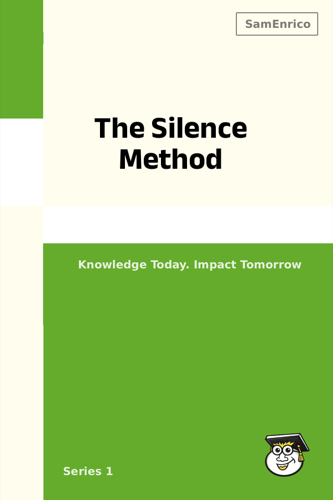
The Silence Method eBook
Use complete silence for maximum cognitive perform
by Hamlin Alexa
Use complete silence for maximum cognitive performance.
Formats
Free sample
Chapter 1: The Cognitive Smog--–- By the time you finish reading this sentence, the average knowledge worker will have lost another twelve seconds of deep cognitive function. Not to a phone call, not to an email, and not to a conversation with a colleague. To nothing. To the mere anticipation of a notification that hasn't even arrived. This is the opening salvo of what I call the Cognitive Smog—the invisible, self-generated fog of auditory pings, notification buzzes, visual clutter, and anxious inner chatter that costs the average professional between eight and twelve hours of focused thinking per week.
That is the equivalent of one full workday lost to absolutely nothing productive. Every single week. Let me say that again: you are losing an entire day every seven days to noise you didn't choose, didn't invite, and likely didn't even notice until this very moment.The Scene You Recognize But Cannot Name Think about your average morning. The alarm blares. Before your feet touch the floor, you have already checked your phone—email, news alerts, social media notifications, a text from a friend, a reminder from an app.
By the time you reach the kitchen, the television is on, or a podcast is playing, or you have summoned a voice assistant to read you the weather and traffic. You step outside, and the world assaults you: traffic, sirens, construction, the tinny leak of someone else's music from their headphones. You arrive at work—an open-plan office, perhaps—and the assault continues: keyboards clacking, phones ringing, colleagues laughing two desks away, the HVAC system humming, the coffee machine grinding.By ten o'clock in the morning, your brain has processed more discrete pieces of auditory and informational stimuli than your great-grandparents processed in an entire week. And you feel fine. You feel normal.
That is the danger.We have adapted to noise the way a frog adapts to slowly boiling water. We no longer register the cost because we have never known anything different. But the cost is real, it is measurable, and it is devastating to your cognitive performance.The Three Faces of Noise Before we can clear the Cognitive Smog, we must name its components. Throughout this book, when I use the word "noise," I am not merely talking about sound. I am talking about three distinct categories of interference, each of which attacks your brain through a different pathway.
Learning to distinguish them is the first step toward mastering The Silence Method.Auditory Noise is the most obvious. This includes the siren outside your window, the conversation at the next table, the dripping faucet, the ringing phone, the leaf blower, the television playing in the waiting room, the hum of your refrigerator, the click of your keyboard, even the sound of your own breathing when the room falls quiet. Auditory noise is processed by the cochlea and routed through the thalamus directly to the amygdala—the brain's threat detection center—before you ever consciously register what you heard. This means your body reacts to a sudden sound (spiking cortisol, increasing heart rate) before your mind has time to decide whether the sound is actually dangerous. Evolutionarily, this was useful.
A twig snap in the forest might be a predator. Today, it is a notification. And your body cannot tell the difference.Informational Noise is more subtle and, in many ways, more insidious. This category includes every email ping, news alert, social media badge, text message banner, calendar reminder, weather update, stock price ticker, and "breaking news" chyron that crosses your field of vision. Informational noise is not necessarily loud, but it is relentlessly demanding.
Each piece of information arrives with a tiny hook: Look at me. Process me. Respond to me. Worry about me. The human brain has a finite attentional budget, typically measured in cognitive scientists' labs at about 120 bits per second.
A single conversation consumes 60 of those bits. When you are simultaneously monitoring your email inbox, a Slack channel, a text message thread, and a news website while someone speaks to you, you are not multitasking. You are rapidly switching attention between five under-served tasks, and every switch carries a switching cost—a tiny tax of time and mental energy. Do this a hundred times a day, and you have paid a tax of several hours.Internal Noise is the loudest of all, and the one most people overlook. This is the chatter inside your own head: the to-do list that loops endlessly, the replay of an argument you had yesterday, the worry about a presentation next week, the replay of an embarrassing moment from five years ago, the self-criticism, the rumination, the planning, the regretting, the fantasizing.
Internal noise never stops. Unlike auditory noise (which you can escape by closing a door) or informational noise (which you can escape by turning off your phone), internal noise follows you everywhere. It is the background hum of your own consciousness, and for most people, it is the primary thief of cognitive performance.A busy street can be tuned out. An anxious inner monologue cannot.The Amygdala's Permanent Overtime Here is what happens inside your skull when noise—any noise—enters your environment. The amygdala, two almond-shaped clusters of neurons deep in the medial temporal lobe, is your brain's dedicated threat detector.
Its job is simple: scan incoming sensory data for anything that might harm you, and if a threat is detected, sound the alarm. The alarm takes the form of cortisol and adrenaline flooding your system, your heart rate increasing, your breathing shallowing, your pupils dilating, and your attention narrowing to focus exclusively on the potential threat. This is the fight-or-flight response, and it saved your ancestors' lives countless times.But the amygdala cannot distinguish between a genuine threat (a predator) and a manufactured one (a notification). It responds to novelty, unpredictability, and sudden change. And modern life is nothing but novelty, unpredictability, and sudden change.
Your phone buzzes unpredictably. Your email chimes with a sender you do not recognize. Your colleague interrupts your work without warning. A car alarm goes off outside. Each of these events triggers a micro-dose of the fight-or-flight response.
Each one spikes your cortisol. Each one narrows your attention.Now consider: how many times does this happen to you in an average day? If you are like most knowledge workers, the answer is between one hundred and fifty and three hundred times. Your amygdala is not sounding the alarm three hundred times a day. It has never turned off.
It is stuck in a state of low-level, chronic alert—what neuroscientists call "allostatic load." Your threat detector is working permanent overtime, and it is exhausting you.The Cortisol Hangover Cortisol is not inherently bad. In short bursts, it sharpens focus, mobilizes energy, and enhances memory formation. The problem is chronic elevation. When cortisol remains high for hours and days and weeks, it begins to damage the very systems it evolved to protect.The first casualty is the prefrontal cortex—the part of your brain responsible for executive functions: planning, reasoning, impulse control, and decision-making. Cortisol suppresses prefrontal activity because, in a genuine emergency, you do not need to plan for next month; you need to run.…
This is the end of the free sample. Get the eBook to keep going. Buy now
About this book
Details
- Author
- Hamlin Alexa
- Publisher
- SamEnrico
- Language
- English
- Genre
- Non-Fiction, Business Brief, Silence
- Released
- 2026-06-10
- Pages (approx.)
- 127
- Available as
- eBook, Audiobook

Read better in the ZLOADR app
Your eBooks on your phone or tablet. Sign in with your SamEnrico account and start reading.
More by Hamlin Alexa
 Quadrant Three Elimination GuideHamlin Alexa$11.99
 Rolling Hills RunHamlin Alexa$11.99
 Flow in DrivingHamlin Alexa$11.99
 Dog Beach Romp CalmHamlin Alexa$11.99
 Stress Jaw Clenching TMJHamlin Alexa$11.99
 Affirmations for Social AnxietyHamlin Alexa$11.99
 Gymnast's Hypnosis GuideHamlin Alexa$11.99
 The Secret Sauce: How a 1950s Gas Station Became a Fast Food GiantHamlin Alexa$11.99
 Blood & Silk: The Opium Cartel’s Last Stand in 19th-Century ChinaHamlin Alexa$11.99
 Western Gorillas: SubspeciesHamlin Alexa$11.99
 A Collector's Handbook to the Wolseley EightHamlin Alexa$11.99
 How to Produce Plant and Animal OilHamlin Alexa$11.99