
Non-FictionSelf-HelpGymnastics
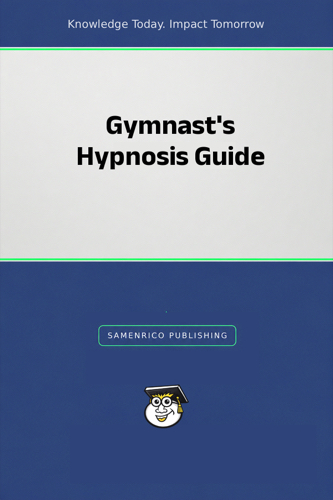
Gymnast's Hypnosis Guide
Improves routine focus and landing.
by Hamlin Alexa
Improves routine focus and landing.
Formats
About this book
Free sample
Chapter 1: The Empty Mind...--–- The roar of the crowd faded into a dull hum. The lights above the balance beam blurred into white streaks. Her feet moved—she knew they were moving—but she couldn't feel the beam beneath them. She saluted. She walked off the mat.
And she had absolutely no memory of the previous ninety seconds. This was the third competition in a row where she had blacked out during her routine. Her coach said she performed beautifully. Her score said she stuck her dismount. But inside her head, there was nothing.
Just white static. Just the empty mind.This is not a rare story. It is not a sign of weakness, lack of talent, or insufficient practice. Ask any competitive gymnast above Level 7 if they have ever finished a routine with no memory of performing it, and more than half will say yes. Ask them if it happens more often during high-stakes competitions than during practice, and nearly all will nod.
The phenomenon has many names: competition fog, blackout, autopilot amnesia, or simply "losing time." But regardless of what you call it, the underlying mechanism is the same. And understanding that mechanism is the first step toward never experiencing it again.The Anatomy of a Blackout To understand why gymnasts blackout, you must first understand how the brain executes a complex motor skill. A back handspring on beam is not one movement. It is hundreds of micro-movements compressed into two seconds: the reach backward, the arch of the spine, the placement of the hands, the push off the beam, the snap down to landing. Each micro-movement requires split-second adjustments based on sensory feedback from the hands, feet, inner ear, and eyes.
This seamless cascade of adjustments is called proprioception—the body's ability to sense where it is in space without looking.When a gymnast practices a skill hundreds of times, the neural pathway for that skill moves from the conscious part of the brain (the prefrontal cortex, responsible for deliberate planning) to the subconscious motor centers (the cerebellum and basal ganglia, responsible for automatic execution). This is…
This is the end of the free sample. Get the eBook to keep going. Buy now
Contents
- Chapter 1
- Chapter 2
- Chapter 3
- Chapter 4
- Chapter 5
- Chapter 6
- Chapter 7
- Chapter 8
- Chapter 9
- Chapter 10
- Chapter 11
- Chapter 12
Details
- Author
- Hamlin Alexa
- Publisher
- SamEnrico
- Language
- English
- Genre
- Non-Fiction, Self-Help, Gymnastics
- Released
- 2026-06-05
- Pages (approx.)
- 140
- Available as
- eBook, Audiobook

Read better in the ZLOADR app
Your eBooks on your phone or tablet. Sign in with your SamEnrico account and start reading.
More by Hamlin Alexa
 The Silence MethodHamlin Alexa$11.99
 Quadrant Three Elimination GuideHamlin Alexa$11.99
 Rolling Hills RunHamlin Alexa$11.99
 Flow in DrivingHamlin Alexa$11.99
 Dog Beach Romp CalmHamlin Alexa$11.99
 Stress Jaw Clenching TMJHamlin Alexa$11.99
 Affirmations for Social AnxietyHamlin Alexa$11.99
 The Secret Sauce: How a 1950s Gas Station Became a Fast Food GiantHamlin Alexa$11.99
 Blood & Silk: The Opium Cartel’s Last Stand in 19th-Century ChinaHamlin Alexa$11.99
 Western Gorillas: SubspeciesHamlin Alexa$11.99
 A Collector's Handbook to the Wolseley EightHamlin Alexa$11.99
 How to Produce Plant and Animal OilHamlin Alexa$11.99
You may also like
 Hong Kong Handover 1997Dunn Johnnie$11.99
 Zumba For Postnatal Recovery CourseNeal Christian$11.99
 Zumba for BeginnersLadner Nikia$11.99
 YouTube Comment Mining GuideHumes Pandora$12.99
 Worry Box MeditationCarlin Rudy$11.99
 Workplace Stress MeditationNguyen Lynn$11.99
 Workplace Stress and Sleep RepairHawley Ivory$11.99
 Workplace Perfectionism CureDelaney Jeffry$11.99
 Workplace Injustice Anger GuideWallen Isabelle$11.99
 Work Addiction and Burnout LinkGreenwood Ester$11.99
 Women in Yoga and WellnessBeattie Galina$11.99
 Women in Stand Up ComedyChun Evangeline$11.99