
Non-FictionSelf-HelpResentment
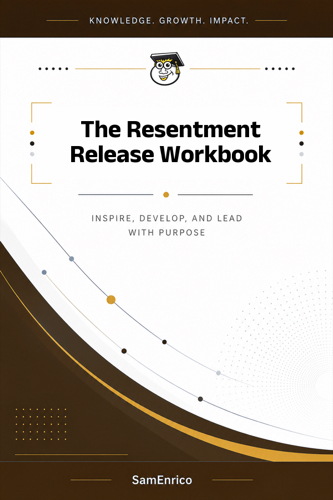
The Resentment Release Workbook eBook
Use step four and step ten to identify, process, a
Use step four and step ten to identify, process, and release resentments systematically.
Formats
Free sample
Chapter 1: The Interest Ledger...--–- You are not holding the resentment. The resentment is holding you.Three years ago, a woman named Maria found herself lying awake at 2:47 AM. Again. Her husband was sleeping peacefully beside her, unaware that Maria's mind was replaying a conversation from 2019. A coworker had taken credit for her presentation.
Maria had smiled, said nothing, and then carried that moment with her through three job changes, two cities, and one marriage. She could still feel the heat in her chest when she thought about it. She had named the resentment "the thing with Jessica," and it had become a roommate she never invited.Last week, Maria's doctor called with her blood work results. Her blood pressure was 148/92. Her cortisol levels were elevated.
She had developed stress-induced eczema on her hands. When the doctor asked about stressors, Maria listed her job, her finances, her aging parents. She did not list Jessica. She did not list the 2019 presentation. She did not realize that her body had been keeping score on a resentment she had stopped consciously thinking about years ago.This chapter is about becoming Maria before she needs another blood pressure medication.
It is about understanding that resentment is not merely an unpleasant emotion you should try to feel less of. It is a physiological occupation of your nervous system, a debt that charges compound interest while the other person makes no payments, and a primary driver of the behaviors that keep you stuck in cycles of destruction, isolation, and self-medication.By the end of this chapter, you will understand exactly what resentment does to your brain, your body, and your behavior. You will complete a tool called The Interest Ledger, which will calculate what your resentments have cost you in relationships, sleep, health, time, and opportunities. And you will make the single most important decision of this entire workbook: the decision to stop being a passive victim of your own bitterness and become an active manager of your emotional sobriety.Let us begin with a question that sounds simple but is not: What is resentment, really?The Definition That Changes Everything Most people think resentment is a feeling. It is not.
Resentment is a story you tell yourself repeatedly until your body believes it is happening right now, in this moment, as a threat to your survival.The word itself comes from the Latin resentire — to feel again. Re-feel. Re-experience. Resentment is the act of re-living an injury so many times that the original event becomes less relevant than the neural pathway you have carved into your brain. The first time someone hurt you, you had a response.
The thousandth time you replayed that memory, you had a thousand responses. Each one left a track.Here is the distinction that will matter for the rest of this workbook:Anger is a clean, present-tense emotion. Someone cuts you off in traffic. You feel a flash of heat. Thirty seconds later, it is gone.
Anger has a short half-life when you let it complete its cycle.Resentment is anger with a time machine. It takes a past injury and projects it into the present and future. Resentment says: "This happened, so I am justified in feeling bad forever." Resentment does not fade on its own because you keep feeding it with rehearsal.The goal of this workbook is not to eliminate anger. Anger is a human, neutral, sometimes useful signal that something has crossed a boundary. The goal is to stop staying angry.
To stop turning a 30-second flash of heat into a 30-year prison sentence.Maria's resentment about the 2019 presentation was not anger anymore. It was a ritual. Every time she felt undervalued at work, she returned to the Jessica story like a prayer. The story had become her identity: "I am the person who gets overlooked." The resentment was not just hurting her; it was defining her.Your Body Keeps the Score (Literally)In 2021, researchers at Harvard Medical School published a longitudinal study tracking 1,200 participants over ten years. They measured two things: the participants' tendency to hold grudges and their cardiovascular health.
The results were stark. Participants who scored high on "ruminative resentment" had significantly higher rates of hypertension, arterial inflammation, and cardiac events — even when controlling for diet, exercise, smoking, and socioeconomic status.The mechanism is not mysterious. Your nervous system cannot tell the difference between a past betrayal and a tiger in the room.When you perceive a threat, your sympathetic nervous system activates. Your adrenal glands release cortisol and adrenaline. Your heart rate increases.
Your blood vessels constrict. Your immune system down-regulates (because fighting an infection is less urgent than running from a predator). This is the fight/flight/freeze response. It is designed for acute threats lasting seconds or minutes.But resentment keeps this system activated for years.Every time you replay the memory, your body floods with the same stress chemicals. Your blood pressure stays elevated.
Your sleep architecture fragments. Your inflammatory markers rise. Over time, chronic resentment contributes to:Cardiovascular disease: Sustained hypertension damages arterial walls Weakened immune function: You get sick more often; wounds heal more slowly Gastrointestinal problems: Stress hormones disrupt digestion Chronic pain: Inflammation amplifies pain signals Hippocampal shrinkage: The memory center of your brain actually atrophies with chronic stress Accelerated cellular aging: Telomeres (the protective caps on your chromosomes) shorten faster This is not metaphorical. This is not spiritual woo-woo. This is measurable physiology.
When you hold a resentment, you are not punishing the person who hurt you. You are punishing yourself for someone else's crime.Maria's eczema, her blood pressure, her insomnia — these were not unrelated health problems. They were the physical manifestation of a resentment she had been holding for three years. Her body was literally keeping score.The Interest Ledger: How Resentment Compounds Imagine you loan someone $100. They promise to pay you back.
They do not. You are angry. That anger is legitimate. But then you spend the next three years thinking about that $100 every single day. You calculate the interest.
You imagine what you could have done with the money. You tell the story to anyone who will listen. You lose sleep over it. Your blood pressure rises. You snap at your children because you are distracted.After three years, the original $100 is long gone.
But you have paid thousands of dollars in "emotional interest" — time, health, relationships, peace of mind. The other person has not made a single payment. They may not even remember the loan.This is The Interest Ledger. Resentment is the only debt where you pay compound interest and the other person never makes a deposit.The workbook element at the end of this chapter will ask you to calculate your own Interest Ledger. For now, let us look at the five domains where resentment extracts its payments:1.
Relationships Every hour you spend rehearsing a resentment is an hour you are not present with the people who are actually in the room with you. You are mentally somewhere else, with someone else, in a time that no longer exists. Resentment does not just damage the relationship with the person you resent. It damages every relationship. Your partner…
This is the end of the free sample. Get the eBook to keep going. Buy now
About this book
Details
- Author
- Farrington Kelsey
- Publisher
- SamEnrico
- Language
- English
- Genre
- Non-Fiction, Self-Help, Resentment
- Released
- 2026-06-08
- Pages (approx.)
- 146
- Available as
- eBook, Audiobook

Read better in the ZLOADR app
Your eBooks on your phone or tablet. Sign in with your SamEnrico account and start reading.
More by Farrington Kelsey
 Resigning from a JobFarrington Kelsey$11.99
 IBS And Caffeine ManagementFarrington Kelsey$11.99
 The Acceptance of EmotionsFarrington Kelsey$11.99
 Closing With Call To ActionFarrington Kelsey$11.99
 Alcohol Detox Blood WorkFarrington Kelsey$11.99
 Catherine Philosopher CorrespondenceFarrington Kelsey$11.99
 Gut Master GuideFarrington Kelsey$11.99
 The Silk and the Spy: The Untold Love Affair That Changed Cold War EspionageFarrington Kelsey$11.99
 The Poisoned Medicine: Colombia's Deadly Cartel Conspiracy (1940s)Farrington Kelsey$11.99
 How to Produce Eggshell Acrylic Interior PaintFarrington Kelsey$11.99
 How to Produce Trail and Snack MixesFarrington Kelsey$11.99
 Marketing Strategy Time BlocksFarrington Kelsey$12.99
You may also like
 Hong Kong Handover 1997Dunn Johnnie$11.99
 Zumba For Postnatal Recovery CourseNeal Christian$11.99
 Zumba for BeginnersLadner Nikia$11.99
 YouTube Comment Mining GuideHumes Pandora$12.99
 Worry Box MeditationCarlin Rudy$11.99
 Workplace Stress MeditationNguyen Lynn$11.99
 Workplace Stress and Sleep RepairHawley Ivory$11.99
 Workplace Perfectionism CureDelaney Jeffry$11.99
 Workplace Injustice Anger GuideWallen Isabelle$11.99
 Work Addiction and Burnout LinkGreenwood Ester$11.99
 Women in Yoga and WellnessBeattie Galina$11.99
 Women in Stand Up ComedyChun Evangeline$11.99