
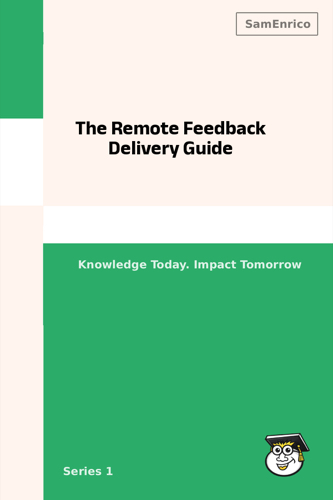
The Remote Feedback Delivery Guide
Gives constructive criticism via video or chat.
Gives constructive criticism via video or chat.
Formats
About this book
Free sample
Chapter 1: The Empathy Gap--–- Let me tell you something that will unsettle you. The feedback you gave yesterday—the same words you would have used standing next to someone’s desk, the same tone, the same intent—landed like a punch. And you have no idea it happened. The employee on the other end of that video call spent the next twenty minutes staring at their own reflection in the dark corner of their screen, replaying your words, filling in the emotional blanks with the worst possible interpretation. Not because you were cruel.
Not because you were wrong. But because the medium stripped away everything that makes feedback feel safe.This is the hidden crisis of remote work. Managers are delivering the same feedback they always have, using the same scripts, the same directness, the same assumptions about how their words will land. And it is failing. Systematically, silently, and at enormous cost to morale, retention, and psychological safety.We call this the Empathy Gap.It is the distance between what you mean when you speak and what they hear when you are not in the room.
And in remote work, that distance is not a few feet. It is a chasm.Let me show you what the research reveals about why your feedback is landing harder than you think, why your best intentions are being misinterpreted, and why the very structure of digital communication is working against your ability to connect, correct, and coach.The 7-38-55 Rule and What It Means for Remote Work In 1967, psychologist Albert Mehrabian published a study that would become both famous and frequently misunderstood. He found that when people communicated feelings and attitudes—not facts, but emotions—the receiver’s understanding broke down along a specific ratio. Seven percent of emotional meaning came from the actual words. Thirty-eight percent came from vocal tone, including pitch, pace, and volume.
And fifty-five percent came from visual cues, including facial expression, posture, and body language.Let me say that again. For emotional communication, your words account for only seven percent of the message. The other ninety-three…
This is the end of the free sample. Get the eBook to keep going. Buy now
Contents
- Chapter 1
- Chapter 2
- Chapter 3
- Chapter 4
- Chapter 5
- Chapter 6
- Chapter 7
- Chapter 8
- Chapter 9
- Chapter 10
- Chapter 11
- Chapter 12
Details
- Author
- Bozeman Rosenda
- Publisher
- SamEnrico
- Language
- English
- Genre
- Non-Fiction, Self-Help, Feedback
- Released
- 2026-06-05
- Pages (approx.)
- 140
- Available as
- eBook, Audiobook

Read better in the ZLOADR app
Your eBooks on your phone or tablet. Sign in with your SamEnrico account and start reading.
More by Bozeman Rosenda
 Reinhard Bonnke Gospel CrusadesBozeman Rosenda$11.99
 The Complicated Grief for ChaplainsBozeman Rosenda$11.99
 Pet Loss And Identity CrisisBozeman Rosenda$11.99
 Beginner Mindfulness for EmetophobiaBozeman Rosenda$11.99
 The Hippocratic Legacy: How Ancient Greece Laid the Foundations of Modern MedicineBozeman Rosenda$11.99
 How to Become a Shearing-machine OperatorBozeman Rosenda$11.99
 Understanding Subacute Cerebellar DegenerationBozeman Rosenda$17.99
 Data Quality ManagerBozeman Rosenda$11.99
 Intangible Asset Valuation Brand IP GuideBozeman Rosenda$12.99
 Fairtrade Coffee ExportBozeman Rosenda$12.99
You may also like
 Hong Kong Handover 1997Dunn Johnnie$11.99
 Zumba For Postnatal Recovery CourseNeal Christian$11.99
 Zumba for BeginnersLadner Nikia$11.99
 YouTube Comment Mining GuideHumes Pandora$12.99
 Worry Box MeditationCarlin Rudy$11.99
 Workplace Stress MeditationNguyen Lynn$11.99
 Workplace Stress and Sleep RepairHawley Ivory$11.99
 Workplace Perfectionism CureDelaney Jeffry$11.99
 Workplace Injustice Anger GuideWallen Isabelle$11.99
 Work Addiction and Burnout LinkGreenwood Ester$11.99
 Women in Yoga and WellnessBeattie Galina$11.99
 Women in Stand Up ComedyChun Evangeline$11.99