
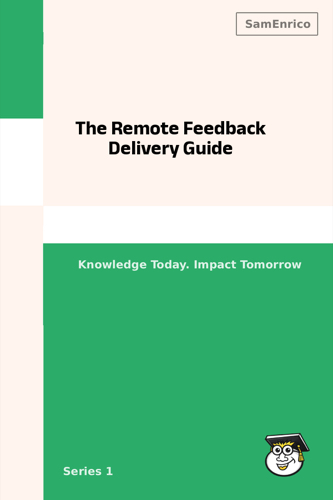
The Remote Feedback Delivery Guide eBook
Gives constructive criticism via video or chat.
Gives constructive criticism via video or chat.
Formats
Free sample
Chapter 1: The Empathy Gap--–- Let me tell you something that will unsettle you. The feedback you gave yesterday—the same words you would have used standing next to someone’s desk, the same tone, the same intent—landed like a punch. And you have no idea it happened. The employee on the other end of that video call spent the next twenty minutes staring at their own reflection in the dark corner of their screen, replaying your words, filling in the emotional blanks with the worst possible interpretation. Not because you were cruel.
Not because you were wrong. But because the medium stripped away everything that makes feedback feel safe.This is the hidden crisis of remote work. Managers are delivering the same feedback they always have, using the same scripts, the same directness, the same assumptions about how their words will land. And it is failing. Systematically, silently, and at enormous cost to morale, retention, and psychological safety.We call this the Empathy Gap.It is the distance between what you mean when you speak and what they hear when you are not in the room.
And in remote work, that distance is not a few feet. It is a chasm.Let me show you what the research reveals about why your feedback is landing harder than you think, why your best intentions are being misinterpreted, and why the very structure of digital communication is working against your ability to connect, correct, and coach.The 7-38-55 Rule and What It Means for Remote Work In 1967, psychologist Albert Mehrabian published a study that would become both famous and frequently misunderstood. He found that when people communicated feelings and attitudes—not facts, but emotions—the receiver’s understanding broke down along a specific ratio. Seven percent of emotional meaning came from the actual words. Thirty-eight percent came from vocal tone, including pitch, pace, and volume.
And fifty-five percent came from visual cues, including facial expression, posture, and body language.Let me say that again. For emotional communication, your words account for only seven percent of the message. The other ninety-three percent is your face, your voice, and your body.Now ask yourself a dangerous question. When you deliver constructive criticism via chat, what percentage of that emotional signal remains? Zero.
Text strips away everything except the seven percent. When you deliver via video call, you keep the vocal tone and some of the visual cues, but not all. The frame cuts off your hands, your posture, the subtle lean of your torso. The compression algorithms flatten micro-expressions. The slight delay between speaking and response triggers a threat response that has nothing to do with your words.You are not giving the same feedback.
You are giving a degraded signal and expecting it to arrive intact.This is not a matter of effort or intention. It is a matter of physics and neurobiology. The medium imposes constraints that no amount of good will can overcome. But awareness of those constraints is the first step toward designing around them.Consider the difference between these two scenarios.In person, you lean slightly forward, your eyebrows soften, your voice drops into a gentler register, and you say, “Hey, can we talk about that client email?” The employee sees your open posture, hears your calm tone, reads the concern in your face, and understands this is a coaching moment, not an attack.On Slack, you type, “Hey, can we talk about that client email?” The employee sees only the words. Their brain fills in the missing ninety-three percent with the worst available option.
They imagine an angry face, a sharp tone, a looming threat. Because that is what human brains do. We are hardwired for threat detection. In the absence of information, we assume danger.This is the Empathy Gap in its purest form. And it is the single greatest obstacle to effective remote feedback.The Zoom Silence Effect: Why One Second Feels Like an Eternity There is a specific phenomenon that every remote manager has experienced but few have named.
You ask a question. The employee pauses. In that pause, something happens in your chest. Did you offend them? Are they angry?
Are they crying? Are they preparing a response or disengaging entirely?Then they answer. The answer is fine. The pause meant nothing. But the damage of that second of uncertainty is already done.Neuroscientists have studied this.
When there is a delay in conversational turn-taking—even a delay as short as five hundred milliseconds—the brain’s anterior cingulate cortex activates. This region is responsible for error detection and conflict monitoring. In other words, your brain literally interprets a half-second pause as something going wrong.On a video call, the typical delay is between 0.5 and 1.5 seconds, depending on connection quality and platform. That means every time you stop speaking and wait for a response, your brain—and theirs—is registering a small error signal. Do this ten times in a conversation, and you have accumulated a low-grade threat response across the entire interaction.Now add the content of constructive criticism to that neurological environment.
You are not just telling someone they missed a deadline. You are telling them they missed a deadline while their nervous system is already primed for threat detection. The combination is explosive.This is why remote feedback conversations often feel more tense than their in-person counterparts, even when the words are identical. The medium is not neutral. It is actively amplifying anxiety.I have watched managers describe this phenomenon with frustration.
“She seemed fine on the call,” they say, “but then she went quiet for a week.” Or, “He agreed with everything I said, and then nothing changed.” The disconnect is not evidence of bad faith or poor listening. It is evidence of a neurological mismatch. The employee heard the words but could not access the warmth that should have accompanied them. So they defaulted to protection mode. They agreed to end the discomfort.
Then they retreated.Understanding the Zoom Silence effect changes how you prepare for feedback conversations. You cannot eliminate the delay. But you can acknowledge it. You can preface your pauses. You can name the discomfort before it takes root.
We will teach you exactly how to do that in later chapters. For now, simply recognize that the silence is not your fault, but it is your responsibility to manage.The Data on Misinterpretation: What the Studies Actually Say Let me give you numbers that should scare you. Not to make you anxious, but to make you precise.A landmark study from the University of Chicago’s Booth School of Business examined how often text-based messages were misinterpreted compared to voice or video. The researchers asked participants to deliver messages with emotional content—constructive criticism, expressions of concern, requests for behavior change—and then asked recipients to identify the intended emotion. The results were stark.
Text-based messages were misinterpreted nearly fifty percent of the time. That is a coin flip. Every other time you send a critical message via chat, the receiver is likely to misunderstand your emotional intent.But here is where it gets worse. The study also found that senders consistently believed their…
This is the end of the free sample. Get the eBook to keep going. Buy now
About this book
Details
- Author
- Bozeman Rosenda
- Publisher
- SamEnrico
- Language
- English
- Genre
- Non-Fiction, Self-Help, Feedback
- Released
- 2026-06-05
- Pages (approx.)
- 140
- Available as
- eBook, Audiobook

Read better in the ZLOADR app
Your eBooks on your phone or tablet. Sign in with your SamEnrico account and start reading.
More by Bozeman Rosenda
 Reinhard Bonnke Gospel CrusadesBozeman Rosenda$11.99
 The Complicated Grief for ChaplainsBozeman Rosenda$11.99
 Pet Loss And Identity CrisisBozeman Rosenda$11.99
 Beginner Mindfulness for EmetophobiaBozeman Rosenda$11.99
 The Hippocratic Legacy: How Ancient Greece Laid the Foundations of Modern MedicineBozeman Rosenda$11.99
 How to Become a Shearing-machine OperatorBozeman Rosenda$11.99
 Understanding Subacute Cerebellar DegenerationBozeman Rosenda$17.99
 Data Quality ManagerBozeman Rosenda$11.99
 Intangible Asset Valuation Brand IP GuideBozeman Rosenda$12.99
 Fairtrade Coffee ExportBozeman Rosenda$12.99
You may also like
 Hong Kong Handover 1997Dunn Johnnie$11.99
 Zumba For Postnatal Recovery CourseNeal Christian$11.99
 Zumba for BeginnersLadner Nikia$11.99
 YouTube Comment Mining GuideHumes Pandora$12.99
 Worry Box MeditationCarlin Rudy$11.99
 Workplace Stress MeditationNguyen Lynn$11.99
 Workplace Stress and Sleep RepairHawley Ivory$11.99
 Workplace Perfectionism CureDelaney Jeffry$11.99
 Workplace Injustice Anger GuideWallen Isabelle$11.99
 Work Addiction and Burnout LinkGreenwood Ester$11.99
 Women in Yoga and WellnessBeattie Galina$11.99
 Women in Stand Up ComedyChun Evangeline$11.99