
Non-FictionSelf-HelpSelf-Awareness
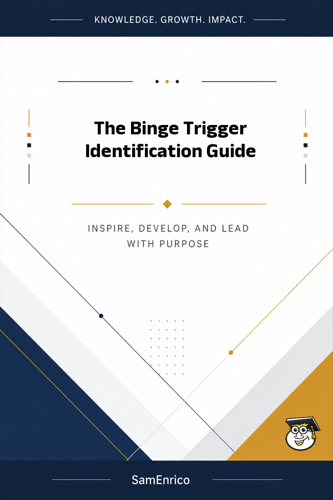
The Binge Trigger Identification Guide eBook
Helps listeners create a personalized trigger map
by Post Sharika
Helps listeners create a personalized trigger map to anticipate and prevent binge episodes before they start.
Formats
Free sample
Chapter 1: The Willpower Trap--–- The brownie sat on the kitchen counter, innocent and immobile, yet it had already won. Sarah had been staring at it for eleven minutes. She had told herself "no" seven times. She had walked out of the kitchen twice. And now, at 10:47 PM, she was eating it standing up, not because she was hungry, not because she even wanted it anymore, but because the fight was more exhausting than the surrender.
By 10:52 PM, she had eaten four more. By 11:15 PM, the empty wrapper was buried in the trash under coffee grounds so her husband wouldn't see it tomorrow morning. She lay in bed hating herself, promising tomorrow would be different. Tomorrow would be the day she finally had enough willpower.Tomorrow, of course, would not be different. Because tomorrow, another brownie—or a bag of chips, or a pint of ice cream, or whatever crossed her path—would sit on another counter, and the same exhausted, shame-filled battle would begin again.
Not because Sarah was weak. Not because she lacked discipline. But because she was fighting the wrong war with the wrong weapons.This chapter dismantles the single most destructive myth about binge eating: the myth that it is a moral failure, a lack of willpower, or a sign that you are broken. If you have ever told yourself "I just need more self-control" or "Why can't I just stop?"—you have been lied to. Not by malicious forces, but by a culture that fundamentally misunderstands how the brain, habits, and cravings actually work.The Myth of the Weak Willed Let us begin with a radical proposition: there is no such thing as willpower.
At least, not in the way most people imagine it. The popular conception of willpower is a kind of internal muscle—some people have more of it, some have less, and if you could just strengthen yours, you could resist any temptation. This idea sells millions of self-help books, fuels countless New Year's resolutions, and generates enormous profit for the diet industry. It is also, according to decades of neuroscience research, almost completely wrong.What actually exists is a complex interplay between triggers, routines, and rewards—what scientists call the habit loop. Your brain does not run on willpower.
It runs on predictions. Every waking moment, your brain is silently asking: "Based on past experience, what is about to happen next, and what should I do about it?" These predictions are not conscious choices. They are automated responses encoded in neural pathways that have been reinforced thousands of times.When Sarah sees a brownie at 10:47 PM, her brain is not making a moral calculation. It is running a prediction: "Ah. This is the time of night when I usually eat.
This is the object I usually eat. And when I eat it, I get a dopamine release that temporarily makes me feel better." That prediction fires before any conscious thought. By the time Sarah says "no," her brain has already released a cascade of neurochemicals preparing her body to eat. She is not fighting a desire. She is fighting a prediction her brain has learned over years of repetition.This is why telling yourself "just stop" is about as effective as telling your heart "just stop beating." The behavior is not controlled by the conscious, reasoning part of your brain.
It is controlled by the ancient, automatic part—the part that evolved to keep you alive by seeking predictable rewards.The Neuroscience of Wanting vs. Liking One of the most important discoveries in addiction research is the distinction between liking and wanting. These two experiences, which most people assume are the same thing, are actually governed by different neural circuits.Liking is the actual pleasure you experience when you eat something delicious. It is mediated by opioid circuits in the brain—the same circuits activated by heroin or orgasm. Liking is relatively stable and surprisingly limited.
No matter how delicious the first bite of brownie is, the tenth bite is never as pleasurable. This is called hedonic adaptation.Wanting, on the other hand, is the craving state—the anticipation of pleasure, not the pleasure itself. Wanting is mediated by dopamine circuits. And here is the cruel trick: wanting can increase almost infinitely, even as liking flatlines or decreases. The more you expose yourself to a trigger (the brownie, the time of night, the location), the more your brain's dopamine system learns to anticipate it.
The wanting grows. The liking does not.This explains a phenomenon every binge eater knows intimately: the first bite is often the most disappointing. You have spent hours anticipating the relief, the pleasure, the escape. And when it finally arrives, it is... fine.
Not transcendent. Not worth the shame that follows. But by then, the habit loop is already complete. The trigger fired. The routine executed.
The reward (however underwhelming) registered. And the neural pathway got a little stronger for next time.You are not weak because you binge. You are operating exactly as your biology dictates—seeking predicted rewards in response to learned triggers. The problem is not your character. The problem is the map your brain has drawn.The Four Phases of a Binge Episode Before we can change a behavior, we must understand its architecture.
Binge episodes are not chaotic explosions of uncontrollable desire. They follow a predictable sequence—and predictability is the enemy of helplessness. Clinical research has identified four distinct phases:Phase 1: The Trigger. Something activates the habit loop. This could be an environmental cue (walking past the pantry, a specific time of day), a biological state (hunger, fatigue, hormonal shifts), a cognitive event (a permissive thought like "I deserve this"), an affective state (boredom, anxiety, loneliness, even excitement), or a social situation (a party, a family dinner, an argument).
Most binges are triggered by a combination of these dimensions, not just one.Phase 2: The Escalation. This is the 15- to 30-minute window between the trigger and the first bite. During this phase, the urge builds. Physical sensations appear: a tightening in the chest, tunnel vision, a buzzing or static feeling in the head, a narrowing of attention that excludes everything except the anticipated food. Most people mistake this escalation for "losing control." In reality, this is the window where intervention is most possible—if you know what to look for.Phase 3: The Binge.
The eating itself. Notably, research shows that the actual experience of binge eating is often dissociative—people report feeling "numb," "on autopilot," or "not really there." The pleasure of the food is significantly lower than anticipated. But the habit loop completes anyway because the brain is executing a learned program, not seeking conscious pleasure.Phase 4: The Aftermath. Shame, guilt, self-disgust, and physical discomfort. And here is the cruelest irony: the shame from Phase 4 becomes a powerful trigger for the next Phase 1.
The binge-shame-binge cycle is one of the most well-documented patterns in eating behavior research. The worst trigger for a binge is often the previous binge.This entire sequence—from trigger to shame—takes anywhere from 30 minutes to several hours. But the critical window, the place where you have the most leverage, is Phase 2. And the first step to…
This is the end of the free sample. Get the eBook to keep going. Buy now
About this book
Details
- Author
- Post Sharika
- Publisher
- SamEnrico
- Language
- English
- Genre
- Non-Fiction, Self-Help, Self-Awareness
- Released
- 2026-06-10
- Pages (approx.)
- 149
- Available as
- eBook, Audiobook

Read better in the ZLOADR app
Your eBooks on your phone or tablet. Sign in with your SamEnrico account and start reading.
More by Post Sharika
 Linaclotide IBS C GuidePost Sharika$11.99
 Free Trade Agreement EssentialsPost Sharika$11.99
 Compulsive Spending for EntrepreneursPost Sharika$11.99
 Euclid's Elements: The Birth of Mathematical RigorPost Sharika$11.99
 How to Start a Ferrosilicon Manganese Business (Beginners Guide)Post Sharika$11.99
 English Test Optimization GuidePost Sharika$12.99
 Test DeveloperPost Sharika$11.99
 How to Produce Antenna AccessoriesPost Sharika$11.99
You may also like
 Hong Kong Handover 1997Dunn Johnnie$11.99
 Zumba For Postnatal Recovery CourseNeal Christian$11.99
 Zumba for BeginnersLadner Nikia$11.99
 YouTube Comment Mining GuideHumes Pandora$12.99
 Worry Box MeditationCarlin Rudy$11.99
 Workplace Stress MeditationNguyen Lynn$11.99
 Workplace Stress and Sleep RepairHawley Ivory$11.99
 Workplace Perfectionism CureDelaney Jeffry$11.99
 Workplace Injustice Anger GuideWallen Isabelle$11.99
 Work Addiction and Burnout LinkGreenwood Ester$11.99
 Women in Yoga and WellnessBeattie Galina$11.99
 Women in Stand Up ComedyChun Evangeline$11.99