
Non-FictionBusiness Brief / Trade Law
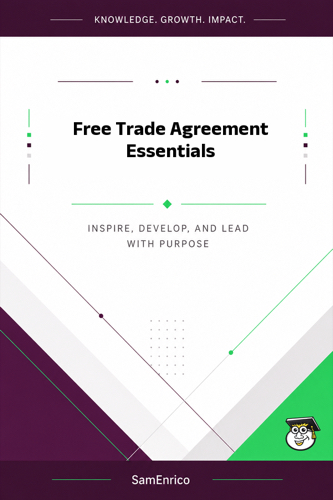
Free Trade Agreement Essentials
Breaks down FTAs like USMCA, CPTPP, and EU agreeme
by Post Sharika
Breaks down FTAs like USMCA, CPTPP, and EU agreements to reduce or eliminate tariff costs.
Formats
About this book
Free sample
Chapter 1: The Tariff Trap--–- Maria Alvarez had never heard of a "Rules of Origin" calculation when she signed the purchase order. She was the CEO of a midsize auto parts manufacturer in Puebla, Mexico, supplying stamped metal brackets to a Detroit-based assembly line. Her company had been doing this for eleven years under NAFTA, paying zero tariffs, moving product across the border in forty-eight hours, and banking a healthy 18% margin. Then the United States-Mexico-Canada Agreement took effect. Within six months, her flagship product—a simple steel bracket that cost $4.27 to manufacture—was suddenly subject to a 25% tariff on entry into the United States.
Her customs broker delivered the news on a Tuesday morning. By Friday, her largest customer had placed her contract under review. By the end of the quarter, she had laid off sixty-two workers.–- The problem was not that the USMCA had raised tariffs. The problem was that Maria had assumed "free trade" meant what it said. She had read the headlines—"USMCA Replaces NAFTA," "Trilateral Deal Preserves Free Trade," "No New Tariffs on Auto Parts"—and she had stopped reading.
But buried on page 1,247 of the agreement, in Annex 4-B, under the subheading "Regional Value Content for Non-Original Materials," a single sentence had changed the economics of her entire business: "For tariff classification 8708.29, the regional value content threshold shall increase from 62.5 percent to 75.0 percent, calculated under the net cost method, effective January 1, 2021." Maria's steel brackets contained 68% North American content. Under NAFTA, that was fine. Under USMCA, it was 7 percentage points short. And 7 percentage points cost her company $4.2 million in the first year alone.–- This chapter dismantles the popular myth that modern Free Trade Agreements aim for zero barriers. It argues that since the collapse of the WTO's Doha Round in 2015, major economies have shifted from multilateral liberalization to "managed trade"—a system where governments actively design rules to protect domestic champions while appearing open to global commerce.
You will learn why Maria Alvarez lost her competitive advantage not because of a tariff increase, but because of a hidden rule that looked like a technicality…
This is the end of the free sample. Get the eBook to keep going. Buy now
Contents
- Chapter 1
- Chapter 2
- Chapter 3
- Chapter 4
- Chapter 5
- Chapter 6
- Chapter 7
- Chapter 8
- Chapter 9
- Chapter 10
- Chapter 11
- Chapter 12
Details
- Author
- Post Sharika
- Publisher
- SamEnrico
- Language
- English
- Genre
- Non-Fiction, Business Brief / Trade Law
- Released
- 2026-06-07
- Pages (approx.)
- 150
- Available as
- eBook, Audiobook

Read better in the ZLOADR app
Your eBooks on your phone or tablet. Sign in with your SamEnrico account and start reading.
More by Post Sharika
 The Binge Trigger Identification GuidePost Sharika$11.99
 Linaclotide IBS C GuidePost Sharika$11.99
 Compulsive Spending for EntrepreneursPost Sharika$11.99
 Euclid's Elements: The Birth of Mathematical RigorPost Sharika$11.99
 How to Start a Ferrosilicon Manganese Business (Beginners Guide)Post Sharika$11.99
 English Test Optimization GuidePost Sharika$12.99
 Test DeveloperPost Sharika$11.99
 How to Produce Antenna AccessoriesPost Sharika$11.99
You may also like
 Hong Kong Handover 1997Dunn Johnnie$11.99
 Zumba For Postnatal Recovery CourseNeal Christian$11.99
 Zumba for BeginnersLadner Nikia$11.99
 YouTube Comment Mining GuideHumes Pandora$12.99
 Worry Box MeditationCarlin Rudy$11.99
 Workplace Stress MeditationNguyen Lynn$11.99
 Workplace Stress and Sleep RepairHawley Ivory$11.99
 Workplace Perfectionism CureDelaney Jeffry$11.99
 Workplace Injustice Anger GuideWallen Isabelle$11.99
 Work Addiction and Burnout LinkGreenwood Ester$11.99
 Women in Yoga and WellnessBeattie Galina$11.99
 Women in Stand Up ComedyChun Evangeline$11.99