
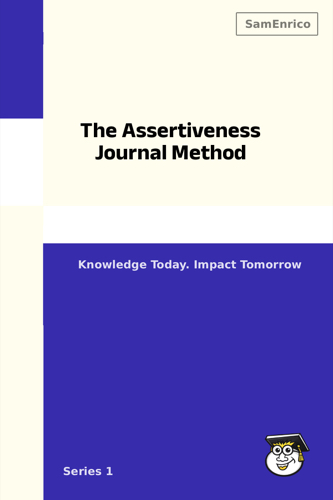
The Assertiveness Journal Method eBook
Track daily assertive moments and reflect on growt
Track daily assertive moments and reflect on growth opportunities.
Formats
Free sample
Chapter 1: The Resentment Ledger--–- You said yes again. The words left your mouth before you could stop them, carried by a current of politeness so automatic it felt like reflex. Now, sitting alone, your jaw is clenched. Your stomach is tight. And somewhere beneath the surface, a quiet voice whispers: Why did I do that?This book is about answering that question—not with shame, but with a system.
Before we build that system, we have to understand what you are already carrying. Most people who struggle with assertiveness do not wake up one day and decide to be passive. They accumulate. Each small "yes" that should have been a "no" adds a grain of sand to an internal weight. Over months and years, that weight becomes resentment fatigue—a state where unexpressed anger no longer feels like anger at all.
It feels like exhaustion. It feels like cynicism. It feels like snapping at your partner for leaving the dishes out when really you are furious at yourself for never asking for help.This chapter is the ledger. We are going to open the books and look at every cost you have been paying to keep the peace. Not to shame you.
Not to overwhelm you. But because you cannot rewrite a contract you have never read.The Four Faces of Communication Before we can track where you lose your voice, we need a map of where your voice actually lives. Most people believe they are either "nice" or "mean," passive or aggressive. The reality is more precise. Communication styles fall into four distinct categories, and most of us use all of them at different times.
The problem is not that you occasionally act passive or aggressive. The problem is when one style becomes your default—the gear you shift into without thinking.Passive Communication is the art of disappearing. You state your needs last, if at all. Your posture shrinks. Your voice softens.
You apologize for taking up space. The math here is simple: you lose, they win. But the hidden cost is that you also lose respect for yourself over time. A passive person does not avoid conflict because they are peaceful. They avoid conflict because they are terrified.
And terror, left unexamined, becomes resentment.Aggressive Communication is the art of conquest. You state your needs first, last, and only. Your posture expands. Your voice rises. You do not apologize for anything.
The math here is: you win, they lose. But the hidden cost is isolation. Aggressive people get what they want in the moment and lose relationships over time. They are not powerful. They are frightened people who learned that attack is the only defense.Passive-Aggressive Communication is the art of the indirect strike.
You do not state your needs clearly. Instead, you sigh loudly. You make sarcastic comments. You "forget" to do what you promised. You show up late.
The math here is: you lose slowly, and you make sure they lose too. Passive-aggression is resentment in motion. It is the language of people who have been taught that direct anger is forbidden, so they weaponize ambiguity.Assertive Communication is the art of standing in your own space without invading anyone else's. You state your needs clearly, calmly, and early. Your posture is open but grounded.
Your voice is steady. You do not apologize for existing, and you do not attack others for existing. The math here is: you win, and they win—or at minimum, you preserve your dignity. Assertiveness is not a personality trait. It is a skill.
And like any skill, it can be learned, practiced, and mastered.Here is what most books will not tell you: assertiveness has two valid forms, and confusing them is why so many people give up. Cooperative assertiveness is for relationships where mutual respect exists—a partner, a reasonable boss, a friend. You aim for win-win because the relationship matters. Protective assertiveness is for situations where the other person does not respect your boundaries—a manipulative family member, an aggressive stranger, a toxic coworker. You aim for your win only, because the relationship is already damaged.
Most of this book teaches cooperative assertiveness. But when we get to Chapters 3 and 5, we will talk explicitly about protective tools. The key is knowing which mode you are in.The Myth of the "Nice" Agreement Here is a dangerous lie: saying yes when you mean no is kind.It is not kind. It is theft—of your time, your energy, and your honest self. When you say yes to something you resent, you are not doing the other person a favor.
You are building a secret prison where you are the only inmate. And eventually, that prison will leak. The resentment will show up as a sharp comment three days later. As a sudden headache before a family gathering. As a mysterious fatigue that doctors cannot explain.Research on emotional suppression is clear.
When you consistently suppress your true feelings, your body pays the price. Cortisol—the stress hormone—remains elevated. Your immune response weakens. In one landmark study, participants who suppressed their emotions during a stressful conversation showed higher blood pressure and slower recovery times than those who expressed themselves assertively. Your body knows the truth before your mouth speaks.
The clench in your jaw. The knot in your stomach. The way your shoulders rise toward your ears. These are not random. They are your nervous system screaming: This is not a yes.We call these signals Somatic Markers—a term we will use throughout this book.
A Somatic Marker is any physical sensation that accompanies an emotional truth. For some people, it is heat in the chest. For others, it is shallow breathing. For many, it is a specific location where anxiety lives, like a tenant who refuses to leave. Your job in this chapter is to identify your own Somatic Markers.
They will become your early warning system, the internal alarm that sounds before you betray yourself again.The Resentment Inventory Let us be specific. Resentment is not a vague feeling. It is a precise accounting of unpaid emotional debt. Every time you said yes when you meant no, you wrote a check your soul had to cash. The resentment inventory is where we find those checks.Take out a journal—preferably the one you will use for this entire book.
At the top of a fresh page, write: Resentment Inventory: Things I Said Yes To That I Wanted To Say No To.Now set a timer for ten minutes. Do not overthink. Do not censor. Write down every single instance you can recall from the past month where you agreed to something and immediately felt that internal twinge. The coworker who asked you to cover their shift.
The friend who needed a ride to the airport at 5 AM. The relative who invited themselves to stay for a week. The store clerk who gave you the wrong change and you just walked away.Do not judge the size of the resentment. Resentment does not care about magnitude. A small betrayal repeated daily is heavier than a large betrayal that happens once.
Some of the items on your list will seem trivial. Write them anyway. The ledger does not discriminate.When the timer…
This is the end of the free sample. Get the eBook to keep going. Buy now
About this book
Details
- Author
- Edgar Ruthanne
- Publisher
- SamEnrico
- Language
- English
- Genre
- Non-Fiction, Self-Help, Journaling
- Released
- 2026-06-11
- Pages (approx.)
- 136
- Available as
- eBook, Audiobook

Read better in the ZLOADR app
Your eBooks on your phone or tablet. Sign in with your SamEnrico account and start reading.
More by Edgar Ruthanne
 Lucknow Residency SiegeEdgar Ruthanne$11.99
 Pregnenolone Memory GuideEdgar Ruthanne$11.99
 Persuasive Vendor SelectionEdgar Ruthanne$11.99
 Angola Independence WarEdgar Ruthanne$11.99
 Anxiety Driven Parent AngerEdgar Ruthanne$11.99
 Workplace Emotion GuideEdgar Ruthanne$11.99
 Representativeness Heuristic RisksEdgar Ruthanne$11.99
 Comfort Discomfort IndicatorsEdgar Ruthanne$11.99
 Specters in the Courtroom: The Forgotten Witchcraft Case That Divided a ColonyEdgar Ruthanne$11.99
 Scipio and Sophia: Love Letters from the Punic WarsEdgar Ruthanne$11.99
 The Alchemist of the Nile: The Lost Secrets of the Black PharaohsEdgar Ruthanne$11.99
 The Mineral Guide to ParachrysotileEdgar Ruthanne$11.99
You may also like
 Stress Journaling for TwoPoirier Melodie$11.99
 Workaholism Recovery JournalParis Cheyenne$11.99
 The Self Esteem Journal for WorkStock Cherrie$11.99
 The Mindset Shift JournalForman Marine$11.99
 Sugar Addiction Recovery Journal WorkbookHelms Letitia$11.99
 Student Journaling for StressWagoner Joetta$11.99
 Procrastination Journal PromptsDover Delmar$11.99
 Procrastination Journal MethodShank Dona$11.99
 Pet Bereavement JournalEuler Ross$11.99
 Loneliness Journal WorkbookLoveless Rosanne$11.99
 Habit Journaling WorkbookLancaster Valentine$11.99
 Daily Reflection Journal WorkbookJohnson Gabriel$11.99