
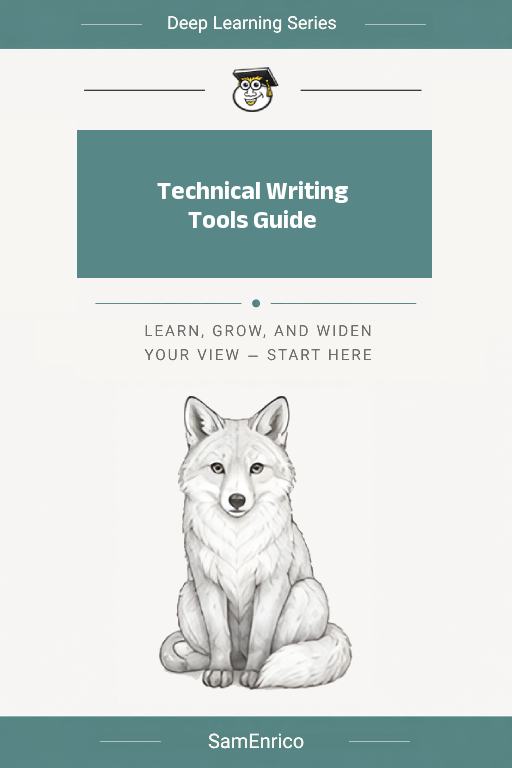
Non-FictionAI OperatorTool Guide
Technical Writing Tools Guide Audiobook
Compare AI tools for technical writing including f
Compare AI tools for technical writing including features and documentation platform integrations.
Formats
Free sample
Chapter 1: The Documentation Graveyard--–- Every software company has one. It lives in a forgotten corner of the shared drive, a neglected Confluence space, or a Git Hub repository that no one dares to archive. The documentation graveyard is where good intentions go to die. Rows of obsolete user manuals, half-finished API guides, and conflicting troubleshooting articles accumulate digital dust while support teams answer the same questions for the thousandth time. “Have you checked the documentation?” the developer asks the customer, both knowing the answer is probably outdated, inconsistent, or simply wrong.This graveyard is not the result of laziness or incompetence.
It is the inevitable consequence of using a technical writing toolkit that was never designed for modern software development. The traditional tools—basic text editors, manual style guides, siloed review processes, and disconnected content management systems—were built for a slower era. They assumed that documentation was a one-time deliverable, a book to be written and shipped, not a living artifact that evolves alongside continuous deployment pipelines and agile sprints.But something has changed. The arrival of large language models and generative AI has shattered the old assumptions. Documentation can now be generated, translated, simplified, and personalized at speeds that were unimaginable just three years ago.
Yet most technical writers are still wielding hammers in an age of CNC machines. They are using the same tools—Word documents passed via email, static PDFs, manual screenshot annotations—while the software they document ships every few hours.This book exists to bridge that gap. It is not a theoretical treatise on artificial intelligence. It is a practical, battle-tested guide to selecting, integrating, and mastering AI tools for technical documentation. Every chapter is grounded in real platform integrations, real feature comparisons, and real workflows that have been tested in production environments.
By the time you finish this chapter, you will understand why the old toolkit failed, what the new pillars of technical writing look like, and how a simple four-part framework will guide every decision in the pages ahead.Welcome to the evolution of technical writing. The graveyard is about to get a lot emptier.The Hidden Cost of Traditional Toolkits For thirty years, the standard technical writing toolkit remained remarkably stable. A writer used Microsoft Word or Adobe Frame Maker for long-form documentation, Snagit or Tech Smith for screenshots, and a shared network drive or early CMS for storage. Reviews happened via…
This is the end of the free sample. Get the Audiobook to keep going. Buy now
About this book
Details
- Author
- Tibbs Dorthea
- Publisher
- SamEnrico
- Language
- English
- Genre
- Non-Fiction, AI Operator, Tool Guide
- Released
- 2026-06-01
- Pages (approx.)
- 158
- Available as
- eBook, Audiobook

Listen in the VoxFlicks app
Audiobooks and audio dramas wherever you go. Sign in with your SamEnrico account and press play.
More by Tibbs Dorthea
 Political Affiliation Wellness DivideTibbs Dorthea$11.99
 Yahoo's 2012 Breach Cover UpTibbs Dorthea$11.99
 Swaziland Sobhuza II GuideTibbs Dorthea$11.99
 Overcoming Self Doubt for TherapistsTibbs Dorthea$11.99
 Metta for Regret and GuiltTibbs Dorthea$11.99
 The Last Queen of France: Marie Antoinette’s Secret ExileTibbs Dorthea$11.99
 Understanding Morse–rawnsley–sargent SyndromeTibbs Dorthea$17.99
 Lead Awareness TrainingTibbs Dorthea$11.99
 Remote Conflict Cheat SheetTibbs Dorthea$12.99
 How to Become a Cloth-mercerizer OperatorTibbs Dorthea$11.99
You may also like
 Hong Kong Handover 1997Dunn Johnnie$11.99
 Zumba For Postnatal Recovery CourseNeal Christian$11.99
 Zumba for BeginnersLadner Nikia$11.99
 YouTube Comment Mining GuideHumes Pandora$12.99
 Worry Box MeditationCarlin Rudy$11.99
 Workplace Stress MeditationNguyen Lynn$11.99
 Workplace Stress and Sleep RepairHawley Ivory$11.99
 Workplace Perfectionism CureDelaney Jeffry$11.99
 Workplace Injustice Anger GuideWallen Isabelle$11.99
 Work Addiction and Burnout LinkGreenwood Ester$11.99
 Women in Yoga and WellnessBeattie Galina$11.99
 Women in Stand Up ComedyChun Evangeline$11.99