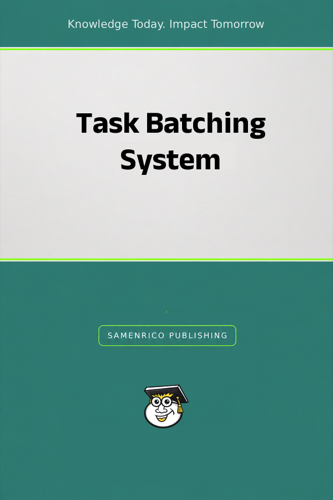
Task Batching System Audiobook
Groups similar work to avoid switching.
by Julian Ryan
Groups similar work to avoid switching.
Formats
Free sample
Chapter 1: The 23-Minute Thief--–- The email arrives at 9:14 AM. You are ninety-three words into a report that needs to be finished by noon. The Slack notification is a simple question: “Got a sec?” You reply quickly—thirty seconds, maybe forty-five. Then you check the email because the preview looked important. Then you return to the report at 9:27 AM.
But something is wrong. The sentence you were writing feels foreign. The argument you were building has collapsed. You read the last paragraph again, then again. Thirteen minutes later, you are still trying to find the thread.
By 9:40 AM, you are back to where you were at 9:13 AM. Twenty-seven minutes have passed. You have advanced exactly zero words. This is not a failure of willpower. This is not laziness.
This is the hidden tax on your attention, and it is stealing years of your life.Every time you switch between tasks, your brain does not simply stop one thing and start another. It performs a “mental reload,” similar to a computer swapping data from fast RAM to slow storage and back again. The process is invisible, unconscious, and brutally expensive. In 2014, researchers at the University of California, Irvine, conducted a study that has since been cited more than three thousand times. They followed knowledge workers in their natural environments and measured how long it took them to return to a state of deep focus after an interruption.
The answer was not a few seconds. It was not even a few minutes. It was an average of twenty-three minutes and fifteen seconds to fully regain the same depth of concentration. That is nearly half an hour of cognitive tax every single time you look away.Now do the math. The average knowledge worker switches tasks every ten to twelve minutes, according to a 2022 study from the University of Illinois.
Some switch every six minutes. If you switch just ten times in a workday—a conservative estimate for anyone who uses email, Slack, and a phone—you lose nearly four hours to the switching penalty alone. Twenty switches per day, which is common for managers and executives, costs more than seven and a half hours. That is not work. That is the sound of your attention being drained into a hole you did not know existed.This chapter is not an introduction.
It is an intervention. Before you learn a single batching technique, before you touch your calendar or reorganize your to-do…
This is the end of the free sample. Get the Audiobook to keep going. Buy now
About this book
Details
- Author
- Julian Ryan
- Publisher
- SamEnrico
- Language
- English
- Genre
- Non-Fiction, Self-Help, Productivity Systems
- Released
- 2026-06-06
- Pages (approx.)
- 150
- Available as
- eBook, Audiobook

Listen in the VoxFlicks app
Audiobooks and audio dramas wherever you go. Sign in with your SamEnrico account and press play.
More by Julian Ryan
 Overcoming Loneliness for Estranged AdultsJulian Ryan$11.99
 The DACA EntrepreneurJulian Ryan$11.99
 Therapy for Emotional NumbnessJulian Ryan$11.99
 OCD Journal WorkbookJulian Ryan$11.99
 Dream Incubation for Legal CasesJulian Ryan$11.99
 Liz Ryan Juvenile JusticeJulian Ryan$11.99
 Fear of Failure for ConstructionJulian Ryan$11.99
 The Siege of Shanghai: The Last Hostage Rescue of the Opium WarsJulian Ryan$11.99
 The Lion of Doha: How an Underdog Became the NFL's First Middle Eastern StarJulian Ryan$11.99
 A Collector's Handbook to the Lotus SprintJulian Ryan$11.99
 Indifference Curve ExcelJulian Ryan$12.99
 Google Scrum With OKRs CourseJulian Ryan$12.99