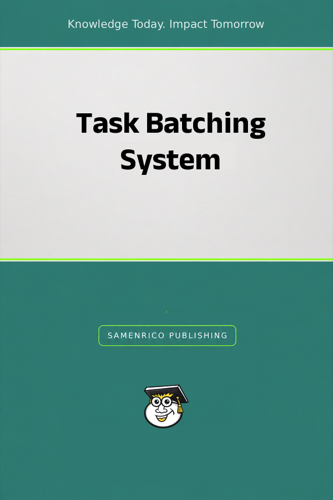
Task Batching System eBook
Groups similar work to avoid switching.
by Julian Ryan
Groups similar work to avoid switching.
Formats
Free sample
Chapter 1: The 23-Minute Thief--–- The email arrives at 9:14 AM. You are ninety-three words into a report that needs to be finished by noon. The Slack notification is a simple question: “Got a sec?” You reply quickly—thirty seconds, maybe forty-five. Then you check the email because the preview looked important. Then you return to the report at 9:27 AM.
But something is wrong. The sentence you were writing feels foreign. The argument you were building has collapsed. You read the last paragraph again, then again. Thirteen minutes later, you are still trying to find the thread.
By 9:40 AM, you are back to where you were at 9:13 AM. Twenty-seven minutes have passed. You have advanced exactly zero words. This is not a failure of willpower. This is not laziness.
This is the hidden tax on your attention, and it is stealing years of your life.Every time you switch between tasks, your brain does not simply stop one thing and start another. It performs a “mental reload,” similar to a computer swapping data from fast RAM to slow storage and back again. The process is invisible, unconscious, and brutally expensive. In 2014, researchers at the University of California, Irvine, conducted a study that has since been cited more than three thousand times. They followed knowledge workers in their natural environments and measured how long it took them to return to a state of deep focus after an interruption.
The answer was not a few seconds. It was not even a few minutes. It was an average of twenty-three minutes and fifteen seconds to fully regain the same depth of concentration. That is nearly half an hour of cognitive tax every single time you look away.Now do the math. The average knowledge worker switches tasks every ten to twelve minutes, according to a 2022 study from the University of Illinois.
Some switch every six minutes. If you switch just ten times in a workday—a conservative estimate for anyone who uses email, Slack, and a phone—you lose nearly four hours to the switching penalty alone. Twenty switches per day, which is common for managers and executives, costs more than seven and a half hours. That is not work. That is the sound of your attention being drained into a hole you did not know existed.This chapter is not an introduction.
It is an intervention. Before you learn a single batching technique, before you touch your calendar or reorganize your to-do list, you must understand the enemy you are fighting. That enemy has a name: the Context Switching Penalty. And it has been robbing you for years without your permission.The Neuroscience of a Single Switch To understand why switching is so expensive, you need to look inside your skull. The prefrontal cortex, the part of your brain just behind your forehead, is responsible for complex problem-solving, strategic thinking, and willful attention.
Unlike a computer, which can run dozens of processes simultaneously, the prefrontal cortex has a single logical thread. It can hold one complex task at a time.When you are writing a report, your prefrontal cortex constructs what neuroscientists call a “task set”—a temporary neural network that includes the rules, goals, and context of that specific activity. This network is fragile. It takes time to build, and it disintegrates rapidly when you look away. When you switch to answering an email, your brain dismantles the report’s task set and builds a new one for the email.
When you switch back, it must rebuild the report’s task set from scratch. The twenty-three minutes measured by the UC Irvine study is not the time to notice you have been interrupted. It is the time to rebuild the original task set to the same depth of activation it had before the interruption.The analogy of a computer is useful but incomplete. A computer’s memory is perfect. It loads a file exactly as it was saved.
Your brain is not a computer. Your brain’s memory is reconstructive, not replayable. When you return to a task after a switch, you do not pick up where you left off. You spend minutes reorienting, re-reading, re-remembering, and often redoing work you already did because you cannot trust that you did it correctly. This is why you read the same paragraph three times after an interruption.
This is why you lose your place in a list. This is why you send emails with missing attachments. The switching penalty is not just time—it is error.The Switching Tax Calculator: Your Personal Reckoning Let us make this real. Take out a piece of paper or open a note. You are going to calculate your personal switching tax.
This is not a theoretical exercise. These are your hours, your weeks, your years.Step 1: Estimate your daily switches. For one day tomorrow, keep a tally. Every time you switch between unrelated tasks—from email to a report, from Slack to a spreadsheet, from a call to a document—make a mark. If you prefer not to wait, use the industry averages: knowledge workers average 12–20 switches per hour, but many of those are micro-switches.
A conservative estimate is 15–25 switches per day for focused workers, and 30–50 switches per day for highly interrupted roles like management or customer support. For this exercise, start with 20.Step 2: Multiply by the penalty. Twenty switches × 23 minutes = 460 minutes per day. That is 7 hours and 40 minutes of switching penalty every single day. But wait—you are not actually losing 460 minutes because not every switch requires a full 23-minute rebuild.
The 23-minute figure is the average full recovery time. Some switches are shallow (e.g., glancing at a notification without engaging) and cost less. Some switches are deep (e.g., leaving a report to handle a crisis) and cost more. Researchers estimate the effective daily loss at 2–4 hours for most workers. Let us use 2.5 hours per day as a conservative, research-backed estimate.Step 3: Calculate weekly loss.
2.5 hours × 5 workdays = 12.5 hours per week. That is more than a full workday.Step 4: Calculate monthly loss. 12.5 hours × 4.3 weeks = 53.75 hours per month. That is more than a full workweek lost every month.Step 5: Calculate annual loss. 12.5 hours × 48 workweeks (accounting for vacation and holidays) = 600 hours per year.
Six hundred hours is fifteen standard workweeks. It is seventy-five eight-hour days. It is nearly three full months of your working life, every single year, burned on the act of switching between tasks rather than doing them.Now multiply that by the number of years you have been in the workforce. A thirty-year-old professional who has worked for eight years has lost approximately 4,800 hours—the equivalent of two full years of work. A forty-five-year-old has lost more than four years.
This is not a productivity hack. This is a life audit. The switching penalty has stolen years from you, and you did not even know it was there.The Myth of the Super-Productive Multitasker If switching is so expensive, why does everyone do it? The answer lies in a cognitive illusion called the “productivity theater.” When you switch rapidly between tasks, you feel busy. Your brain releases small amounts of dopamine with each completed micro-task—a replied-to email, a answered Slack message, a checked box.
This dopamine creates a sensation of progress. But sensation is not reality.In a landmark 2013 study published in the Journal…
This is the end of the free sample. Get the eBook to keep going. Buy now
About this book
Details
- Author
- Julian Ryan
- Publisher
- SamEnrico
- Language
- English
- Genre
- Non-Fiction, Self-Help, Productivity Systems
- Released
- 2026-06-06
- Pages (approx.)
- 150
- Available as
- eBook, Audiobook

Read better in the ZLOADR app
Your eBooks on your phone or tablet. Sign in with your SamEnrico account and start reading.
More by Julian Ryan
 Overcoming Loneliness for Estranged AdultsJulian Ryan$11.99
 The DACA EntrepreneurJulian Ryan$11.99
 Therapy for Emotional NumbnessJulian Ryan$11.99
 OCD Journal WorkbookJulian Ryan$11.99
 Dream Incubation for Legal CasesJulian Ryan$11.99
 Liz Ryan Juvenile JusticeJulian Ryan$11.99
 Fear of Failure for ConstructionJulian Ryan$11.99
 The Siege of Shanghai: The Last Hostage Rescue of the Opium WarsJulian Ryan$11.99
 The Lion of Doha: How an Underdog Became the NFL's First Middle Eastern StarJulian Ryan$11.99
 A Collector's Handbook to the Lotus SprintJulian Ryan$11.99
 Indifference Curve ExcelJulian Ryan$12.99
 Google Scrum With OKRs CourseJulian Ryan$12.99