
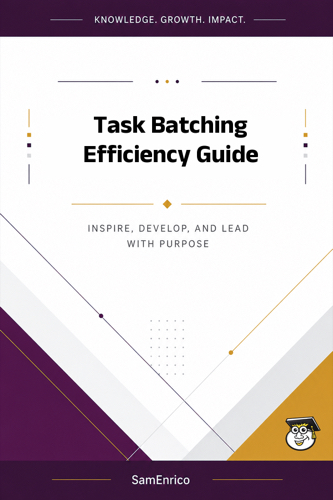
Non-FictionSelf-HelpTask Management
Task Batching Efficiency Guide Audiobook
Groups similar small tasks into single time blocks
by Otoole Henry
Groups similar small tasks into single time blocks.
Formats
Free sample
Chapter 1: The 23-Minute Lie–- Sarah was proud of her multitasking. She answered emails during conference calls, drafted proposals while waiting for files to download, and kept three chat windows open at all times. Her desk had two monitors, and she used both constantly. When her manager praised her for being “responsive,” she felt validated. When colleagues asked how she got so much done, she shrugged and said, “I just work fast.”Then one Tuesday, she decided to track her time.
Not her tasks—her switches. Every time she jumped from email to Slack to a spreadsheet to a text message, she made a tally mark. At the end of the day, she had seventy-three switches. Seventy-three times her brain had slammed on the brakes, turned a corner, and tried to accelerate again. She did the math.
If each switch cost her even ninety seconds of lost focus—a conservative estimate—she had lost nearly two hours that day to nothing but the act of switching. Not to the work itself. To the friction between tasks.Sarah is not lazy. She is not undisciplined. She is not bad at her job.
Sarah is paying a tax she did not know existed. This book is her refund slip.The Myth You Have Been Sold You have been told, explicitly or implicitly, that multitasking is a skill. That the best workers are the ones who can juggle multiple balls at once. That being “busy” means being effective. That the person who responds fastest to email is the most valuable team member.Every single one of these statements is false.
And the science is not ambiguous about it.The human brain cannot process two conscious tasks simultaneously. It cannot. This is not a matter of willpower, training, or intelligence. It is a hardwired biological constraint, like the fact that your eyes cannot look north and south at the same time. What we call “multitasking” is actually rapid task-switching.
Your brain slams the door on Task A, walks across the hall, opens the door to Task B, does a little work, then slams that door and runs back to Task A. Each time you switch, you pay a toll.The question is not whether you pay the toll. The question is how much.Attention Residue: The Hidden Thief In 2009, researchers Sophie Leroy published a landmark study on what she called “attention residue.” The concept is…
This is the end of the free sample. Get the Audiobook to keep going. Buy now
About this book
Details
- Author
- Otoole Henry
- Publisher
- SamEnrico
- Language
- English
- Genre
- Non-Fiction, Self-Help, Task Management
- Released
- 2026-06-06
- Pages (approx.)
- 157
- Available as
- eBook, Audiobook

Listen in the VoxFlicks app
Audiobooks and audio dramas wherever you go. Sign in with your SamEnrico account and press play.
More by Otoole Henry
 Heroin Maintenance Alternatives GuideOtoole Henry$11.99
 High Performer Breakfast HabitsOtoole Henry$11.99
 From Refugee to Restaurant EmpireOtoole Henry$11.99
 Road Rage Journal WorkbookOtoole Henry$11.99
 Elder Care AyurvedaOtoole Henry$11.99
 Temple Dream SymbolOtoole Henry$11.99
 Caregiver Medication DispenserOtoole Henry$11.99
 WWII European Theater POWOtoole Henry$11.99
 The Lazarus Protocol: How the Nazis Resurrected Ancient SecretsOtoole Henry$11.99
 The Grand Illusion: How the Ritz-Carlton Empire Built a Legacy of LuxuryOtoole Henry$11.99
 The Forgotten Broadcast: How One Radio Show Sparked a Global RevolutionOtoole Henry$11.99
 Understanding Agyria-pachygyria Type 1Otoole Henry$17.99
You may also like
 Hong Kong Handover 1997Dunn Johnnie$11.99
 Zumba For Postnatal Recovery CourseNeal Christian$11.99
 Zumba for BeginnersLadner Nikia$11.99
 YouTube Comment Mining GuideHumes Pandora$12.99
 Worry Box MeditationCarlin Rudy$11.99
 Workplace Stress MeditationNguyen Lynn$11.99
 Workplace Stress and Sleep RepairHawley Ivory$11.99
 Workplace Perfectionism CureDelaney Jeffry$11.99
 Workplace Injustice Anger GuideWallen Isabelle$11.99
 Work Addiction and Burnout LinkGreenwood Ester$11.99
 Women in Yoga and WellnessBeattie Galina$11.99
 Women in Stand Up ComedyChun Evangeline$11.99