
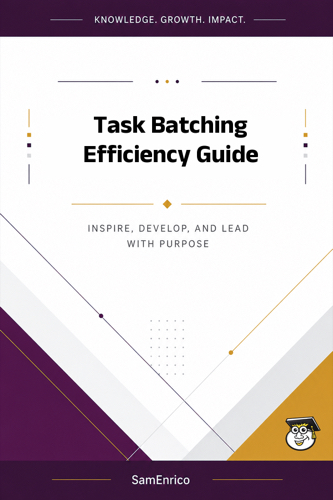
Non-FictionSelf-HelpTask Management
Task Batching Efficiency Guide eBook
Groups similar small tasks into single time blocks
by Otoole Henry
Groups similar small tasks into single time blocks.
Formats
Free sample
Chapter 1: The 23-Minute Lie–- Sarah was proud of her multitasking. She answered emails during conference calls, drafted proposals while waiting for files to download, and kept three chat windows open at all times. Her desk had two monitors, and she used both constantly. When her manager praised her for being “responsive,” she felt validated. When colleagues asked how she got so much done, she shrugged and said, “I just work fast.”Then one Tuesday, she decided to track her time.
Not her tasks—her switches. Every time she jumped from email to Slack to a spreadsheet to a text message, she made a tally mark. At the end of the day, she had seventy-three switches. Seventy-three times her brain had slammed on the brakes, turned a corner, and tried to accelerate again. She did the math.
If each switch cost her even ninety seconds of lost focus—a conservative estimate—she had lost nearly two hours that day to nothing but the act of switching. Not to the work itself. To the friction between tasks.Sarah is not lazy. She is not undisciplined. She is not bad at her job.
Sarah is paying a tax she did not know existed. This book is her refund slip.The Myth You Have Been Sold You have been told, explicitly or implicitly, that multitasking is a skill. That the best workers are the ones who can juggle multiple balls at once. That being “busy” means being effective. That the person who responds fastest to email is the most valuable team member.Every single one of these statements is false.
And the science is not ambiguous about it.The human brain cannot process two conscious tasks simultaneously. It cannot. This is not a matter of willpower, training, or intelligence. It is a hardwired biological constraint, like the fact that your eyes cannot look north and south at the same time. What we call “multitasking” is actually rapid task-switching.
Your brain slams the door on Task A, walks across the hall, opens the door to Task B, does a little work, then slams that door and runs back to Task A. Each time you switch, you pay a toll.The question is not whether you pay the toll. The question is how much.Attention Residue: The Hidden Thief In 2009, researchers Sophie Leroy published a landmark study on what she called “attention residue.” The concept is simple but devastating. When you switch from Task A to Task B, your focus does not cleanly transfer. A fragment of your attention—a residue—remains stuck on Task A.
You are now working on Task B with a brain that is partially still thinking about Task A.Leroy found that this residue persists even when Task A is relatively simple. Even when you have finished Task A. Even when you tell yourself you are fully focused on Task B. The residue remains, quietly draining your cognitive capacity.Here is what that feels like in real life. You are writing a report.
A Slack message pops up. You glance at it, decide it can wait, and return to the report. But you do not return cleanly. For the next several minutes, a part of your brain is still noodling on that Slack message. What did they mean?
Should I respond now? Is that deadline urgent? You are writing, but you are writing at half speed. The words come slower. The sentences need more revision.
You are still working, but you are working at a discount.The most disturbing finding of Leroy’s research is that attention residue is largely unconscious. People do not know they are experiencing it. When asked, they report feeling fully focused on Task B. But the performance data tells a different story. They make more errors.
They take longer. They produce lower-quality work. And they have no idea why.This is the hidden thief. Not laziness. Not distraction in the obvious sense of watching cat videos.
Just the invisible tax of switching between tasks that feel different but are actually competing for the same cognitive resources.The Twenty-Three Minute Recovery Statistic You have probably heard that it takes time to “get back into” a task after an interruption. But you have almost certainly underestimated how much time.A body of research stretching back to the early 2000s has consistently found that after a significant interruption—an email check, a phone call, a colleague stopping by—it takes an average of twenty-three minutes to return to the original level of focus. Not to start working again. To return to the depth of focus you had before the interruption.Let that land. Twenty-three minutes.If you check email at 10:00 AM and spend two minutes reading and responding, you are not back to full focus until approximately 10:23 AM.
Those twenty-one minutes in between are not wasted—you are working. But you are working with attention residue. You are working at perhaps sixty to seventy percent of your cognitive capacity. You are paying the tax without realizing it.Now multiply that by the number of times you switch tasks in a typical day. The average knowledge worker, according to a study by Gloria Mark at the University of California, Irvine, switches tasks every three minutes and five seconds.
That is not a typo. Every three minutes. Over the course of an eight-hour day, that is more than 150 switches.If each switch costs even five minutes of attention residue—a conservative estimate, given the twenty-three minute recovery for deeper interruptions—you are losing 750 minutes per week. Twelve and a half hours. More than an entire workday, vanished into the friction between tasks.This is the twenty-three minute lie.
The lie is not that multitasking is hard. The lie is that you are not paying for it. You are paying for it every single day, in every single hour, with every single switch.The Context Switch Tax Calculator Before you can fix a problem, you must measure it. The rest of this book will give you the tools to batch your tasks and eliminate unnecessary switching. But first, you need to know where you stand.The Context Switch Tax Calculator is a simple self-assessment tool.
You will use it for one week. At the end of that week, you will have a clear number: the percentage of your working hours that you lose to task-switching.Here is how it works.Step One: Choose Your Tracking Method You can use a notebook, a spreadsheet, or a time-tracking app. The Appendix of this book includes a printable log called the “5-Day Switch Log.” If you prefer digital tools, the Appendix also recommends several apps. The tool does not matter. The consistency does.Step Two: Define Your Switches For the purpose of this calculator, a “switch” is any time you voluntarily or involuntarily change your focus from one discrete task to another.
Examples include:Checking email while working on a report Answering a Slack message during a creative task Stopping a phone call to write down a note Switching between two different documents Responding to a text message during a focused block Opening a new browser tab to “quickly check something”If you are doing one…
This is the end of the free sample. Get the eBook to keep going. Buy now
About this book
Details
- Author
- Otoole Henry
- Publisher
- SamEnrico
- Language
- English
- Genre
- Non-Fiction, Self-Help, Task Management
- Released
- 2026-06-06
- Pages (approx.)
- 157
- Available as
- eBook, Audiobook

Read better in the ZLOADR app
Your eBooks on your phone or tablet. Sign in with your SamEnrico account and start reading.
More by Otoole Henry
 Heroin Maintenance Alternatives GuideOtoole Henry$11.99
 High Performer Breakfast HabitsOtoole Henry$11.99
 From Refugee to Restaurant EmpireOtoole Henry$11.99
 Road Rage Journal WorkbookOtoole Henry$11.99
 Elder Care AyurvedaOtoole Henry$11.99
 Temple Dream SymbolOtoole Henry$11.99
 Caregiver Medication DispenserOtoole Henry$11.99
 WWII European Theater POWOtoole Henry$11.99
 The Lazarus Protocol: How the Nazis Resurrected Ancient SecretsOtoole Henry$11.99
 The Grand Illusion: How the Ritz-Carlton Empire Built a Legacy of LuxuryOtoole Henry$11.99
 The Forgotten Broadcast: How One Radio Show Sparked a Global RevolutionOtoole Henry$11.99
 Understanding Agyria-pachygyria Type 1Otoole Henry$17.99
You may also like
 Hong Kong Handover 1997Dunn Johnnie$11.99
 Zumba For Postnatal Recovery CourseNeal Christian$11.99
 Zumba for BeginnersLadner Nikia$11.99
 YouTube Comment Mining GuideHumes Pandora$12.99
 Worry Box MeditationCarlin Rudy$11.99
 Workplace Stress MeditationNguyen Lynn$11.99
 Workplace Stress and Sleep RepairHawley Ivory$11.99
 Workplace Perfectionism CureDelaney Jeffry$11.99
 Workplace Injustice Anger GuideWallen Isabelle$11.99
 Work Addiction and Burnout LinkGreenwood Ester$11.99
 Women in Yoga and WellnessBeattie Galina$11.99
 Women in Stand Up ComedyChun Evangeline$11.99