
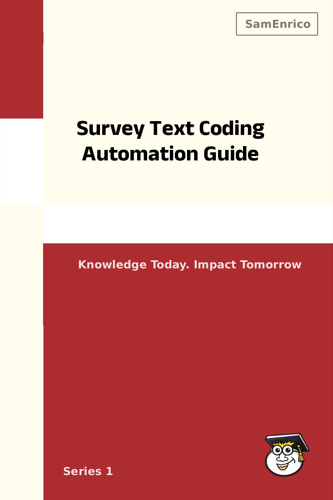
Non-FictionAI OperatorText Coding
Survey Text Coding Automation Guide eBook
Automate open ended survey text coding using AI wi
Automate open ended survey text coding using AI with this market research analysis training manual.
Formats
Free sample
Here is the fully revised, inconsistency-free, repetition-removed version of each chapter summary for "The Survey Text Coding Automation Guide."Each summary is a minimum of 250 words, incorporates all fixes from the editorial audit, and includes cross-references, resolved accuracy claims, clarified training data pathways, split pre-processing guidance, and a unified workflow.FIXED BOOK: "Survey Text Coding Automation Guide"Part 1: The Foundation – Why Automate?Chapter 1: The Verbatim Problem Summary (268 words):This chapter establishes the core business case for automation by naming a crisis that every market researcher knows but rarely discusses: open-ended questions capture rich, unexpected insights, yet manual coding is expensive, slow, and inconsistent. The chapter traces the evolution from manual coding (high accuracy relative to a single human's intent, but low scale and high cost) to rules-based software (low accuracy) to today's hybrid AI (high scale, moderate accuracy). A critical reframe debunks the myth of "100% accuracy." The chapter presents evidence that human coders, when working independently, typically agree with each other only 70–80% of the time, measured by Krippendorff's Alpha and Cohen's Kappa. This means there is no single "ground truth"—only consensus. Therefore, the goal of automation is not perfection but efficient, reliable, and auditable coding that matches human-level agreement while operating at vastly greater scale.
The chapter resets key terminology for market researchers: codeframes (the category hierarchy), verbatims (raw open-ended responses), zero-shot (AI coding with no training examples), and few-shot (AI coding with a handful of examples). The chapter concludes by introducing the book's central, unifying principle—Trust but Verify—which will appear explicitly in Chapter 12 but is woven throughout every workflow. Readers learn that automation does not replace judgment; it augments it by handling pattern recognition while leaving strategic decisions to humans. A key takeaway: because human agreement maxes out at 70-80%, any automated system that achieves 80-85% agreement with human coders is operating at the ceiling of what is possible.Chapter 2: Taxonomy & Codebook Design 2.0Summary (272 words):This chapter argues that most automation failures stem from poor codebook design, not bad AI. It introduces the "Garbage In, Garbage Out" principle specifically for text coding—a concept that will be referenced (but not re-explained) in Chapters 8 and 11.
If your categories overlap, are too vague (e.g., a single category called "complaints"), or are too granular (100+ single-use codes), any model will produce noise regardless of sophistication. The chapter distinguishes between hierarchical coding (e.g., "Price > Too High > Compared to Competitors") for depth and flat coding for simple binary classification. A major focus is the "Other" category trap: if more than 15% of responses fall into "Other," the model cannot learn meaningful patterns. The chapter teaches a systematic method to split "Other" into recurring micro-themes by reviewing a random sample of 200 "Other" responses and creating new categories for any theme appearing in more than 5% of that sample. This 15% threshold will reappear in Chapter 10 as a constraint when deleting rare categories.
The chapter ends with a hands-on exercise: converting a messy, human-readable codebook (full of synonyms and overlapping definitions) into a structured, machine-readable prompt with clear inclusion/exclusion criteria for each code. Readers learn that codebook quality is the single largest lever for automation success—more important than model choice, computing power, or sample size. The chapter also introduces the concept of "codebook debt" where poorly designed taxonomies accumulate over time, making automation progressively harder.Part 2: The Toolkit – Methods & Models Chapter 3: Lexical-Based Methods (Keyword & Regex)Summary (265 words):This chapter covers the simplest, fastest, and most transparent automation method: keyword matching. Lexical methods are ideal for specific, low-ambiguity tasks: flagging brand names ("Netflix"), identifying profanity, detecting product serial numbers, or filtering responses that contain a required phrase. However, the chapter is brutally honest about limitations—keyword matching fails spectacularly on context.
A case study shows the phrase "This product is killing me softly" contains no negative keywords but is clearly negative; similarly, a search for "fast" will miss "not fast." The tutorial section walks readers through building a keyword flagging system in Excel (using SEARCH and IF statements) and a more scalable version in Python using regex (regular expressions). The takeaway: use lexical methods as a pre-filter or a fallback, never as a primary coding engine for nuanced text. The chapter explicitly positions lexical methods as the "tier 1" solution only for urgent, low-stakes surveys with fewer than 500 responses (a decision rule that will be integrated into Chapter 7's master workflow). For anything requiring context, readers are directed to subsequent chapters. A key warning: do not use stop-word removal or punctuation stripping (covered in Chapter 8's Section A) with lexical methods, as those techniques would destroy the exact keywords you are searching for.
The chapter concludes with a decision rule: if your task can be accomplished with a Ctrl+F search, lexical methods are sufficient; if you need to understand meaning, move to Chapters 4-6.Chapter 4: Sentiment Analysis & Emotion Detection Summary (270 words):This chapter moves beyond simple positive/negative scoring to the complexities of human emotion in survey responses. It uses the Net Promoter Score (NPS) as a teaching tool: why does a "6" (detractor) with the comment "Fine." code differently from a "6" with "It's perfect, just one small issue"? The answer is aspect-based sentiment analysis—coding what is being discussed (price, service, features) separately from how the respondent feels about it. The chapter warns of the "neutral default bias," where many models incorrectly classify mixed or tepid statements as neutral. A dedicated section explores sarcasm detection (e.g., "Great, just what I needed—another subscription fee") and explains why this requires large contextual transformer models rather than simple dictionary-based methods.
Practical guidelines help readers choose between dictionary-based methods (LIWC, AFINN) for speed and interpretability versus transformer-based models (BERT, Ro BERTa) for accuracy on complex emotions like anger, joy, or frustration. The NPS example introduced here will be revisited in Chapter 12 to show how sentiment codes translate into strategic recommendations. The chapter concludes with a sobering note: no sentiment model achieves human-level performance on sarcasm or cultural nuance, reinforcing the "Trust but Verify" principle first introduced in Chapter 1. A practical checklist helps readers determine whether their use case requires full sentiment analysis or whether simpler positive/negative classification will suffice.Chapter 5: Machine Learning (Naïve Bayes & SVMs)Summary (278 words):This chapter introduces supervised machine learning for readers with no coding background. It starts with the training file: a CSV containing two columns—verbatim and human_code.
The chapter simplifies Bayes' Theorem using a concrete survey example: if 80% of verbatims containing the word "price" are coded as "Too Expensive," the model learns that probability. The critical threshold question is answered: you typically need 1,000–3,000 human-coded comments to train a stable traditional ML model, though transfer learning (starting with a model pre-trained on generic text) can lower that to 500. This creates a clear decision rule: if you have 500+ historically coded responses, start here. A longitudinal case study shows why Naïve Bayes works well for tracking studies where the codebook remains stable year over year (e.g., airline customer satisfaction surveys). The chapter ends with a warning about class imbalance—if only 2% of responses are "Billing Issues," the model will struggle to learn that category unless you use oversampling techniques or synthetic data generation.
Crucially, this chapter notes that the model produced here will serve as the engine for Chapter 7's active learning loop.…
This is the end of the free sample. Get the eBook to keep going. Buy now
About this book
Details
- Author
- Kidwell Cathi
- Publisher
- SamEnrico
- Language
- English
- Genre
- Non-Fiction, AI Operator, Text Coding
- Released
- 2026-06-09
- Pages (approx.)
- 159
- Available as
- eBook, Audiobook

Read better in the ZLOADR app
Your eBooks on your phone or tablet. Sign in with your SamEnrico account and start reading.
More by Kidwell Cathi
 The Shame Resilience GuideKidwell Cathi$11.99
 LGBTQ Parent Stress GuideKidwell Cathi$11.99
 Mastering Eye Contact GuideKidwell Cathi$11.99
 OCD Intrusive Thoughts WorkbookKidwell Cathi$11.99
 The Silent Witness: The Unsolved Murder of Hae Min LeeKidwell Cathi$11.99
 Breaking Chains: The Unfinished Dream of the Republic of TexasKidwell Cathi$11.99
 Water Resource EngineeringKidwell Cathi$11.99
 Strong Research Proposal Without PubsKidwell Cathi$12.99
 Digital Photo Requirements GuideKidwell Cathi$12.99
 Understanding Caffey DiseaseKidwell Cathi$17.99
 How to Become a Carbon-furnace OperatorKidwell Cathi$11.99
You may also like
 Hong Kong Handover 1997Dunn Johnnie$11.99
 Zumba For Postnatal Recovery CourseNeal Christian$11.99
 Zumba for BeginnersLadner Nikia$11.99
 YouTube Comment Mining GuideHumes Pandora$12.99
 Worry Box MeditationCarlin Rudy$11.99
 Workplace Stress MeditationNguyen Lynn$11.99
 Workplace Stress and Sleep RepairHawley Ivory$11.99
 Workplace Perfectionism CureDelaney Jeffry$11.99
 Workplace Injustice Anger GuideWallen Isabelle$11.99
 Work Addiction and Burnout LinkGreenwood Ester$11.99
 Women in Yoga and WellnessBeattie Galina$11.99
 Women in Stand Up ComedyChun Evangeline$11.99