
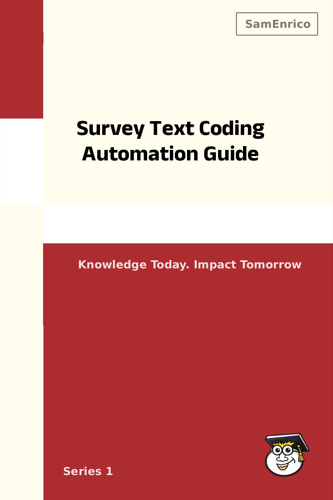
Survey Text Coding Automation Guide Audiobook
Automate open ended survey text coding using AI wi
Automate open ended survey text coding using AI with this market research analysis training manual.
Formats
Free sample
Here is the fully revised, inconsistency-free, repetition-removed version of each chapter summary for "The Survey Text Coding Automation Guide."Each summary is a minimum of 250 words, incorporates all fixes from the editorial audit, and includes cross-references, resolved accuracy claims, clarified training data pathways, split pre-processing guidance, and a unified workflow.FIXED BOOK: "Survey Text Coding Automation Guide"Part 1: The Foundation – Why Automate?Chapter 1: The Verbatim Problem Summary (268 words):This chapter establishes the core business case for automation by naming a crisis that every market researcher knows but rarely discusses: open-ended questions capture rich, unexpected insights, yet manual coding is expensive, slow, and inconsistent. The chapter traces the evolution from manual coding (high accuracy relative to a single human's intent, but low scale and high cost) to rules-based software (low accuracy) to today's hybrid AI (high scale, moderate accuracy). A critical reframe debunks the myth of "100% accuracy." The chapter presents evidence that human coders, when working independently, typically agree with each other only 70–80% of the time, measured by Krippendorff's Alpha and Cohen's Kappa. This means there is no single "ground truth"—only consensus. Therefore, the goal of automation is not perfection but efficient, reliable, and auditable coding that matches human-level agreement while operating at vastly greater scale.
The chapter resets key terminology for market researchers: codeframes (the category hierarchy), verbatims (raw open-ended responses), zero-shot (AI coding with no training examples), and few-shot (AI coding with a handful of examples). The chapter concludes by introducing the book's central, unifying principle—Trust but Verify—which will appear explicitly in Chapter 12 but is woven throughout every workflow. Readers learn that automation does not replace judgment; it augments it by handling pattern recognition while leaving strategic decisions to humans. A key takeaway: because human agreement maxes out at 70-80%, any automated system that achieves 80-85% agreement with human coders is operating at the ceiling of what is possible.Chapter 2: Taxonomy & Codebook Design 2.0Summary (272 words):This chapter argues that most automation failures stem from poor codebook design, not bad AI. It introduces the "Garbage In, Garbage Out" principle specifically for text coding—a concept that will be referenced (but not re-explained) in Chapters 8 and 11.
If your categories overlap, are too vague (e.g., a single category called "complaints"), or are too granular (100+ single-use codes), any model will produce noise regardless of sophistication. The chapter distinguishes between hierarchical coding (e.g., "Price > Too High > Compared to…
This is the end of the free sample. Get the Audiobook to keep going. Buy now
About this book
Details
- Author
- Kidwell Cathi
- Publisher
- SamEnrico
- Language
- English
- Genre
- Non-Fiction, AI Operator, Text Coding
- Released
- 2026-06-09
- Pages (approx.)
- 159
- Available as
- eBook, Audiobook

Listen in the VoxFlicks app
Audiobooks and audio dramas wherever you go. Sign in with your SamEnrico account and press play.
More by Kidwell Cathi
 The Shame Resilience GuideKidwell Cathi$11.99
 LGBTQ Parent Stress GuideKidwell Cathi$11.99
 Mastering Eye Contact GuideKidwell Cathi$11.99
 OCD Intrusive Thoughts WorkbookKidwell Cathi$11.99
 The Silent Witness: The Unsolved Murder of Hae Min LeeKidwell Cathi$11.99
 Breaking Chains: The Unfinished Dream of the Republic of TexasKidwell Cathi$11.99
 Water Resource EngineeringKidwell Cathi$11.99
 Strong Research Proposal Without PubsKidwell Cathi$12.99
 Digital Photo Requirements GuideKidwell Cathi$12.99
 Understanding Caffey DiseaseKidwell Cathi$17.99
 How to Become a Carbon-furnace OperatorKidwell Cathi$11.99