
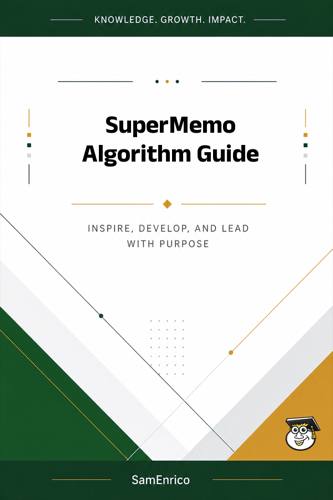
Non-FictionSelf-Help / SuperMemo
SuperMemo Algorithm Guide
undefined
by Klein Bryant
undefined
Formats
About this book
Free sample
Chapter 1: The Forgetting Gift--–- Every day, you wake up having forgotten the majority of what you learned yesterday. This is not a design flaw. It is the brain’s most sophisticated energy-saving mechanism. The trouble is, modern education treats forgetting as a enemy to be crushed with cramming, rereading, and highlighters—weapons that are not only ineffective but actively harmful. This chapter will reframe forgetting as a signal, not a failure, and introduce the radical idea that the perfect moment to review is not “as soon as possible” but precisely when you are about to forget.The Discovery That Changed Everything In 1885, a German philosopher named Hermann Ebbinghaus did something unusual: he became his own laboratory animal.
Using nonsense syllables (e.g., WID, ZOF, KEB) to eliminate any prior meaning, he memorized lists of words and then tested himself at various intervals. What he discovered became the foundation of all modern memory research: the forgetting curve.Ebbinghaus found that forgetting is not linear. It is exponential. Within one hour, you lose approximately 50% of new information. Within 24 hours, that number climbs to nearly 70%.
After one week, unless reinforced, you retain less than 25%. The curve looks like a steep ski slope that gradually flattens—most forgetting happens immediately, then slows down.But here is the crucial insight that most people miss: the forgetting curve is not fixed. Every time you successfully recall a piece of information, the curve reshapes. It becomes shallower. The second forgetting curve decays more slowly than the first.
The third decays even more slowly. With enough well-timed repetitions, the curve can become nearly flat, meaning the memory lasts for years or even decades.This is where the Super Memo algorithm enters. Piotr Woźniak, a Polish student in the 1980s, was failing his English exams not because he was lazy but because he was using the wrong schedule. He would cram before tests, forget everything after, and then cram again. Frustrated, he built a paper-based system to calculate the optimal review intervals.
That system, refined over 40 years, became the Super Memo algorithm. This book is the guide to understanding not just…
This is the end of the free sample. Get the eBook to keep going. Buy now
Contents
- Chapter 1
- Chapter 2
- Chapter 3
- Chapter 4
- Chapter 5
- Chapter 6
- Chapter 7
- Chapter 8
- Chapter 9
- Chapter 10
- Chapter 11
- Chapter 12
Details
- Author
- Klein Bryant
- Publisher
- SamEnrico
- Language
- English
- Genre
- Non-Fiction, Self-Help / SuperMemo
- Released
- 2026-06-06
- Pages (approx.)
- 123
- Available as
- eBook, Audiobook

Read better in the ZLOADR app
Your eBooks on your phone or tablet. Sign in with your SamEnrico account and start reading.
More by Klein Bryant
 The Quit Smoking Breath TestKlein Bryant$11.99
 Conversation Starters for RealtorsKlein Bryant$11.99
 Airport Work Distraction GuideKlein Bryant$11.99
 Zumba for Large GroupsKlein Bryant$11.99
 Pre Exam MeditationKlein Bryant$11.99
 The Camgirl Coercion RingKlein Bryant$11.99
 Unaccompanied Minor ArrivesKlein Bryant$11.99
 Teacher EQ Classroom ManagementKlein Bryant$11.99
 The Unseen Hand: How One Man Orchestrated the Fall of a Corporate EmpireKlein Bryant$11.99
 The American Enlightenment: Jefferson’s Vision of a New AthensKlein Bryant$11.99
 The Navigator and the New World: Henry the Navigator's VisionKlein Bryant$11.99
 The Mineral Guide to KeroliteKlein Bryant$11.99
You may also like
 Hong Kong Handover 1997Dunn Johnnie$11.99
 Zumba For Postnatal Recovery CourseNeal Christian$11.99
 Zumba for BeginnersLadner Nikia$11.99
 YouTube Comment Mining GuideHumes Pandora$12.99
 Worry Box MeditationCarlin Rudy$11.99
 Workplace Stress MeditationNguyen Lynn$11.99
 Workplace Stress and Sleep RepairHawley Ivory$11.99
 Workplace Perfectionism CureDelaney Jeffry$11.99
 Workplace Injustice Anger GuideWallen Isabelle$11.99
 Work Addiction and Burnout LinkGreenwood Ester$11.99
 Women in Yoga and WellnessBeattie Galina$11.99
 Women in Stand Up ComedyChun Evangeline$11.99