
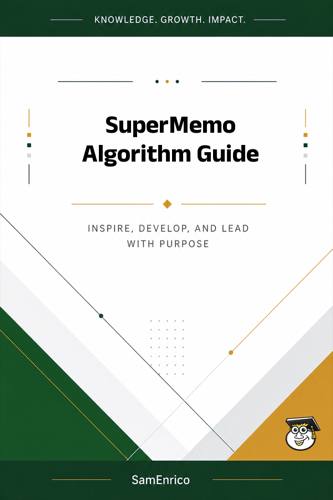
Non-FictionSelf-Help / SuperMemo
SuperMemo Algorithm Guide eBook
undefined
by Klein Bryant
undefined
Formats
Free sample
Chapter 1: The Forgetting Gift--–- Every day, you wake up having forgotten the majority of what you learned yesterday. This is not a design flaw. It is the brain’s most sophisticated energy-saving mechanism. The trouble is, modern education treats forgetting as a enemy to be crushed with cramming, rereading, and highlighters—weapons that are not only ineffective but actively harmful. This chapter will reframe forgetting as a signal, not a failure, and introduce the radical idea that the perfect moment to review is not “as soon as possible” but precisely when you are about to forget.The Discovery That Changed Everything In 1885, a German philosopher named Hermann Ebbinghaus did something unusual: he became his own laboratory animal.
Using nonsense syllables (e.g., WID, ZOF, KEB) to eliminate any prior meaning, he memorized lists of words and then tested himself at various intervals. What he discovered became the foundation of all modern memory research: the forgetting curve.Ebbinghaus found that forgetting is not linear. It is exponential. Within one hour, you lose approximately 50% of new information. Within 24 hours, that number climbs to nearly 70%.
After one week, unless reinforced, you retain less than 25%. The curve looks like a steep ski slope that gradually flattens—most forgetting happens immediately, then slows down.But here is the crucial insight that most people miss: the forgetting curve is not fixed. Every time you successfully recall a piece of information, the curve reshapes. It becomes shallower. The second forgetting curve decays more slowly than the first.
The third decays even more slowly. With enough well-timed repetitions, the curve can become nearly flat, meaning the memory lasts for years or even decades.This is where the Super Memo algorithm enters. Piotr Woźniak, a Polish student in the 1980s, was failing his English exams not because he was lazy but because he was using the wrong schedule. He would cram before tests, forget everything after, and then cram again. Frustrated, he built a paper-based system to calculate the optimal review intervals.
That system, refined over 40 years, became the Super Memo algorithm. This book is the guide to understanding not just how it works, but why it works better than any alternative.The Biology of Forgetting: Why Your Brain Prunes Memories To understand the algorithm, you must first understand a uncomfortable biological fact: your brain is designed to forget. Memory is expensive. Maintaining synaptic connections requires energy, protein synthesis, and physical space inside your skull. The brain, which consumes about 20% of your daily calories despite being only 2% of your body weight, cannot afford to remember everything.The process is called synaptic pruning.
Throughout your life, your brain evaluates which neural connections are useful and which are not. Connections that fire frequently (because you use that memory often) are strengthened through long-term potentiation (LTP). Connections that rarely fire are tagged for elimination. Microglial cells physically engulf and remove those synapses, freeing resources for more important information.This is why you remember your childhood address but not the name of the person you met at a party three years ago. Your brain is not malicious; it is economical.
Forgetting is the brain’s way of asking: “Is this information worth the metabolic cost of keeping it?”The Super Memo algorithm works with this biology, not against it. By reviewing information at the precise moment before it would be pruned, you send a strong signal to your brain: “This connection is important. Do not eliminate it.” Each successful review increases the memory’s stability—a concept we will explore in depth in Chapter 3—making it more resistant to future decay.The Myth of Learning Styles and the Reality of Timing Before we go further, we must clear away a popular misconception that has wasted millions of hours of study time. You have probably heard that you are a “visual learner,” an “auditory learner,” or a “kinesthetic learner.” This idea—that matching instruction to a preferred modality improves learning—has been thoroughly debunked by multiple meta-analyses involving over 1,000 studies.The most comprehensive review, published in Psychological Science in the Public Interest (2008), concluded: “There is no adequate evidence base to justify incorporating learning styles assessments into general educational practice.” In other words, thinking of yourself as a “visual learner” does not help you learn better. It may actually harm you by discouraging you from using effective strategies that feel uncomfortable at first.What does work?
Structured timing. The single most powerful predictor of long-term retention is not how you encode information (visually, verbally, or otherwise) but when you retrieve it. The spacing effect, first documented by Ebbinghaus and later replicated in hundreds of studies, shows that spaced repetitions produce dramatically better retention than massed repetitions (cramming). A student who studies a topic for one hour each day for five days will remember far more than a student who studies for five hours in a single day, even though total study time is identical.The Super Memo algorithm is a precision tool for implementing the spacing effect. It does not care whether you are using images, text, audio, or virtual reality.
It cares only about the timing of your retrieval attempts. This makes it domain-agnostic: the same algorithm that helps you memorize medical terminology also works for learning a language, a musical score, or historical dates.Defining the Optimum Interval: The 10-20% Forgetting Index Now we arrive at the central concept of this chapter: the optimum interval. What is the perfect moment to review a piece of information? Too early, and you waste time reinforcing a memory that was not at risk. Too late, and the memory has already decayed below retrievability, forcing you to relearn it from near zero.The answer comes from a surprising source: economic optimization.
The Super Memo research team analyzed millions of repetitions across thousands of users to find the forgetting index (the percentage of items you fail to recall at review time) that minimizes total study time while maximizing long-term retention.The result: a forgetting index of 10% to 20% is optimal. In practical terms, this means you should aim to forget 10% to 20% of the items you review. For every 100 items you study, you should fail to recall 10 to 20 of them.If this sounds counterintuitive—“Why would I want to forget anything?”—consider the alternative. A forgetting index of 0% (perfect recall at every review) requires you to review items so frequently that the intervals never grow. Your total study time becomes astronomical.
On the other end, a forgetting index above 30% means you are forgetting too much; the cost of relearning outweighs the savings from longer intervals.The 10-20% sweet spot balances two competing forces: the cost of forgetting (relearning takes effort) and the cost of reviewing (every repetition takes time). At a 15% forgetting index, the algorithm estimates that you will spend approximately 50% less total study time over a year compared to a 5% forgetting index, while only losing about 5% absolute retention. For most purposes, that trade-off is overwhelmingly favorable.There is, however, one important exception to this rule, which we will cover in Chapter 9. High-stakes domains—medical licensing, legal boards, aviation certification—may justify a lower forgetting index (5-10%) because the cost of forgetting a single diagnosis or…
This is the end of the free sample. Get the eBook to keep going. Buy now
About this book
Details
- Author
- Klein Bryant
- Publisher
- SamEnrico
- Language
- English
- Genre
- Non-Fiction, Self-Help / SuperMemo
- Released
- 2026-06-06
- Pages (approx.)
- 123
- Available as
- eBook, Audiobook

Read better in the ZLOADR app
Your eBooks on your phone or tablet. Sign in with your SamEnrico account and start reading.
More by Klein Bryant
 The Quit Smoking Breath TestKlein Bryant$11.99
 Conversation Starters for RealtorsKlein Bryant$11.99
 Airport Work Distraction GuideKlein Bryant$11.99
 Zumba for Large GroupsKlein Bryant$11.99
 Pre Exam MeditationKlein Bryant$11.99
 The Camgirl Coercion RingKlein Bryant$11.99
 Unaccompanied Minor ArrivesKlein Bryant$11.99
 Teacher EQ Classroom ManagementKlein Bryant$11.99
 The Unseen Hand: How One Man Orchestrated the Fall of a Corporate EmpireKlein Bryant$11.99
 The American Enlightenment: Jefferson’s Vision of a New AthensKlein Bryant$11.99
 The Navigator and the New World: Henry the Navigator's VisionKlein Bryant$11.99
 The Mineral Guide to KeroliteKlein Bryant$11.99
You may also like
 Hong Kong Handover 1997Dunn Johnnie$11.99
 Zumba For Postnatal Recovery CourseNeal Christian$11.99
 Zumba for BeginnersLadner Nikia$11.99
 YouTube Comment Mining GuideHumes Pandora$12.99
 Worry Box MeditationCarlin Rudy$11.99
 Workplace Stress MeditationNguyen Lynn$11.99
 Workplace Stress and Sleep RepairHawley Ivory$11.99
 Workplace Perfectionism CureDelaney Jeffry$11.99
 Workplace Injustice Anger GuideWallen Isabelle$11.99
 Work Addiction and Burnout LinkGreenwood Ester$11.99
 Women in Yoga and WellnessBeattie Galina$11.99
 Women in Stand Up ComedyChun Evangeline$11.99