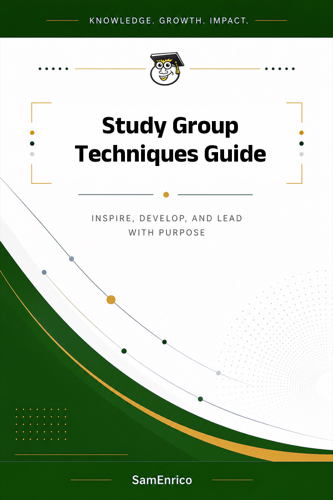
Study Group Techniques Guide
Learn cooperatively with peer quizzing and teachin
Learn cooperatively with peer quizzing and teaching strategies.
Formats
About this book
Free sample
Chapter 1: Why Silence Fails--–- Marcus believed he was a disciplined student. Every Tuesday and Thursday evening, he carried his organic chemistry textbook to the library's fourth floor, found a quiet corner, and studied for exactly three hours. He read each chapter twice. He copied key reactions into a spiral notebook. He reviewed his notes before packing up.
After six weeks of this routine, he felt ready for the first midterm. He knew the material. He had seen every reaction, memorized every mechanism, and highlighted every exception. When the exam landed on his desk, he flipped through the pages and felt a wave of recognition. There was the SN2 reaction.
There was carbocation stability. He knew these questions. But when he tried to write the answers, his hand froze. He could not predict the products. He could not draw the curved arrows.
He could not explain why one nucleophile would work and another would fail. He recognized everything and recalled almost nothing. He scored a 62 percent. The library's fourth floor had been a tomb, not a classroom. The silence had been a lie.Marcus did not fail because he was lazy.
He failed because he misunderstood how human memory works. He confused the feeling of familiarity with the fact of mastery. That confusion is not a personal weakness. It is a design flaw in the human brain, one that every student must learn to overcome. This chapter will show you why passive study methods like re-reading, highlighting, and passive listening produce the illusion of competence rather than real learning.
You will learn the neuroscience of why silence—the kind where one person reads and another listens, or where everyone reads alone—is often the enemy of retention. And you will discover the two cognitive principles that make cooperative peer quizzing and teaching the most powerful study methods available. By the end of this chapter, you will understand why most study groups fail and how yours will succeed.The Recognition Trap Every day, in libraries and coffee shops around the world, millions of students commit the same cognitive error. They open a textbook, read…
This is the end of the free sample. Get the eBook to keep going. Buy now
Contents
- Chapter 1
- Chapter 2
- Chapter 3
- Chapter 4
- Chapter 5
- Chapter 6
- Chapter 7
- Chapter 8
- Chapter 9
- Chapter 10
- Chapter 11
- Chapter 12
Details
- Author
- Cockrell Veola
- Publisher
- SamEnrico
- Language
- English
- Genre
- Non-Fiction, Self-Help, Collaborative Learning
- Released
- 2026-06-09
- Pages (approx.)
- 148
- Available as
- eBook, Audiobook

Read better in the ZLOADR app
Your eBooks on your phone or tablet. Sign in with your SamEnrico account and start reading.
More by Cockrell Veola
 Diplomatic Security Agent StressCockrell Veola$11.99
 Temperature Anger ConnectionCockrell Veola$11.99
 The Uncle in PrisonCockrell Veola$11.99
 Senior Advance DirectiveCockrell Veola$11.99
 Football Quarterback HypnosisCockrell Veola$11.99
 Goal Setting for MarketersCockrell Veola$11.99
 Chest Compression Depth GuideCockrell Veola$11.99
 Whispers of the Bamboo: The Ghostly Wail of the YureiCockrell Veola$11.99
 The Last Whisper of the Woolly Mammoth: Decoding the Ice Age's Greatest MysteryCockrell Veola$11.99
 How to Produce Pretzel MakersCockrell Veola$11.99
 Freemium to Paid Lead ScoringCockrell Veola$12.99
 Angel Investor Term Sheet WorkbookCockrell Veola$12.99