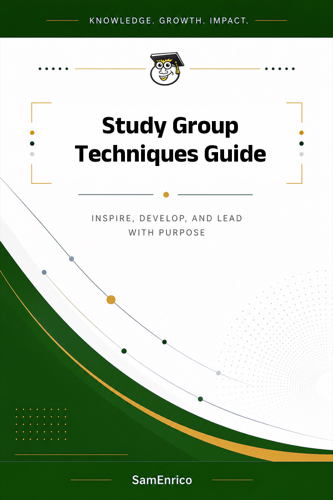
Study Group Techniques Guide eBook
Learn cooperatively with peer quizzing and teachin
Learn cooperatively with peer quizzing and teaching strategies.
Formats
Free sample
Chapter 1: Why Silence Fails--–- Marcus believed he was a disciplined student. Every Tuesday and Thursday evening, he carried his organic chemistry textbook to the library's fourth floor, found a quiet corner, and studied for exactly three hours. He read each chapter twice. He copied key reactions into a spiral notebook. He reviewed his notes before packing up.
After six weeks of this routine, he felt ready for the first midterm. He knew the material. He had seen every reaction, memorized every mechanism, and highlighted every exception. When the exam landed on his desk, he flipped through the pages and felt a wave of recognition. There was the SN2 reaction.
There was carbocation stability. He knew these questions. But when he tried to write the answers, his hand froze. He could not predict the products. He could not draw the curved arrows.
He could not explain why one nucleophile would work and another would fail. He recognized everything and recalled almost nothing. He scored a 62 percent. The library's fourth floor had been a tomb, not a classroom. The silence had been a lie.Marcus did not fail because he was lazy.
He failed because he misunderstood how human memory works. He confused the feeling of familiarity with the fact of mastery. That confusion is not a personal weakness. It is a design flaw in the human brain, one that every student must learn to overcome. This chapter will show you why passive study methods like re-reading, highlighting, and passive listening produce the illusion of competence rather than real learning.
You will learn the neuroscience of why silence—the kind where one person reads and another listens, or where everyone reads alone—is often the enemy of retention. And you will discover the two cognitive principles that make cooperative peer quizzing and teaching the most powerful study methods available. By the end of this chapter, you will understand why most study groups fail and how yours will succeed.The Recognition Trap Every day, in libraries and coffee shops around the world, millions of students commit the same cognitive error. They open a textbook, read a paragraph, and feel a small surge of satisfaction. They understand the words.
The sentences make sense. The diagrams seem clear. They close the book and believe they have learned something. They have not. They have experienced recognition, not recall.
The difference between these two mental operations is the difference between passing an exam and failing it.Recognition is the brain's fast, automatic system for detecting familiarity. When you see a face you have seen before, your brain produces a recognition signal within milliseconds. You do not have to reconstruct the face from memory. You simply feel a sense of knowing. That feeling is useful for navigating the world—it tells you that someone is not a stranger—but it is useless for academic learning.
Recognition requires almost no cognitive effort. It leaves no lasting trace. You can recognize a page you read ten minutes ago without having learned a single fact from it.Recall is different. Recall is the brain's slow, effortful system for reconstructing information from scratch. When you recall something, you are not just detecting familiarity.
You are rebuilding a memory, piece by piece, without any external cues. Recall is hard. It feels hard. That difficulty is not a bug. It is a feature.
Each time you successfully recall information, you strengthen the neural pathways that hold that information. Each failed attempt—the frustrating sensation of a word on the tip of your tongue—still strengthens those pathways, as long as you eventually encounter the correct answer. The struggle itself is the learning.The problem is that recognition feels like learning. When Marcus read his organic chemistry textbook for the second time, every reaction looked familiar. That familiarity tricked his brain into believing he had mastered the material.
He had not. He had only seen it before. The exam demanded recall. He had practiced recognition. The mismatch destroyed his grade.This is not Marcus's fault.
His brain was doing exactly what evolution designed it to do: conserve energy whenever possible. Recognizing a familiar pattern costs almost no calories. Recalling information from scratch costs many calories. Your brain would rather recognize than recall. It takes deliberate effort to override that default.
Most students never learn how.The Fluency Illusion Cognitive psychologists have a name for Marcus's mistake: the fluency illusion. The fluency illusion occurs when the ease of processing a piece of information leads you to overestimate how well you have learned it. A textbook written in clear, simple language creates fluency. A lecture delivered by a charismatic professor creates fluency. A set of highlighted notes creates fluency.
In each case, the information feels easy to process, so your brain assumes it must be easy to remember. The assumption is wrong.In one famous study, researchers gave students a list of word pairs to learn. Some pairs were presented in an easy-to-read font. Others were presented in a small, blurry, difficult-to-read font. After studying, the students predicted how many pairs they would remember.
Students who studied the easy-to-read font predicted significantly higher scores than students who studied the blurry font. But when tested, the opposite was true. Students who studied the blurry font remembered more. The difficulty of reading had forced deeper processing. The ease of reading had created a fluency illusion.Highlighting is particularly dangerous because it creates fluency without effort.
When you highlight a sentence, you perform a small physical action that feels productive. The sentence stands out from the page. When you review your highlights, the material feels organized and accessible. But highlighting does not require you to recall anything. It does not require you to explain anything.
It does not require you to connect the sentence to anything else you know. Highlighting is a motor activity, not a cognitive one. Students who highlight perform no better on exams than students who do not. The illusion of productivity is the only product.The same is true for re-reading. Reading a chapter twice feels like hard work.
It takes time. It takes attention. Surely that investment must produce learning. But study after study shows that re-reading produces negligible benefits over a single reading. The second time through, your brain recognizes the sentences and moves on.
No retrieval occurs. No strengthening occurs. The time is wasted.The Testing Effect: Retrieval as a Learning Event If re-reading and highlighting do not work, what does? The most robust finding in the science of learning is the testing effect: the act of retrieving information from memory makes that information more recallable in the future. Testing is not just a way to measure learning.
Testing is a way to create learning.In a landmark study, psychologists Jeffrey Karpicke and Henry Roediger had college students learn a list of foreign language vocabulary words. One group studied the words by reading and re-reading the full list. Another group studied by reading the list and then testing themselves on the words, dropping out the words they got right and continuing to test themselves on the words they got wrong. A third group studied by reading the list and then testing themselves repeatedly…
This is the end of the free sample. Get the eBook to keep going. Buy now
About this book
Details
- Author
- Cockrell Veola
- Publisher
- SamEnrico
- Language
- English
- Genre
- Non-Fiction, Self-Help, Collaborative Learning
- Released
- 2026-06-09
- Pages (approx.)
- 148
- Available as
- eBook, Audiobook

Read better in the ZLOADR app
Your eBooks on your phone or tablet. Sign in with your SamEnrico account and start reading.
More by Cockrell Veola
 Diplomatic Security Agent StressCockrell Veola$11.99
 Temperature Anger ConnectionCockrell Veola$11.99
 The Uncle in PrisonCockrell Veola$11.99
 Senior Advance DirectiveCockrell Veola$11.99
 Football Quarterback HypnosisCockrell Veola$11.99
 Goal Setting for MarketersCockrell Veola$11.99
 Chest Compression Depth GuideCockrell Veola$11.99
 Whispers of the Bamboo: The Ghostly Wail of the YureiCockrell Veola$11.99
 The Last Whisper of the Woolly Mammoth: Decoding the Ice Age's Greatest MysteryCockrell Veola$11.99
 How to Produce Pretzel MakersCockrell Veola$11.99
 Freemium to Paid Lead ScoringCockrell Veola$12.99
 Angel Investor Term Sheet WorkbookCockrell Veola$12.99