
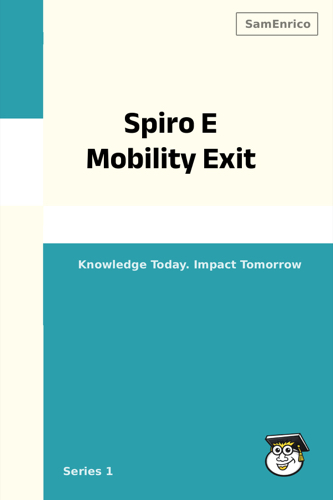
Non-FictionBusiness BriefE Mobility
Spiro E Mobility Exit eBook
Analyze the Benin based electric bike company's sc
Analyze the Benin based electric bike company's scale and liquidity.
Formats
Free sample
Chapter 1: The Swarm Theorem...–- The first thing you need to understand about building a billion-dollar company in a frontier market is that GDP per capita is a lie. The second thing is that Excel will kill you. The third—and this is the one that took me almost losing everything to learn—is that you don’t measure a market in dollars. You measure it in dust.I learned this lesson on a Tuesday afternoon in Cotonou, Benin, standing in a cloud of red dust so thick it turned the setting sun into a dull orange coin. I was not a founder yet.
I was a consultant—the kind of person who flies into a country, stays in a hotel with armed guards, and tells locals how to run their businesses without ever touching the ground. My client was a microfinance institution that lent money to motorcycle taxi drivers, known across West Africa as “boda boda” drivers. They had a problem: default rates were spiking. Drivers were taking loans for petrol bikes, working eighteen-hour days, and still falling behind. The MFI wanted me to fix their credit scoring model.Instead, I spent two weeks riding on the back of boda bodas.Not the tourist version—the real version.
I paid a driver named Kofi (not his real name, for reasons that will become clear) $20 a day to let me sit behind him from 6 a.m. to 10 p.m. We drove through Cotonou’s packed markets, down unpaved roads to satellite villages, and along the coastal highway where trucks kicked stones at our shins. Kofi made 8,000 CFA francs a day—about $14 at the exchange rate then. He spent 4,500 CFA on petrol.
Another 1,000 on maintenance. He kept the rest for his wife and three children. On a good day, that was $4 of profit. On a bad day—rain, a flat tire, a police bribe—he lost money.What I saw during those two weeks changed my understanding of scale forever. Not because of the poverty—I had seen poverty before.
But because of the swarm. At every intersection, every market entrance, every bus stop, there were boda bodas. Dozens of them. Hundreds. They didn’t compete like Western businesses, with marketing budgets and loyalty programs.
They competed like ants. They swarmed. Wherever there was demand—a woman with heavy bags, a businessman late for a meeting, a student rushing to an exam—the boda bodas appeared within seconds. They knew the shortcuts, the police checkpoints, the roads that flooded in the rain. They were a distributed intelligence network made of flesh, steel, and gasoline.And every single one of them was losing money to their fuel tank.That was the moment I understood the Swarm Theorem: In a frontier market, the value of an electrification company is not proportional to the number of vehicles it sells.
It is proportional to the density of the swarm it serves.Let me say that again, because most investors still don’t believe it: density matters more than volume. A thousand bikes spread across ten cities is a logistics nightmare. A thousand bikes in one neighborhood of one city—operating out of ten swap stations—is a fortress. The swarm creates the infrastructure. The infrastructure creates the data.
The data creates the liquidity. But almost everyone gets the order wrong.The Benin Hypothesis When I finally started Spiro (the name came later, after a lawyer told me “Swarm Energy” was already trademarked by a German solar company), I had a simple hypothesis: if you want to prove that electric mobility can work in Africa, you do not start in Lagos (too chaotic), Nairobi (too expensive), or Johannesburg (too car-centric). You start in Benin.Specifically, you start in Cotonou. And you start with boda bodas.Why Benin? The standard answer—the one I gave to investors who asked—was that Benin had political stability, a francophone legal system tied to the Euro (so currency risk was lower), and a government that wanted to be seen as green.
All of that was true. But the real reason was Kofi. Not Kofi personally—he had moved to Ghana by the time I raised the first round. But the pattern of Kofi’s life. Benin has 13 million people.
It has an estimated 300,000 commercial motorcycle taxis. That is one boda boda for every 43 people. In Lagos, the ratio is one to 27, but the traffic is so bad that a bike can only do a third as many trips per day. In Nairobi, the ratio is one to 60, and the weather is cold enough that riders don’t work after dark. Cotonou was the Goldilocks city: dense enough for high utilization, warm enough for 24-hour operation, and poor enough that fuel costs were the single largest line item in a driver’s P&L.But here is what I never told investors in those early pitch decks: I chose Benin because no one else would.
The Chinese e-mobility companies (Yadea, Niu, Sunra) were focused on India and Southeast Asia. The European startups (Cooltra, Cityscoot) were doing shared scooters in Paris and Barcelona. The Silicon Valley VCs who claimed to care about “emerging markets” were actually investing in Latin America—specifically Mexico and Brazil—because the flight from San Francisco was shorter. Africa was a blind spot. West Africa was a black hole.
Benin was a blank spot on the map where the cartographers had written “here be dragons.”That was the opportunity. Dragons don’t have competitors.The Dust Measurement Problem Let me introduce you to the concept that separates successful frontier founders from the ones who go home broke: swarm density.Most investors measure a market by GDP, population, or vehicle sales. These are clean numbers that fit neatly into Excel models. They are also almost completely useless for predicting the success of a capital-intensive, infrastructure-dependent business like electric mobility. GDP tells you how much money is in the country, not how much of that money moves through a motorcycle tank.
Population tells you how many people exist, not how many of them need to go somewhere every day. Vehicle sales tell you how many new bikes are bought each year, not how many used bikes are already on the road competing with you.Swarm density is different. It is a measurement that requires you to leave your hotel, walk to an intersection, and count. Specifically: number of commercial two-wheelers per square kilometer during peak hours, weighted by average daily distance traveled. I am not being cute about this.
In the early days, I actually did this with a clicker counter, a stopwatch, and a notebook. I stood at the intersection of Boulevard Saint Michel and Rue du Gouverneur Bayol in Cotonou—the busiest intersection in the city—from 7 a.m. to 9 a.m. for five consecutive weekdays. I counted 1,200 to 1,500 boda bodas per hour.
That meant, at peak times, there were roughly 40 boda bodas passing through that intersection every minute.Each one burned about 0.4 liters of petrol per hour of operation. At the time, petrol cost 600 CFA per liter (about $1). That intersection alone was consuming $16,000 worth of petrol per hour during peak periods. That is…
This is the end of the free sample. Get the eBook to keep going. Buy now
About this book
Details
- Author
- Cranford Kala
- Publisher
- SamEnrico
- Language
- English
- Genre
- Non-Fiction, Business Brief, E Mobility
- Released
- 2026-06-11
- Pages (approx.)
- 132
- Available as
- eBook, Audiobook

Read better in the ZLOADR app
Your eBooks on your phone or tablet. Sign in with your SamEnrico account and start reading.
More by Cranford Kala
 Car Music For Anger ReductionCranford Kala$11.99
 TM Doubt Resolution GuideCranford Kala$11.99
 Smoking Cessation for Back HealthCranford Kala$11.99
 Facility Management TechCranford Kala$11.99
 The Forgotten Bomb: The Untold Story of the Tsar BombaCranford Kala$11.99
 Apple: The Steve Jobs EraCranford Kala$11.99
 Ride Hailing Market MapCranford Kala$12.99
 Unfair Advantage Definition GuideCranford Kala$12.99
 Understanding Pfeiffer–mayer SyndromeCranford Kala$17.99
 How to Start a Cable Accessory Business (Beginners Guide)Cranford Kala$11.99
You may also like
 Hong Kong Handover 1997Dunn Johnnie$11.99
 Zumba For Postnatal Recovery CourseNeal Christian$11.99
 Zumba for BeginnersLadner Nikia$11.99
 YouTube Comment Mining GuideHumes Pandora$12.99
 Worry Box MeditationCarlin Rudy$11.99
 Workplace Stress MeditationNguyen Lynn$11.99
 Workplace Stress and Sleep RepairHawley Ivory$11.99
 Workplace Perfectionism CureDelaney Jeffry$11.99
 Workplace Injustice Anger GuideWallen Isabelle$11.99
 Work Addiction and Burnout LinkGreenwood Ester$11.99
 Women in Yoga and WellnessBeattie Galina$11.99
 Women in Stand Up ComedyChun Evangeline$11.99