
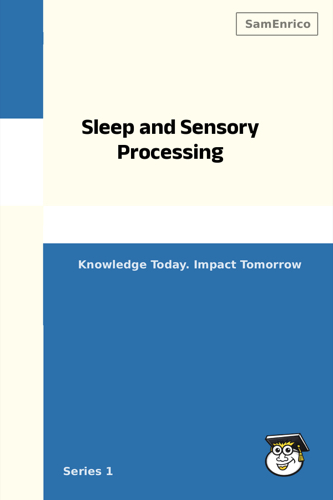
Non-FictionHealth & WellnessSensory
Sleep and Sensory Processing eBook
Address sensory seekers and avoiders who struggle
by Mallory Les
Address sensory seekers and avoiders who struggle with sleep.
Formats
Free sample
Chapter 1: The Silent Scream...--You are not broken.This is the first thing you need to hear, and I need you to let it land. Because if you are reading this book, chances are excellent that you have been told—directly or indirectly—that your inability to sleep is your fault. You have been told to try harder. To relax more. To put away your phone earlier.
To drink chamomile tea. To meditate. To just close your eyes and breathe.And when those things didn't work, you were told—again, directly or indirectly—that you must be doing something wrong. That you are anxious. That you are resistant.
That you are, in the quiet judgment of a partner or a parent or a well-meaning doctor, simply not trying hard enough.Let me be very clear about what this book is not. It is not another sleep hygiene manual. It will not tell you to buy blackout curtains and a white noise machine and call it a day—though we will talk about those things. It will not tell you to wake up at the same time every morning and avoid caffeine after 2 PM and take magnesium and hope for the best. Those interventions work for people whose nervous systems operate according to the standard factory settings.
Those interventions fail—catastrophically, repeatedly, devastatingly—for people whose nervous systems did not come with those settings.This book is for the second group.This book is for the people who have tried everything and still find themselves lying awake at 2 AM with their skin crawling, their jaw clenched, their partner's breathing sounding like a freight train, and their brain spinning through a loop of every mistake they have ever made. It is for the parents whose children fight bedtime with a ferocity that looks like defiance but feels like drowning. It is for the adults who have been told they have "anxiety" and "insomnia" and "sensory processing issues" as if those were separate problems rather than different names for the same storm.And it is for the people who have never been told anything at all—who have simply suffered in silence, assuming that everyone else finds sleep this hard and is just better at hiding it.You are not broken. Your nervous system is different. And different is not defective.
Different just requires a different manual.The Night That Changed Everything Before we go any further, I want to tell you about a patient I will call Maya.Maya was thirty-four years old when she walked into my office. She was a graphic designer, articulate, accomplished, and utterly exhausted. She had not slept more than four consecutive hours in seven years. She had seen three primary care physicians, two sleep specialists, a neurologist, a psychiatrist, and an acupuncturist. She had tried cognitive behavioral therapy for insomnia (CBT-I), which everyone agreed was the gold standard.
She had tried Ambien, Lunesta, trazodone, and a rotating cocktail of over-the-counter supplements that she could no longer keep straight. She had tried eliminating caffeine, sugar, alcohol, and dairy. She had tried yoga, meditation, and a $400 "sleep optimizing" mattress topper that she later discovered was just memory foam with better marketing.Nothing worked. Or rather, nothing worked consistently. Some nights she would fall asleep quickly, only to wake at 2 AM with her heart racing and her sheets soaked in sweat.
Other nights she would lie awake for hours, unable to pinpoint what was wrong except that everything felt wrong. Her pajamas felt wrong. The sheets felt wrong. The silence felt wrong. The sound of the fan felt wrong.
Her own body felt wrong, like she was wearing a suit that didn't fit.Every doctor had told her the same thing: reduce stress, improve sleep hygiene, and consider that she might have an anxiety disorder. Maya did not dispute the anxiety—she was anxious, profoundly so, but she had begun to suspect that her anxiety was a symptom of her sleeplessness rather than the cause. No one listened. No one asked her what the insomnia actually felt like in her body.When I asked her to describe the experience of trying to fall asleep, she paused for a long time. Then she said something I have never forgotten."It feels like my skin is screaming," she said.
"And no one can hear it."That image—the silent scream of a nervous system in distress—became the organizing principle of everything that followed. Because Maya was not anxious in the way that word is usually used. She was not worrying about her job or her relationships or the state of the world. She was not ruminating on past mistakes or catastrophizing about future disasters. She was experiencing a physiological alarm response that had no identifiable trigger.
Her nervous system was sounding an alarm, and her conscious mind was frantically searching for a threat that did not exist.Maya was a sensory avoider. She did not know that term. No one had ever told her that her nervous system was wired to interpret ordinary sensory input—the texture of her sheets, the sound of her partner breathing, the temperature of the room—as potential threats. No one had explained that her "anxiety" was actually her amygdala doing its job too well, tagging neutral stimuli as dangers and flooding her system with cortisol. No one had told her that the reason she woke at 2 AM was not psychological weakness but neurological architecture.When we finally understood her profile, everything changed.
Not overnight, and not without effort. But the interventions that finally worked for Maya were not the ones she had been given before. She stopped trying to "relax" and started using deep pressure protocols that gave her nervous system the input it needed to feel safe. She stopped forcing herself to lie still and started using a body sock that provided even, gentle compression. She stopped pretending that she could tolerate her partner's breathing and started using brown noise at a carefully calibrated volume.
She stopped blaming herself for being "too sensitive" and started building an environment that honored her sensitivity instead of fighting it.Maya sleeps now. Not perfectly, and not every night. But she sleeps. And more importantly, she has stopped believing that her sleeplessness is a moral failure.I am telling you Maya's story because it is not unique. It is the story of thousands of people I have worked with, and millions more who have never found their way to someone who understands this connection.
The connection between sensory processing and sleep is one of the most underrecognized and undertreated factors in all of insomnia medicine. And once you see it, you cannot unsee it.The Wired & Tired Epidemic Let me give you a number that should alarm you: approximately one in five adults meets the diagnostic criteria for insomnia. Among children, the numbers are similar. But among people with sensory processing differences—including those with autism, ADHD, anxiety disorders, and subclinical sensory sensitivities—the rate of chronic sleep disturbance approaches eighty percent.Eighty percent.That is not a coincidence. That is a direct line from sensory dysregulation to sleep failure.Here is what the standard sleep medicine model gets wrong.…
This is the end of the free sample. Get the eBook to keep going. Buy now
About this book
Details
- Author
- Mallory Les
- Publisher
- SamEnrico
- Language
- English
- Genre
- Non-Fiction, Health & Wellness, Sensory
- Released
- 2026-06-10
- Pages (approx.)
- 144
- Available as
- eBook, Audiobook

Read better in the ZLOADR app
Your eBooks on your phone or tablet. Sign in with your SamEnrico account and start reading.
More by Mallory Les
 Philippine Overseas Workers TrendsMallory Les$11.99
 Moroccan Green Tax Credits CourseMallory Les$11.99
 Bodyweight Back Training GuideMallory Les$11.99
 Innocence Project Nebraska CasesMallory Les$11.99
 The Man Who Sold the Moon: How a Visionary Convinced the World to Look UpMallory Les$11.99
 The Silk Road Heist: A Digital Ponzi SchemeMallory Les$11.99
 How to Start a Hobby in Orchid RaisingMallory Les$11.99
 Understanding Chromosome 21 RingMallory Les$17.99
 Zero Cost Idea Validation HandbookMallory Les$12.99
 Business Insurance Basics GuideMallory Les$12.99
 Forensic ScientistMallory Les$11.99
You may also like
 Hong Kong Handover 1997Dunn Johnnie$11.99
 Zumba For Postnatal Recovery CourseNeal Christian$11.99
 Zumba for BeginnersLadner Nikia$11.99
 YouTube Comment Mining GuideHumes Pandora$12.99
 Worry Box MeditationCarlin Rudy$11.99
 Workplace Stress MeditationNguyen Lynn$11.99
 Workplace Stress and Sleep RepairHawley Ivory$11.99
 Workplace Perfectionism CureDelaney Jeffry$11.99
 Workplace Injustice Anger GuideWallen Isabelle$11.99
 Work Addiction and Burnout LinkGreenwood Ester$11.99
 Women in Yoga and WellnessBeattie Galina$11.99
 Women in Stand Up ComedyChun Evangeline$11.99