
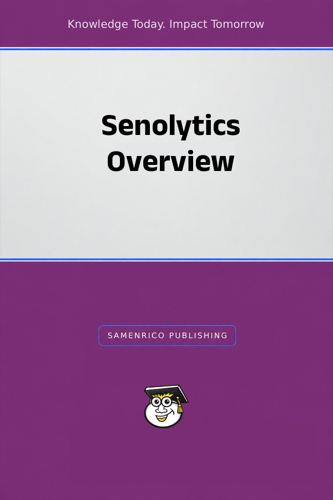
Non-FictionHealth & WellnessLongevity
Senolytics Overview eBook
Explains clearing senescent cells for healthspan e
Explains clearing senescent cells for healthspan extension.
Formats
Free sample
Chapter 1: The Zombie Within--For most of human history, aging was accepted as the slow, inevitable wearing down of a biological machine—like rust on a car or cracks in a building’s foundation. We grew old because we simply fell apart. Muscles weakened, joints stiffened, memories faded, and we called this process “natural.” But what if aging isn’t passive decay at all? What if aging is an active biological program—a series of deliberate cellular decisions that go catastrophically wrong? And what if the key to extending human healthspan lies not in preventing damage, but in clearing out the cells that have become toxic to everything around them?This chapter introduces you to the “zombie” cell—a cell that is not dead, not alive in the productive sense, but something far more insidious.
These are senescent cells, and their discovery in the 1960s set off a chain of research that would eventually upend everything we thought we knew about why we age and how we might slow it down.Before we can understand senolytics—the drugs that selectively kill these zombie cells—we must first understand the enemy. What are senescent cells? Why do they exist at all if they cause so much trouble? And why does your body, which was once so good at clearing them out, eventually stop doing its job?This chapter answers those questions. We begin with the story of two researchers who accidentally discovered that cells have a finite lifespan.
We then explore the double-edged sword of cellular senescence—how a mechanism designed to protect us from cancer becomes, with age, a primary driver of nearly every chronic disease of aging. Finally, we define the Senescence-Associated Secretory Phenotype, or SASP, the toxic cocktail that zombie cells use to corrupt their healthy neighbors. By the end of this chapter, you will understand why the accumulation of senescent cells is not merely a consequence of aging but a root cause of it—and why clearing them out may be the most important medical intervention of the coming decade.The Discovery That Changed Everything In 1961, a young researcher named Leonard Hayflick was working at the Wistar Institute in Philadelphia, a renowned center for biological research. He was studying human fetal fibroblasts—connective tissue cells that are easy to grow in a laboratory dish. His colleague Paul Moorhead was a cytogeneticist with expertise in cell biology.
Together, they set out to answer a question that seemed simple at the time: how many times can a normal human cell divide before it stops?The prevailing belief in 1961, championed by Nobel laureate Alexis Carrel, was that normal cells were immortal. Carrel had claimed, in the early 1900s, to have maintained a chicken heart cell culture for decades, with cells dividing indefinitely. This idea—that cells placed in the right environment could divide forever—dominated biological thinking for nearly sixty years. Carrel’s claim was eventually shown to be the result of experimental error (he had unknowingly introduced fresh cells each time he added nutrients), but his influence lingered.Hayflick and Moorhead’s experiment was straightforward. They took human fetal fibroblasts and cultured them, carefully counting each division.
They replenished the nutrients regularly and kept the cells in optimal conditions. And then something unexpected happened. After about forty to sixty divisions, the cells simply stopped.They weren’t dead. They were still metabolically active—they consumed oxygen, produced proteins, responded to signals. But they would not divide again, no matter what Hayflick and Moorhead did.
They had entered a state of permanent cell cycle arrest. This limit, later named the Hayflick Limit, was a bombshell. If normal human cells could only divide a finite number of times, then aging was not merely the result of environmental wear and tear. It was built into the very biology of our cells.Hayflick published his findings in 1965 in the journal Experimental Cell Research. The response was not applause but hostility.
Senior biologists accused him of sloppy technique. They argued that his cells had stopped dividing because of contamination, or because he had somehow damaged them. Hayflick spent years defending his work, eventually reproducing the results in multiple cell types from multiple species. By the 1970s, the scientific community had accepted the Hayflick Limit as a fundamental biological reality. But the deeper question remained: why would evolution create a mechanism that limits how many times a cell can divide?
What purpose could this possibly serve?The Good: A Cancer Prevention System To understand why the Hayflick Limit exists, we have to think about cancer. Every time a cell divides, it must copy its entire genome—three billion base pairs of DNA. Mistakes happen. Most of these mutations are harmless, occurring in non-coding regions or in genes that don’t matter much. But occasionally, a mutation occurs in a gene that controls cell division.
When that happens, the cell may begin dividing uncontrollably. That is the beginning of cancer.Imagine a cell that has sustained DNA damage from UV radiation, or from a chemical carcinogen in cigarette smoke, or simply from the random errors that occur during replication. If that cell continues to divide, it will pass its damaged DNA to its daughter cells, accumulating more mutations with each generation. Eventually, it may acquire the hallmarks of cancer: uncontrolled proliferation, evasion of cell death, and the ability to invade other tissues.The body has multiple defense mechanisms against this scenario. One of them is programmed cell death, or apoptosis.
If a cell detects that its DNA is damaged beyond repair, it can activate a suicide pathway, eliminating itself before it becomes a threat. But apoptosis is an extreme response. What if the damage is moderate—not enough to trigger cell death, but enough to make continued division risky? Evolution has provided a middle ground: cellular senescence.Senescence is a permanent cell cycle arrest. The cell stops dividing, but it does not die.
It remains alive, metabolically active, and locked in a state of suspended animation. From the perspective of cancer prevention, this is an elegant solution. The cell cannot become cancerous because it cannot divide. But the body does not have to mount an inflammatory response to clear dead cell debris. The senescent cell simply sits there, harmless—or so it seemed.For decades, researchers assumed that senescent cells were benign.
They were like retired workers: no longer productive, but not causing any harm. This view began to change in the early 2000s, when several laboratories independently discovered that senescent cells are not silent at all. They are, in fact, shouting. They secrete a complex mixture of inflammatory signals, growth factors, and enzymes that reshape their surrounding environment. This secretion is not random; it is an organized, regulated program that researchers named the Senescence-Associated Secretory Phenotype, or SASP.But before we dive into the SASP, we need to appreciate that senescence, in young, healthy organisms, serves critical functions beyond cancer suppression.
Senescent cells play a vital role in embryonic development, helping to sculpt tissues and organs by creating boundaries between different cell populations. They are involved in wound healing, where they secrete factors that recruit immune cells and promote tissue repair. They also help maintain tissue…
This is the end of the free sample. Get the eBook to keep going. Buy now
About this book
Details
- Author
- Foust Angelia
- Publisher
- SamEnrico
- Language
- English
- Genre
- Non-Fiction, Health & Wellness, Longevity
- Released
- 2026-06-05
- Pages (approx.)
- 142
- Available as
- eBook, Audiobook

Read better in the ZLOADR app
Your eBooks on your phone or tablet. Sign in with your SamEnrico account and start reading.
More by Foust Angelia
 The Alcohol and RelationshipsFoust Angelia$11.99
 CrossFit Mental Toughness GuideFoust Angelia$11.99
 Anki For ArchitectureFoust Angelia$11.99
 Creative Confidence for Tech LeadsFoust Angelia$11.99
 Letting Go of Aging ShameFoust Angelia$11.99
 Managing Distractions for ConsultantsFoust Angelia$11.99
 Andes Jungle DescentFoust Angelia$11.99
 The Healers of Nubia: Ancient Secrets of the Black PharaohsFoust Angelia$11.99
 The Alchemist's Secret: Lavoisier and the Birth of Modern ChemistryFoust Angelia$11.99
 Tapioca: Cassava StarchFoust Angelia$11.99
 The Essential Guide to Big BandFoust Angelia$11.99
 How to Produce Epoxy PuttyFoust Angelia$11.99
You may also like
 Hong Kong Handover 1997Dunn Johnnie$11.99
 Zumba For Postnatal Recovery CourseNeal Christian$11.99
 Zumba for BeginnersLadner Nikia$11.99
 YouTube Comment Mining GuideHumes Pandora$12.99
 Worry Box MeditationCarlin Rudy$11.99
 Workplace Stress MeditationNguyen Lynn$11.99
 Workplace Stress and Sleep RepairHawley Ivory$11.99
 Workplace Perfectionism CureDelaney Jeffry$11.99
 Workplace Injustice Anger GuideWallen Isabelle$11.99
 Work Addiction and Burnout LinkGreenwood Ester$11.99
 Women in Yoga and WellnessBeattie Galina$11.99
 Women in Stand Up ComedyChun Evangeline$11.99