
Non-FictionInformativeEducational
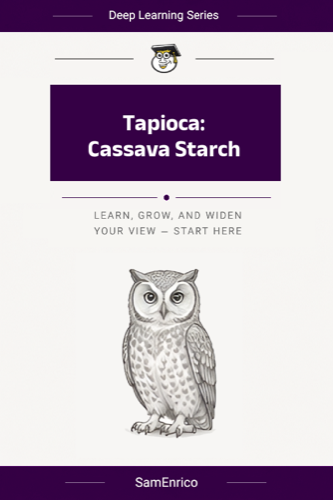
Tapioca: Cassava Starch
This harvesting publication, published by SamEnric
This harvesting publication, published by SamEnrico, covers Tapioca: Cassava Starch
Formats
About this book
Free sample
Chapter 1: The White Gold...-- The story of tapioca begins not in a laboratory or a factory, but in the bitter, swollen roots of a plant that most of the world ignores. Manihot esculenta Crantz—cassava—is a botanical survivor, a perennial shrub of the Euphorbiaceae family that thrives where corn wilts and wheat withers. Its origins trace to the southern Amazon basin, somewhere between present-day Brazil and Paraguay, where indigenous peoples domesticated it more than ten thousand years ago. Unlike the showy grains of the Old World—wheat with its golden heads, rice with its nodding panicles—cassava hides its gift underground. The root is gnarled, brown, unremarkable on the outside.
But within that homely tuber lies one of nature's most versatile polymers: starch. Purified, dried, and milled, it becomes tapioca, a substance so white, so neutral, so adaptable that it has earned the nickname "white gold."This chapter establishes the foundational importance of cassava as more than a subsistence crop. It traces the botanical journey of Manihot esculenta from its South American cradle to its current status as a global commodity, examines the production statistics that define today's market leaders, distinguishes between food-grade and industrial starch value streams, and provides a historical overview of the tapioca trade—from pre-Columbian farinha to containerized exports. Along the way, the reader will learn why Thailand dominates starch exports while Nigeria leads in raw tonnage, how Portuguese traders accidentally created a global crop, and why tariff policies in Brussels and biofuel mandates in Brasília shape the price of your gluten-free crackers. By the end of this chapter, the humble cassava root will never look quite the same.The Botanical Foundation: Manihot esculenta Crantz To understand tapioca, one must first understand the plant that produces it.
Cassava is a woody shrub that grows to two to four meters in height, with palmate leaves resembling those of its relative, the rubber tree. The edible portion is a tuberous root, technically a swollen adventitious root, that develops in clusters of four to eight per plant. A single root can weigh anywhere from 500 grams…
This is the end of the free sample. Get the eBook to keep going. Buy now
Contents
- Chapter 1
- Chapter 2
- Chapter 3
- Chapter 4
- Chapter 5
- Chapter 6
- Chapter 7
- Chapter 8
- Chapter 9
- Chapter 10
- Chapter 11
- Chapter 12
Details
- Author
- Foust Angelia
- Publisher
- SamEnrico
- Language
- English
- Genre
- Non-Fiction, Informative, Educational
- Released
- 2026-06-03
- Pages (approx.)
- 158
- Available as
- eBook, Audiobook

Read better in the ZLOADR app
Your eBooks on your phone or tablet. Sign in with your SamEnrico account and start reading.
More by Foust Angelia
 The Alcohol and RelationshipsFoust Angelia$11.99
 CrossFit Mental Toughness GuideFoust Angelia$11.99
 Anki For ArchitectureFoust Angelia$11.99
 Creative Confidence for Tech LeadsFoust Angelia$11.99
 Letting Go of Aging ShameFoust Angelia$11.99
 Managing Distractions for ConsultantsFoust Angelia$11.99
 Andes Jungle DescentFoust Angelia$11.99
 Senolytics OverviewFoust Angelia$11.99
 The Healers of Nubia: Ancient Secrets of the Black PharaohsFoust Angelia$11.99
 The Alchemist's Secret: Lavoisier and the Birth of Modern ChemistryFoust Angelia$11.99
 The Essential Guide to Big BandFoust Angelia$11.99
 How to Produce Epoxy PuttyFoust Angelia$11.99
You may also like
 Hong Kong Handover 1997Dunn Johnnie$11.99
 Zumba For Postnatal Recovery CourseNeal Christian$11.99
 Zumba for BeginnersLadner Nikia$11.99
 YouTube Comment Mining GuideHumes Pandora$12.99
 Worry Box MeditationCarlin Rudy$11.99
 Workplace Stress MeditationNguyen Lynn$11.99
 Workplace Stress and Sleep RepairHawley Ivory$11.99
 Workplace Perfectionism CureDelaney Jeffry$11.99
 Workplace Injustice Anger GuideWallen Isabelle$11.99
 Work Addiction and Burnout LinkGreenwood Ester$11.99
 Women in Yoga and WellnessBeattie Galina$11.99
 Women in Stand Up ComedyChun Evangeline$11.99