
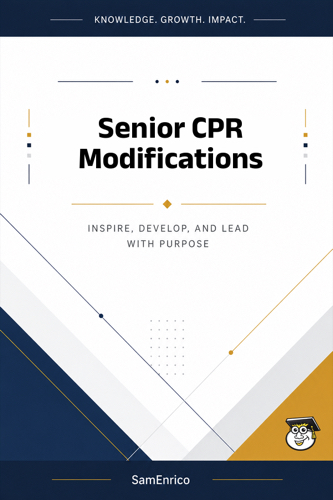
Non-FictionHealth & WellnessGeriatric
Senior CPR Modifications eBook
Adjust technique for frail elderly with osteoporos
Adjust technique for frail elderly with osteoporosis.
Formats
Free sample
Chapter 1: The Hidden Calculus...--The paramedics found James Whitmore on his kitchen floor, facedown, a half-empty coffee mug beside his outstretched hand. He was seventy-nine years old, a retired civil engineer with a neatly trimmed beard and a gold wedding band that had not left his finger in fifty-two years. His wife of five decades, Margaret, had been in the next room when she heard the crash—the ceramic sound of the mug, then the heavier, more terrible sound of a body collapsing. She ran to him, rolled him over, and saw that his lips were already turning the color of a late winter sky. He was not breathing.
She could not find a pulse. The 911 dispatcher told her to start CPR. Push hard, the dispatcher said. Push fast. In the center of the chest.
Margaret placed her hands on her husband’s sternum—the same chest she had rested her head on every night for fifty-two years—and pushed. On the fourth compression, she felt something give way beneath her palms. Not a crack, exactly. More like the feeling of stepping on a frozen branch hidden beneath fresh snow. A sudden, sickening surrender of structure.
She kept pushing because the dispatcher told her to keep pushing. When the paramedics arrived nine minutes later, James had a return of spontaneous circulation. His heart was beating again. But three of his ribs were fractured, and his sternum had separated at the manubriosternal junction—a flail chest that would require surgical stabilization. He survived the cardiac arrest only to die six weeks later in a rehabilitation facility, never having taken a single unassisted breath, never having spoken more than a few fractured words.
The official cause of death was listed as complications of blunt chest trauma. The unofficial cause, known only to Margaret and the night she cannot forget, was love.This book is not written for paramedics or emergency physicians or nursing home administrators, although they will find much of value within these pages. This book is written for Margaret. It is written for the daughter who kneels beside her mother in a carpeted living room, for the son who finds his father unresponsive in a recliner, for the home health aide who has been trained to “push hard, push fast” but has never been told what that means when the bones beneath her hands are as fragile as dried autumn leaves. It is written for everyone who has ever been told that CPR is a lifesaving measure but has never been told that for the osteoporotic elderly patient, standard CPR is also a bone-breaking measure—and that the two outcomes are not always separable.The Arithmetic of Desperation: What Standard CPR Actually Does Let us begin with a number that should disturb you: seventy to ninety percent.
That is the range of rib fracture rates reported in studies of elderly patients who receive standard CPR. Not a rare complication. Not an unusual finding in frail patients. The majority. The overwhelming majority.
Depending on the study, between seven and nine out of every ten elderly patients who receive standard CPR will leave the resuscitation with at least one broken rib. Between five and fifteen percent will leave with a broken sternum. A smaller but still significant percentage—approximately two to four percent—will suffer a flail chest: three or more adjacent ribs fractured in two or more places, creating a segment of chest wall that moves independently and paradoxically, collapsing inward during inhalation and bulging outward during exhalation. Flail chest is a surgical emergency. It requires mechanical ventilation, often for weeks.
In elderly patients, the mortality rate for flail chest approaches thirty percent—not from the cardiac arrest that prompted the CPR, but from the chest wall injury that the CPR caused.These numbers come from autopsy studies, from forensic examinations, from systematic reviews published in peer-reviewed journals like Resuscitation and the Journal of Trauma. They are not outliers. They are the consensus of the medical literature over the past twenty years. And yet, these numbers are almost never mentioned in CPR certification courses. They do not appear in the American Heart Association’s Basic Life Support provider manual, except for a single sentence acknowledging that “older patients may have more fragile bones.” They are not discussed in the video segments showing fit, middle-aged mannequins with perfectly intact plastic sternums.
The result is a catastrophic mismatch between expectation and reality: family members and first responders are taught that CPR is a clean, mechanical procedure—push here, at this rate, to this depth, and the heart will restart—while the biological truth is that for a large and growing segment of the population, CPR is a blunt instrument applied to a structure that was already failing.The medical term for this phenomenon is iatrogenic injury: harm caused by the very intervention designed to help. Iatrogenic rib fractures from CPR are not malpractice. They are not necessarily the result of incorrect technique. They are, in most cases, the predictable consequence of applying standard force to a non-standard skeleton. The engineer in James Whitmore, the one who spent forty years designing bridges and calculating load tolerances, would have understood this immediately.
A bridge designed for a maximum load of ten tons will fail at six tons if the steel has been rusting from within for decades. The sternum of a seventy-nine-year-old man with undiagnosed osteoporosis is that rusting bridge. The question is not whether it will fail under standard CPR. The question is when.The Osteoporotic Sternum: A Mechanical Analysis To understand why the osteoporotic sternum fails under standard CPR, we must first understand what osteoporosis does to the microarchitecture of bone. Healthy cortical bone—the dense outer layer of the sternum, the ribs, and the long bones—is composed of osteons: cylindrical structures that function like microscopic load-bearing columns.
Each osteon contains a central canal surrounded by concentric rings of mineralized collagen. This design is exquisitely optimized for force distribution. When a load is applied to healthy bone, the osteons compress slightly, transferring force across their interfaces and dissipating energy before it can concentrate at any single point.Osteoporosis disrupts this architecture at the molecular level. The bone remodeling cycle—the continuous process of old bone resorption by osteoclasts and new bone formation by osteoblasts—becomes unbalanced. Osteoclast activity accelerates while osteoblast activity slows.
The result is a net loss of bone mineral density, typically at a rate of one to two percent per year in postmenopausal women and slightly slower in elderly men. But the loss is not uniform. The trabecular bone—the honeycomb-like inner structure—is lost first and fastest. The honeycomb becomes a lattice with missing struts. The lattice becomes a collection of isolated spicules.
Eventually, even the cortical bone thins, losing its osteon structure and becoming what pathologists call porotic: riddled with microscopic pores that act as stress concentrators.The biomechanical consequences are stark. In healthy adult bone, the fracture threshold—the force required to initiate a crack—is approximately three hundred fifty to four hundred fifty Newtons for the sternum and one hundred fifty to two hundred Newtons for an individual rib. In osteoporotic bone, those thresholds drop by forty to…
This is the end of the free sample. Get the eBook to keep going. Buy now
About this book
Details
- Author
- Moe Mackenzie
- Publisher
- SamEnrico
- Language
- English
- Genre
- Non-Fiction, Health & Wellness, Geriatric
- Released
- 2026-06-10
- Pages (approx.)
- 148
- Available as
- eBook, Audiobook

Read better in the ZLOADR app
Your eBooks on your phone or tablet. Sign in with your SamEnrico account and start reading.
More by Moe Mackenzie
 Joyful Sports Fanship GuideMoe Mackenzie$11.99Joyful Sports Fanship GuideMoe Mackenzie$11.99
 Facebook Influencer RiseMoe Mackenzie$11.99
 Claustrophobia Elevator BreathMoe Mackenzie$11.99
 Migraine Trigger Identification WorkbookMoe Mackenzie$11.99
 Jerry Springer FinalMoe Mackenzie$11.99
 The Live In Nanny NightmareMoe Mackenzie$11.99
 No Fresh Water for WeeksMoe Mackenzie$11.99
 Downshift Stress Blue ZonesMoe Mackenzie$11.99
 Gold and Ghosts: The Lost Treasure of the Sable Island BeaconMoe Mackenzie$11.99
 Whispers of the Last Voyage: The Heartbreaking Fate of the MV Doña PazMoe Mackenzie$11.99
 Benedict Arnold: The Traitor Who Almost Won the RevolutionMoe Mackenzie$11.99
You may also like
 Hong Kong Handover 1997Dunn Johnnie$11.99
 Zumba For Postnatal Recovery CourseNeal Christian$11.99
 Zumba for BeginnersLadner Nikia$11.99
 YouTube Comment Mining GuideHumes Pandora$12.99
 Worry Box MeditationCarlin Rudy$11.99
 Workplace Stress MeditationNguyen Lynn$11.99
 Workplace Stress and Sleep RepairHawley Ivory$11.99
 Workplace Perfectionism CureDelaney Jeffry$11.99
 Workplace Injustice Anger GuideWallen Isabelle$11.99
 Work Addiction and Burnout LinkGreenwood Ester$11.99
 Women in Yoga and WellnessBeattie Galina$11.99
 Women in Stand Up ComedyChun Evangeline$11.99