
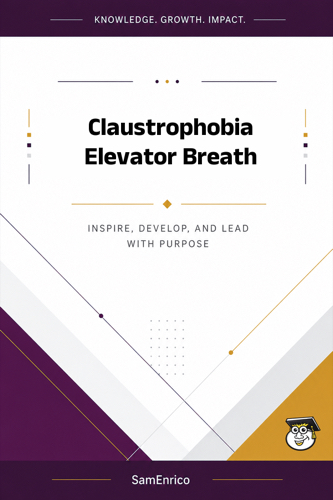
Claustrophobia Elevator Breath
Use breath focus to remain calm in confined spaces
Use breath focus to remain calm in confined spaces like elevators and tunnels.
Formats
About this book
Free sample
Chapter 1: Your Lungs Are Liars--–- The elevator doors slide shut, and within one second, your chest tightens. Your throat feels like it is narrowing. A voice inside your head whispers: You can’t breathe in here. That voice is lying. Not exaggerating.
Not guessing. Lying. The air around you contains exactly 20.9 percent oxygen—the same as the air in your living room, your office, or a vast open field. The elevator is not a vacuum. The tunnel is not a tomb.
But your brain has misinterpreted the sensation of confined space as the beginning of suffocation, and now it is sounding every alarm it owns.This chapter dismantles the most terrifying illusion of claustrophobia: the feeling that you cannot breathe. You will learn why your lungs are perfectly fine while your brain panics, how a simple feedback loop turns mild discomfort into full-blown terror, and why the walls only seem closer because your breathing has changed. By the end of this chapter, you will understand that your body is not betraying you—it is trying to protect you from a danger that does not exist. And once you see the mechanism clearly, the mechanism loses much of its power.The Anatomy of a False Alarm Every panic attack in a confined space follows the same biological script. You enter an elevator, a tunnel, an MRI machine, or a small windowless room.
Your brain’s threat-detection system—a small almond-shaped region called the amygdala—scans the environment. It notices three things: walls are close, the exit is not immediately accessible, and the usual sensory cues (windows, open sky, distant horizons) are absent. For someone without claustrophobia, this registers as mildly unpleasant at most. For someone with claustrophobia, the amygdala flags the situation as a high-alert event.Here is what happens next. The amygdala sends a distress signal to the hypothalamus, which activates the sympathetic nervous system—your body’s gas pedal.
Adrenaline floods your bloodstream. Your heart rate accelerates. Your muscles tense, including the muscles around your rib cage and your neck. And this is where the illusion begins. Because…
This is the end of the free sample. Get the eBook to keep going. Buy now
Contents
- Chapter 1
- Chapter 2
- Chapter 3
- Chapter 4
- Chapter 5
- Chapter 6
- Chapter 7
- Chapter 8
- Chapter 9
- Chapter 10
- Chapter 11
- Chapter 12
Details
- Author
- Moe Mackenzie
- Publisher
- SamEnrico
- Language
- English
- Genre
- Non-Fiction, Self-Help
- Released
- 2026-06-09
- Pages (approx.)
- 135
- Available as
- eBook, Audiobook

Read better in the ZLOADR app
Your eBooks on your phone or tablet. Sign in with your SamEnrico account and start reading.
More by Moe Mackenzie
 Joyful Sports Fanship GuideMoe Mackenzie$11.99Joyful Sports Fanship GuideMoe Mackenzie$11.99
 Senior CPR ModificationsMoe Mackenzie$11.99
 Facebook Influencer RiseMoe Mackenzie$11.99
 Migraine Trigger Identification WorkbookMoe Mackenzie$11.99
 Jerry Springer FinalMoe Mackenzie$11.99
 The Live In Nanny NightmareMoe Mackenzie$11.99
 No Fresh Water for WeeksMoe Mackenzie$11.99
 Downshift Stress Blue ZonesMoe Mackenzie$11.99
 Gold and Ghosts: The Lost Treasure of the Sable Island BeaconMoe Mackenzie$11.99
 Whispers of the Last Voyage: The Heartbreaking Fate of the MV Doña PazMoe Mackenzie$11.99
 Benedict Arnold: The Traitor Who Almost Won the RevolutionMoe Mackenzie$11.99
You may also like
 Hong Kong Handover 1997Dunn Johnnie$11.99
 Zumba For Postnatal Recovery CourseNeal Christian$11.99
 Zumba for BeginnersLadner Nikia$11.99
 YouTube Comment Mining GuideHumes Pandora$12.99
 Worry Box MeditationCarlin Rudy$11.99
 Workplace Stress MeditationNguyen Lynn$11.99
 Workplace Stress and Sleep RepairHawley Ivory$11.99
 Workplace Perfectionism CureDelaney Jeffry$11.99
 Workplace Injustice Anger GuideWallen Isabelle$11.99
 Work Addiction and Burnout LinkGreenwood Ester$11.99
 Women in Yoga and WellnessBeattie Galina$11.99
 Women in Stand Up ComedyChun Evangeline$11.99