
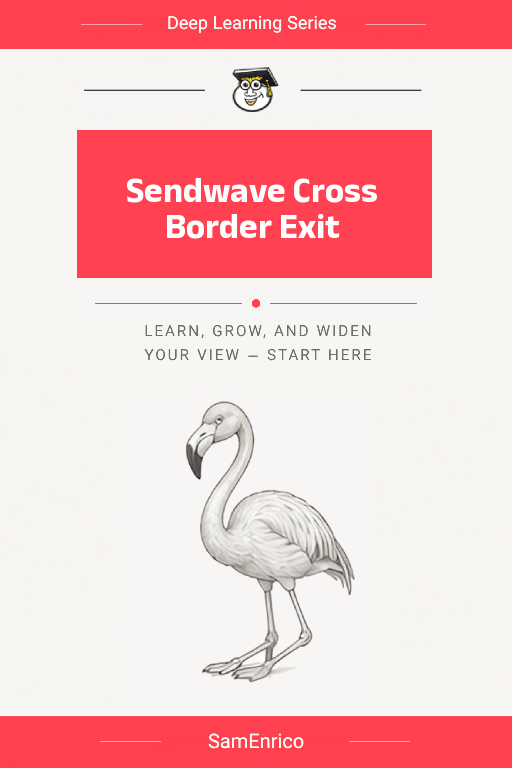
Sendwave Cross Border Exit eBook
Target diaspora payment acquirers using Sendwave's
by Damron Audie
Target diaspora payment acquirers using Sendwave's Canadian acquisition of UK remittance player WorldRemit.
Formats
Free sample
Chapter 1: The $500M Text Message...--The year is 2014, and a twenty-something Harvard graduate named Lincoln Quirk is standing in a crowded Y Combinator demo day in Mountain View, California. He has sixty seconds to convince a room full of Silicon Valley’s most skeptical investors that sending money by text message is not only possible but inevitable. The audience has already seen dozens of pitches that day—crypto wallets, peer-to-peer lending apps, social trading platforms—and their patience is wearing thin. Quirk pulls out his phone, types a message, and hits send. In less than thirty seconds, a woman in Dakar, Senegal receives the equivalent of $20 on her mobile phone.
The room goes quiet. Then, someone in the back row whispers, “How did you do that?”That moment was the beginning of a journey that would end six years later in a $500 million acquisition. But the story of Sendwave is not just a fintech success tale. It is a blueprint for a much larger opportunity—one that most Canadian payment companies have completely missed, and one that is sitting right now in the basements of Brampton, the storefronts of Surrey, and the churches of Toronto.The Problem That Everyone Else Ignored To understand why Sendwave mattered, you first have to understand the world of cross-border remittances before 2014. For decades, sending money from one country to another was an expensive, slow, and frustrating experience.
If a Ghanaian nurse working in the Bronx wanted to send 100tohermotherin Accra,shehadthreeoptions.Thefirstwas Western Unionor Money Gram,whichchargedfeesbetween7and12percentofthetransferamount,plusafixedfeethatcouldeatupanother100 to her mother in Accra, she had three options. The first was Western Union or Money Gram, which charged fees between 7 and 12 percent of the transfer amount, plus a fixed fee that could eat up another 100tohermotherin Accra,shehadthreeoptions.Thefirstwas Western Unionor Money Gram,whichchargedfeesbetween7and12percentofthetransferamount,plusafixedfeethatcouldeatupanother5 to 10.Thesecondwasabankwire,whichcost10. The second was a bank wire, which cost 10.Thesecondwasabankwire,whichcost35 to $50 and took three to five business days to clear. The third was informal—handing cash to a trusted community member who was traveling home, a system that required no fees but carried significant risk of theft or loss.According to World Bank data, the average global cost of sending $200 in 2014 was 8.9 percent. For corridors serving sub-Saharan Africa, the average was closer to 12 percent.
This was not a technology problem. It was a business model problem. The incumbent players had no incentive to lower prices because there was no competition. They owned the agent networks, they owned the correspondent banking relationships, and they owned the regulatory licenses. A new entrant would need to build all of that from scratch.But Quirk and his co-founders, Drew Durbin and Sean O’Connor, saw something that the incumbents did not.
They saw that the mobile phone—specifically, the simple text message—could replace the entire agent network. They saw that the diaspora communities in North America and Europe were already using Whats App and SMS to coordinate everything from weddings to business deals. Why not money?Sendwave launched initially in the Senegal-to-US corridor, then expanded to Ghana. The product was brutally simple. A user downloaded the app, linked their bank account or debit card, and entered a recipient’s phone number.
The recipient received a text message with a code. They took that code to any of Sendwave’s local partners—mobile money agents, grocery stores, gas stations—and collected cash. The entire process took less than ten minutes. The fee was 2 to 3 percent, a fraction of what Western Union charged.The user adoption was immediate and viral. Within eighteen months, Sendwave had processed over $100 million in transfers.
But the founders soon realized that their original corridors, while successful, were not the goldmine they had hoped for. The Senegal and Ghana markets were relatively small in terms of total diaspora population, and the competition from local mobile money operators was heating up. They needed a bigger market. They needed a corridor that combined high volume, low competition, and a diaspora community that was both wealthy enough to send significant amounts and connected enough to adopt new technology quickly.That corridor, they discovered, was Canada to East Africa.The Canadian Anomaly Most fintech investors in 2015 had no idea what was happening in Canada. The country was not on the radar for global remittance players.
Wise (then Transfer Wise) had barely launched in the UK. Remitly was focused on the US–Mexico corridor. World Remit was building its UK–Africa business. Everyone was looking at the obvious flows: US to Mexico, UK to India, US to the Philippines. No one was looking at Canada to Kenya, or Canada to Nigeria, or Canada to Uganda.This was a massive oversight.
Canada has one of the highest per-capita remittance outflows in the world, driven by a diaspora population that makes up over 22 percent of the total population—the highest proportion among G7 nations. According to Statistics Canada, the country’s top sources of immigrants in the 2010s were India, China, the Philippines, and Nigeria. The Nigerian diaspora in Canada alone grew by over 200 percent between 2011 and 2016. These were not low-income migrants sending small amounts. They were professionals, students, and entrepreneurs sending tuition payments, mortgage installments, and business capital.Sendwave’s data confirmed the opportunity.
Users in Toronto sent an average of 350pertransactionto Kenya,comparedto350 per transaction to Kenya, compared to 350pertransactionto Kenya,comparedto150 per transaction from US users to Senegal. The Canadian user base was also more loyal. Churn rates were half of what Sendwave experienced in the US market. Why? Because the competition was virtually nonexistent.
A Nigerian software engineer in Vancouver could walk into a Western Union agent and pay 10 percent to send $500 to Lagos, or they could open the Sendwave app and pay 2 percent. The choice was obvious. And once they told their friends, the network effect took over.But the real secret sauce was not just the pricing. It was the trust that Sendwave built within the diaspora communities themselves. The founders did not rely on Facebook ads or Google Ad Words.
They went to churches in Brampton, to halal grocery stores in Scarborough, to Filipino community centers in Winnipeg. They handed out flyers in Tagalog, Punjabi, and Yoruba. They sponsored soccer tournaments organized by Somali community associations. They understood something that most Silicon Valley founders never do: in diaspora communities, trust is not built through a landing page. It is built through a handshake.One of Sendwave’s earliest Canadian agents was a Somali money transfer operator in Etobicoke named Ali.
Ali had been running an informal remittance business out of his convenience store for fifteen years. He knew every Somali family in a five-kilometer radius. He knew who had just had a baby, who was looking for work, who needed to send money home for a funeral. When Sendwave approached him about becoming a cash-out agent, he was skeptical. Why would his customers trust an app?Sendwave gave Ali a tablet and a stack of printed guides in Somali.
They trained him on the system and paid him a commission on every transaction. Within three months, Ali was processing over $50,000 per month through Sendwave. His customers loved it because it was cheaper than…
This is the end of the free sample. Get the eBook to keep going. Buy now
About this book
Details
- Author
- Damron Audie
- Publisher
- SamEnrico
- Language
- English
- Genre
- Non-Fiction, Business Brief
- Released
- 2026-06-01
- Pages (approx.)
- 143
- Available as
- eBook, Audiobook

Read better in the ZLOADR app
Your eBooks on your phone or tablet. Sign in with your SamEnrico account and start reading.
More by Damron Audie
 Teen Depression HandbookDamron Audie$11.99
 Citation Rules for Retracted Articles CourseDamron Audie$11.99
 Essay Exam Writing GuideDamron Audie$11.99
 Career Transition for Healthcare WorkersDamron Audie$11.99
 Chuck Yeager BiographyDamron Audie$11.99
 Financial Independence Without HustleDamron Audie$11.99
 Twelve Step Recovery Foundations GuideDamron Audie$11.99
 Sherman Tank Modifications for NormandyDamron Audie$11.99
 Disappointment In BodyDamron Audie$11.99
 The Phantom of the Grand Palais: The Haunting Legacy of Black BallerinasDamron Audie$11.99
 The Silk and the Steel: How a Spy’s Love Betrayed a NationDamron Audie$11.99
 Steel and Shadows: The Collapse of the I-35W Mississippi River BridgeDamron Audie$11.99
You may also like
 Hong Kong Handover 1997Dunn Johnnie$11.99
 Zumba For Postnatal Recovery CourseNeal Christian$11.99
 Zumba for BeginnersLadner Nikia$11.99
 YouTube Comment Mining GuideHumes Pandora$12.99
 Worry Box MeditationCarlin Rudy$11.99
 Workplace Stress MeditationNguyen Lynn$11.99
 Workplace Stress and Sleep RepairHawley Ivory$11.99
 Workplace Perfectionism CureDelaney Jeffry$11.99
 Workplace Injustice Anger GuideWallen Isabelle$11.99
 Work Addiction and Burnout LinkGreenwood Ester$11.99
 Women in Yoga and WellnessBeattie Galina$11.99
 Women in Stand Up ComedyChun Evangeline$11.99