
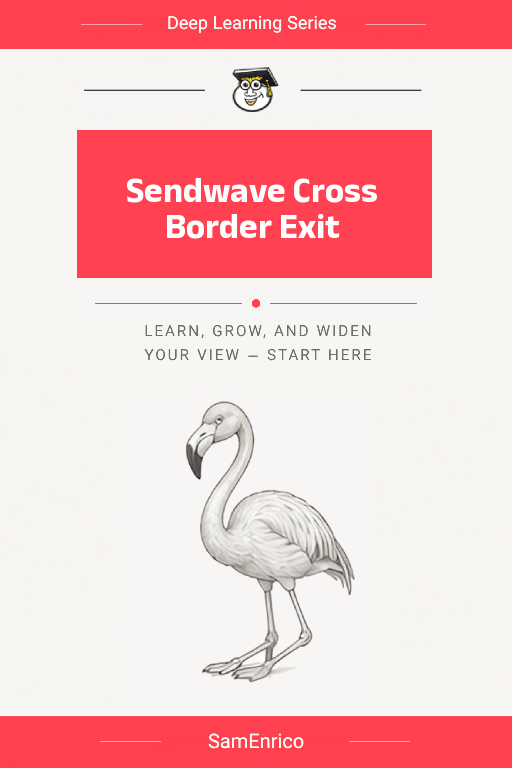
Sendwave Cross Border Exit
Target diaspora payment acquirers using Sendwave's
by Damron Audie
Target diaspora payment acquirers using Sendwave's Canadian acquisition of UK remittance player WorldRemit.
Formats
About this book
Free sample
Chapter 1: The $500M Text Message...--The year is 2014, and a twenty-something Harvard graduate named Lincoln Quirk is standing in a crowded Y Combinator demo day in Mountain View, California. He has sixty seconds to convince a room full of Silicon Valley’s most skeptical investors that sending money by text message is not only possible but inevitable. The audience has already seen dozens of pitches that day—crypto wallets, peer-to-peer lending apps, social trading platforms—and their patience is wearing thin. Quirk pulls out his phone, types a message, and hits send. In less than thirty seconds, a woman in Dakar, Senegal receives the equivalent of $20 on her mobile phone.
The room goes quiet. Then, someone in the back row whispers, “How did you do that?”That moment was the beginning of a journey that would end six years later in a $500 million acquisition. But the story of Sendwave is not just a fintech success tale. It is a blueprint for a much larger opportunity—one that most Canadian payment companies have completely missed, and one that is sitting right now in the basements of Brampton, the storefronts of Surrey, and the churches of Toronto.The Problem That Everyone Else Ignored To understand why Sendwave mattered, you first have to understand the world of cross-border remittances before 2014. For decades, sending money from one country to another was an expensive, slow, and frustrating experience.
If a Ghanaian nurse working in the Bronx wanted to send 100tohermotherin Accra,shehadthreeoptions.Thefirstwas Western Unionor Money Gram,whichchargedfeesbetween7and12percentofthetransferamount,plusafixedfeethatcouldeatupanother100 to her mother in Accra, she had three options. The first was Western Union or Money Gram, which charged fees between 7 and 12 percent of the transfer amount, plus a fixed fee that could eat up another 100tohermotherin Accra,shehadthreeoptions.Thefirstwas Western Unionor Money Gram,whichchargedfeesbetween7and12percentofthetransferamount,plusafixedfeethatcouldeatupanother5 to 10.Thesecondwasabankwire,whichcost10. The second was a bank wire, which cost 10.Thesecondwasabankwire,whichcost35 to $50 and took three to five business days to clear. The third was informal—handing cash to a trusted community member who was traveling home, a system that required no fees but carried significant risk of theft or loss.According to World Bank data, the average…
This is the end of the free sample. Get the eBook to keep going. Buy now
Contents
- Chapter 1
- Chapter 2
- Chapter 3
- Chapter 4
- Chapter 5
- Chapter 6
- Chapter 7
- Chapter 8
- Chapter 9
- Chapter 10
- Chapter 11
- Chapter 12
Details
- Author
- Damron Audie
- Publisher
- SamEnrico
- Language
- English
- Genre
- Non-Fiction, Business Brief
- Released
- 2026-06-01
- Pages (approx.)
- 143
- Available as
- eBook, Audiobook

Read better in the ZLOADR app
Your eBooks on your phone or tablet. Sign in with your SamEnrico account and start reading.
More by Damron Audie
 Teen Depression HandbookDamron Audie$11.99
 Citation Rules for Retracted Articles CourseDamron Audie$11.99
 Essay Exam Writing GuideDamron Audie$11.99
 Career Transition for Healthcare WorkersDamron Audie$11.99
 Chuck Yeager BiographyDamron Audie$11.99
 Financial Independence Without HustleDamron Audie$11.99
 Twelve Step Recovery Foundations GuideDamron Audie$11.99
 Sherman Tank Modifications for NormandyDamron Audie$11.99
 Disappointment In BodyDamron Audie$11.99
 The Phantom of the Grand Palais: The Haunting Legacy of Black BallerinasDamron Audie$11.99
 The Silk and the Steel: How a Spy’s Love Betrayed a NationDamron Audie$11.99
 Steel and Shadows: The Collapse of the I-35W Mississippi River BridgeDamron Audie$11.99
You may also like
 Hong Kong Handover 1997Dunn Johnnie$11.99
 Zumba For Postnatal Recovery CourseNeal Christian$11.99
 Zumba for BeginnersLadner Nikia$11.99
 YouTube Comment Mining GuideHumes Pandora$12.99
 Worry Box MeditationCarlin Rudy$11.99
 Workplace Stress MeditationNguyen Lynn$11.99
 Workplace Stress and Sleep RepairHawley Ivory$11.99
 Workplace Perfectionism CureDelaney Jeffry$11.99
 Workplace Injustice Anger GuideWallen Isabelle$11.99
 Work Addiction and Burnout LinkGreenwood Ester$11.99
 Women in Yoga and WellnessBeattie Galina$11.99
 Women in Stand Up ComedyChun Evangeline$11.99