
Non-FictionSelf-HelpValidation
Self Validate Emotion Guide eBook
Acknowledge your feelings as understandable withou
Acknowledge your feelings as understandable without judgment.
Formats
Free sample
Chapter 1: The Judgment Reflex...--–- You are about to do something that no animal on earth has ever done. In the next sixty seconds, you will feel an emotion—perhaps annoyance at this sentence, or curiosity, or even a flicker of impatience—and then, almost instantly, you will judge yourself for feeling it. That second step, the judgment, is uniquely human. A dog does not feel guilty for feeling afraid. A bird does not criticize itself for feeling irritable.
But you, like nearly every adult human, have been trained to treat your own inner weather as either morally good or morally bad. This chapter is about why you learned that reflex, why it is destroying your ability to think clearly, and how to take the first, most radical step toward self-validation: simply noticing the judgment without acting on it.The Unconscious Habit That Runs Your Life Let us begin with a simple experiment. Read the following list of emotions and notice what happens in your body and mind as you read each word: anger, sadness, fear, jealousy, shame. Now read this second list: happiness, calm, excitement, pride, relief. If you are like most people, the first list triggered a subtle tightening somewhere—perhaps in your jaw, your chest, or your stomach—accompanied by a quiet internal phrase like “those are bad” or “I shouldn’t feel those.” The second list likely produced a small sensation of expansion or relief.
You might have thought, “Those are good. Those are allowed.”What you just experienced is what this book calls the Judgment Reflex. It is the automatic, unconscious habit of categorizing your own emotional states into “acceptable” and “unacceptable” before you have even had time to fully feel them. This reflex is so fast, so deeply practiced, that most people never notice it at all. They go directly from feeling something to criticizing themselves for feeling it, bypassing the crucial middle step where validation could occur.Consider a common scenario.
You are at work, and a colleague receives praise that you believe you deserved. Within seconds, you feel a flash of jealousy. But you do not simply feel jealous. Almost simultaneously, a second voice says, “That’s awful. You shouldn’t be jealous.
You’re supposed to be happy for others. What is wrong with you?” By the time you have taken three breaths, you have moved from a simple feeling (jealousy) to a moral indictment (I am a bad person for feeling this). The original feeling was uncomfortable but manageable. The indictment is heavy, sticky, and exhausting.This book is built on a single, uncompromising premise: your feelings are never wrong. They can be uncomfortable, inconvenient, disproportionate, or confusing.
But they are never morally wrong. The Judgment Reflex tells you otherwise. It tells you that anger is bad, that sadness is weak, that fear is cowardly, that jealousy is ugly. And because you believe this reflex, you spend enormous energy trying not to feel what you actually feel. That energy is stolen from living, from loving, from working, from resting.The Social Origins of Emotional Shame Where does the Judgment Reflex come from?
The answer is not biology but conditioning. Infants do not judge their own crying. Toddlers do not feel ashamed of their own tantrums. The reflex is taught, and it is taught so thoroughly that by adulthood it feels like truth rather than training.From the earliest age, most children receive explicit and implicit messages about which emotions are permissible. “Don’t cry” is a common instruction to a sad child.
“Calm down” to an angry one. “There’s nothing to be afraid of” to a frightened one. “Don’t be jealous” to a child who wants what another has. Each of these statements, however well-intentioned, delivers the same underlying message: your feeling is wrong, and you should not be having it.Over time, these external instructions become internalized. The parent who said “don’t cry” becomes the adult who says “I shouldn’t be sad.” The teacher who said “calm down” becomes the adult who says “I’m weak for being angry.” The culture that valorizes positivity and productivity becomes the internal voice that dismisses grief, exhaustion, and fear as failures of character.This internalization is not merely psychological.
It is physiological. The Judgment Reflex becomes wired into your nervous system through repetition. Every time you suppress a feeling and criticize yourself for having it, you strengthen the neural pathway that makes suppression and self-criticism your default response. Conversely, every time you allow yourself to feel without judgment, you weaken that pathway and strengthen a new one: the pathway of self-validation.But before we can build that new pathway, we must understand exactly what the Judgment Reflex costs you.The Neuroscience of Suppression: Why Judging Your Feelings Backfires For decades, neuroscientists have studied what happens when people suppress their emotions. The findings are unambiguous: suppression does not work, and it actively harms cognitive function.When you feel an emotion, your amygdala—an ancient, almond-shaped structure deep in the brain—activates.
The amygdala’s job is to detect threats and opportunities, and it does not care about social niceties or moral judgments. It simply sounds the alarm. In a healthy response, that alarm signals the prefrontal cortex (the rational, planning part of the brain) to assess the situation and respond appropriately.However, when the Judgment Reflex kicks in, something different happens. Instead of the amygdala signaling the prefrontal cortex, the prefrontal cortex becomes occupied with a different task: suppressing the amygdala’s signal. You tell yourself “I shouldn’t feel this,” and your brain obediently tries to shut down the feeling.
But suppression is metabolically expensive. It requires sustained prefrontal cortex activation to inhibit the limbic system. While your prefrontal cortex is busy suppressing, it has fewer resources available for problem-solving, learning, memory, and emotional regulation.This is why, after a day of “keeping it together” at work or “being strong” for your family, you feel exhausted even though you did not obviously exert yourself. You were exerting yourself—invisibly, continuously, against your own biology.Worse, suppression does not actually eliminate the emotion. It drives it underground, where it often intensifies or finds indirect expression.
Research on thought suppression (the famous “white bear” studies) shows that trying not to think about something makes you think about it more. The same is true for emotions. Trying not to feel angry makes anger more likely to erupt later, often disproportionately, at an undeserving target. Trying not to feel sad makes sadness linger longer, untreated.The Judgment Reflex also impairs learning. Emotions contain data—information about your relationship to your environment.
Fear tells you that you perceive a threat. Anger tells you that a boundary has been crossed. Sadness tells you that something of value has been lost. When you judge these feelings as bad and suppress them, you also suppress the data they carry. You lose the opportunity to learn what is threatening you, where your boundaries are, or what you have lost and still grieve.In short, the Judgment Reflex is not a tool for emotional health.
It is a bug—a well-intentioned but destructive piece of mental software that you were taught to install and that you…
This is the end of the free sample. Get the eBook to keep going. Buy now
About this book
Details
- Author
- Hamrick Clementina
- Publisher
- SamEnrico
- Language
- English
- Genre
- Non-Fiction, Self-Help, Validation
- Released
- 2026-06-09
- Pages (approx.)
- 143
- Available as
- eBook, Audiobook

Read better in the ZLOADR app
Your eBooks on your phone or tablet. Sign in with your SamEnrico account and start reading.
More by Hamrick Clementina
 Antwerp Heist NovelizationHamrick Clementina$11.99
 Breath Meditation For MusiciansHamrick Clementina$11.99
 Barber Who Mentored YouthHamrick Clementina$11.99
 Pelvic Floor Pregnancy WorkoutHamrick Clementina$11.99
 The Entrepreneur Priority MatrixHamrick Clementina$11.99
 Stardust Heist MastermindHamrick Clementina$11.99
 Pomodoro For Social Media DetoxHamrick Clementina$11.99
 Frostborn: The Curse of the Troll KingHamrick Clementina$11.99
 The Lioness of Zulu: Shaka’s Warrior Queen and the Birth of a NationHamrick Clementina$11.99
 10 Ways to Use Tabil (Recipe Book)Hamrick Clementina$11.99
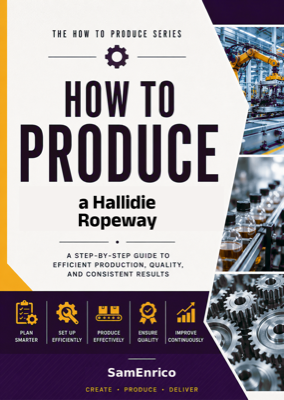 How to Produce a Hallidie RopewayHamrick Clementina$11.99
 Citation for Multilingual SourcesHamrick Clementina$12.99
You may also like
 Hong Kong Handover 1997Dunn Johnnie$11.99
 Zumba For Postnatal Recovery CourseNeal Christian$11.99
 Zumba for BeginnersLadner Nikia$11.99
 YouTube Comment Mining GuideHumes Pandora$12.99
 Worry Box MeditationCarlin Rudy$11.99
 Workplace Stress MeditationNguyen Lynn$11.99
 Workplace Stress and Sleep RepairHawley Ivory$11.99
 Workplace Perfectionism CureDelaney Jeffry$11.99
 Workplace Injustice Anger GuideWallen Isabelle$11.99
 Work Addiction and Burnout LinkGreenwood Ester$11.99
 Women in Yoga and WellnessBeattie Galina$11.99
 Women in Stand Up ComedyChun Evangeline$11.99