
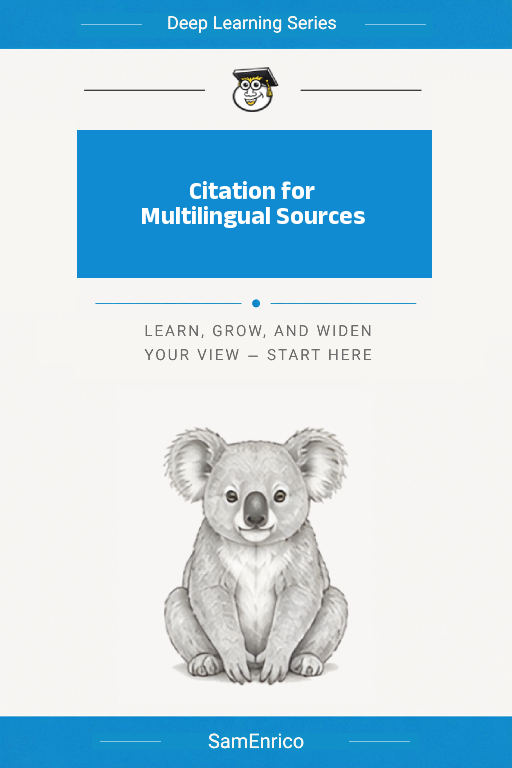
Non-FictionStudent's ShortcutMultilingual
Citation for Multilingual Sources
Cite sources in foreign languages with translation
Cite sources in foreign languages with translations and original scripts.
Formats
About this book
Free sample
Chapter 1: The Korean Report--The email arrived at 11:47 PM on a Tuesday, and Sarah Kim would remember the exact timestamp for the rest of her career.“Dear Ms. Kim,” it began, in the bloodless font of official academic correspondence. “Your dissertation committee has received a concern regarding the authenticity of the sources cited in Chapter 4 of your manuscript. Specifically, the Korean government report cited as ‘Ministry of Unification (2019)’ appears to contain passages that do not appear in the publicly available version of that document. You are requested to appear before the Committee on Academic Integrity on Friday, October 12, at 9:00 AM, to explain your citation practices.”Sarah closed her laptop.
Then she opened it again. Then she closed it. Then she opened her apartment door and threw up in the hallway.She was a fifth-year Ph D candidate in political science at a top-tier American university. Her dissertation examined cross-border economic cooperation between North and South Korea. She spoke zero Korean.
She had never claimed otherwise. But her fourth chapter relied heavily on data from a 2019 white paper published by the South Korean Ministry of Unification—a document she had accessed through an English-language summary posted on a Seoul-based research institute’s website. She had cited the Ministry as the author, the English summary as the source, and had never looked at the original Hangul document.Now someone—a rival? A meticulous peer reviewer? A committee member with native Korean fluency?—had discovered that the English summary contained a statistical error.
The error was not Sarah’s fault. But the citation was. She had cited a document she had never read, in a language she could not read, and had presented it as if she had gone to the source itself.This is the nightmare that every multilingual scholar fears. And this chapter is about how to survive it—not by learning fourteen languages, but by understanding the single most important question in multilingual citation:What does it actually mean to “cite” a source you cannot read?The Verifiability Principle Let us begin with a foundational truth that most style guides dance around but never state directly…
This is the end of the free sample. Get the eBook to keep going. Buy now
Contents
- Chapter 1
- Chapter 2
- Chapter 3
- Chapter 4
- Chapter 5
- Chapter 6
- Chapter 7
- Chapter 8
- Chapter 9
- Chapter 10
- Chapter 11
- Chapter 12
Details
- Author
- Hamrick Clementina
- Publisher
- SamEnrico
- Language
- English
- Genre
- Non-Fiction, Student's Shortcut, Multilingual
- Released
- 2026-06-01
- Pages (approx.)
- 135
- Available as
- eBook, Audiobook

Read better in the ZLOADR app
Your eBooks on your phone or tablet. Sign in with your SamEnrico account and start reading.
More by Hamrick Clementina
 Antwerp Heist NovelizationHamrick Clementina$11.99
 Self Validate Emotion GuideHamrick Clementina$11.99
 Breath Meditation For MusiciansHamrick Clementina$11.99
 Barber Who Mentored YouthHamrick Clementina$11.99
 Pelvic Floor Pregnancy WorkoutHamrick Clementina$11.99
 The Entrepreneur Priority MatrixHamrick Clementina$11.99
 Stardust Heist MastermindHamrick Clementina$11.99
 Pomodoro For Social Media DetoxHamrick Clementina$11.99
 Frostborn: The Curse of the Troll KingHamrick Clementina$11.99
 The Lioness of Zulu: Shaka’s Warrior Queen and the Birth of a NationHamrick Clementina$11.99
 10 Ways to Use Tabil (Recipe Book)Hamrick Clementina$11.99
 How to Produce a Hallidie RopewayHamrick Clementina$11.99
You may also like
 Hong Kong Handover 1997Dunn Johnnie$11.99
 Zumba For Postnatal Recovery CourseNeal Christian$11.99
 Zumba for BeginnersLadner Nikia$11.99
 YouTube Comment Mining GuideHumes Pandora$12.99
 Worry Box MeditationCarlin Rudy$11.99
 Workplace Stress MeditationNguyen Lynn$11.99
 Workplace Stress and Sleep RepairHawley Ivory$11.99
 Workplace Perfectionism CureDelaney Jeffry$11.99
 Workplace Injustice Anger GuideWallen Isabelle$11.99
 Work Addiction and Burnout LinkGreenwood Ester$11.99
 Women in Yoga and WellnessBeattie Galina$11.99
 Women in Stand Up ComedyChun Evangeline$11.99