
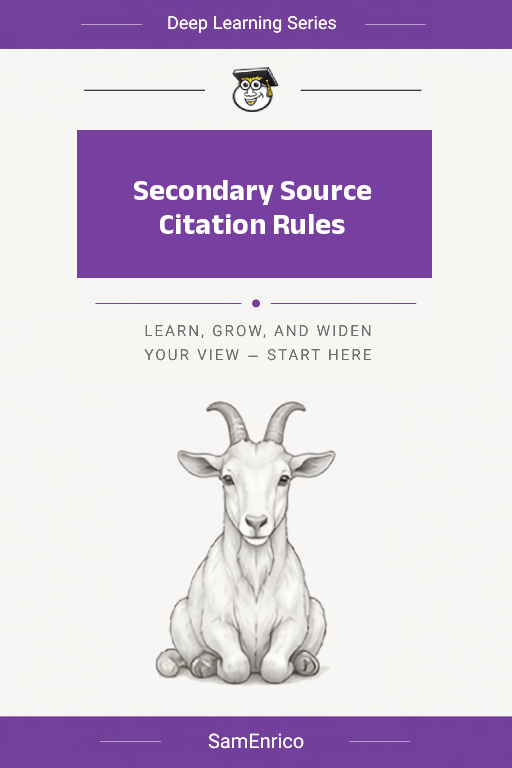
Secondary Source Citation Rules Audiobook
Cite a source cited within another source without
by Strauss Asha
Cite a source cited within another source without confusing readers.
Formats
Free sample
Chapter 1: The Telephone Game...--–- In 2018, a tenured political scientist named Dr. Elena Vasquez submitted what she believed was the crowning achievement of her career: a 40-page manuscript arguing that voter turnout in midwestern swing states followed a predictable psychological pattern first described in a 1975 study by researchers at the University of Michigan. Her argument was elegant, her data was meticulous, and her citations were flawless—or so she thought. The journal's peer reviewers returned with a verdict that was not rejection but something far worse: a formal inquiry into academic misconduct. Dr.
Vasquez had not fabricated data. She had not plagiarized. She had simply cited a study that another study had cited. And the original 1975 paper, when the journal's fact-checkers finally located a physical copy in a university archive, said almost the exact opposite of what Dr. Vasquez had claimed.
The error was not hers alone—the secondary source she had trusted had misrepresented the original. But the journal did not care. The retraction notice, published eighteen months later, named Dr. Vasquez as the sole author responsible. Her university's promotion committee delayed her advancement by three years.
And in the world of political science, her name became a quiet warning whispered in graduate seminars: Don't pull a Vasquez.This is the telephone game played for academic blood. And it happens far more often than anyone wants to admit.The Problem That Has No Name (But Should)Every writer who has ever opened a textbook, a scholarly article, or even a well-researched blog post has encountered the secondary source. It is the quotation within a quotation. The study mentioned in passing. The statistic that appears in one book but originally came from another.
The famous line from a speech that you read not in the original transcript but in a biography. Secondary sources are everywhere because they are necessary. No single person can read every original document, every archival letter, every foreign-language study, every out-of-print monograph. We rely on others to summarize, quote, and contextualize the work that came before us.But here is the uncomfortable truth that no style guide will say aloud: every time you use a secondary source, you are trusting a stranger with your reputation.Think about what actually happens when you cite Smith (2020) for a claim that Smith attributed to Jones (1975). You have not read Jones.
You do not know if Jones actually wrote those words. You do not know if Jones was being sarcastic, tentative…
This is the end of the free sample. Get the Audiobook to keep going. Buy now
About this book
Details
- Author
- Strauss Asha
- Publisher
- SamEnrico
- Language
- English
- Genre
- Non-Fiction, Student's Shortcut
- Released
- 2026-05-30
- Pages (approx.)
- 158
- Available as
- eBook, Audiobook

Listen in the VoxFlicks app
Audiobooks and audio dramas wherever you go. Sign in with your SamEnrico account and press play.
More by Strauss Asha
 Pain Point Prioritization GuideStrauss Asha$11.99
 Thunberg vs World LeadersStrauss Asha$11.99
 Special Teams Excellence GuideStrauss Asha$11.99
 Manager Stress Detection GuideStrauss Asha$11.99
 The Imposter Teen FixStrauss Asha$11.99
 Discussing Miscarriage With PartnerStrauss Asha$11.99
 George McGovernStrauss Asha$11.99
 Habit Mistakes GuideStrauss Asha$11.99
 Caregiver Burnout ReliefStrauss Asha$11.99
 The Last Blockbuster: A Reel of ResilienceStrauss Asha$11.99
 The Alchemists' Feast: A Scientific Revolution BanquetStrauss Asha$11.99
 Andreas Vesalius: The Rebel Anatomist Who Redrew the Human BodyStrauss Asha$11.99
You may also like
 Hong Kong Handover 1997Dunn Johnnie$11.99
 Zumba For Postnatal Recovery CourseNeal Christian$11.99
 Zumba for BeginnersLadner Nikia$11.99
 YouTube Comment Mining GuideHumes Pandora$12.99
 Worry Box MeditationCarlin Rudy$11.99
 Workplace Stress MeditationNguyen Lynn$11.99
 Workplace Stress and Sleep RepairHawley Ivory$11.99
 Workplace Perfectionism CureDelaney Jeffry$11.99
 Workplace Injustice Anger GuideWallen Isabelle$11.99
 Work Addiction and Burnout LinkGreenwood Ester$11.99
 Women in Yoga and WellnessBeattie Galina$11.99
 Women in Stand Up ComedyChun Evangeline$11.99