
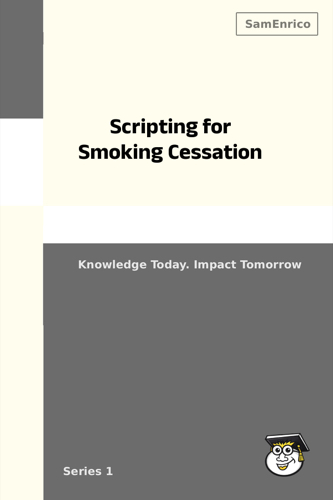
Scripting for Smoking Cessation eBook
Trance scripts to quit cigarettes.
by Song Maida
Trance scripts to quit cigarettes.
Formats
Free sample
Chapter 1: The Smoker’s Prison--–- Every smoker believes they choose each cigarette. You reach for the pack, you pull one out, you light it, you inhale. It feels like a decision. But beneath that conscious action lies a biological trap so elegant, so perfectly designed, that your brain has been fooled into wanting the very thing that is slowly killing you. This chapter is not a lecture about lung cancer or yellow teeth.
You have heard those warnings before, and they did not work. Instead, this chapter is an autopsy of the smoker’s prison—the neurological, psychological, and emotional architecture that keeps your hand reaching for the pack even when your mind screams “stop.” By the time you finish reading, you will understand why willpower alone has failed you, why hypnosis is uniquely suited to dismantle this prison, and why the key to freedom has been hidden not in your conscious mind but deep within the subconscious circuits you never knew were running the show.The Myth of Choice Let us begin with a question that will disturb you. If smoking is a choice, why have you made that same choice thousands of times even though you genuinely want to stop? A real choice implies alternatives. It implies that on any given Tuesday afternoon, you could just as easily choose a walk, a glass of water, or a deep breath.
Yet when the craving arrives, the range of options collapses to one. You smoke. Not because you are weak. Not because you lack character. But because the part of your brain that makes decisions—the prefrontal cortex—has been outvoted by a deeper, older, faster system that does not care about your lungs, your wallet, or your New Year’s resolution.This is the first truth that separates successful quitters from those who relapse repeatedly: smoking is not a bad habit.
It is a hijacking. And you cannot negotiate with a hijacker using the same logic that allowed the hijacking in the first place.Consider the numbers. Nicotine reaches your brain within seven seconds of inhalation—faster than heroin injected into a vein. It slips through the blood-brain barrier and fits into receptors designed for a natural neurotransmitter called acetylcholine. But nicotine does not just fit; it overstimulates.
It floods your brain’s reward circuitry with dopamine at levels three to five times higher than natural rewards like food, sex, or social connection. That flood feels good. But here is the cruel design: the brain, seeking homeostasis, responds by reducing its own dopamine production and eliminating some of those receptor sites. Now you need nicotine just to feel normal. Without it, you feel irritable, anxious, foggy, and hollow.
The cigarette no longer gives you pleasure. It merely relieves the very discomfort that its absence creates. That is not a choice. That is a chemical dependency camouflaged as a ritual.The Limbic Hijack Explained To understand why hypnosis works when willpower fails, you must meet the three key players in your brain: the prefrontal cortex, the nucleus accumbens, and the amygdala. Think of them as a CEO, an impulsive teenager, and a security guard with a hair trigger.Your prefrontal cortex (PFC) sits just behind your forehead.
It is the CEO. It plans for the future, delays gratification, understands that lung cancer is bad, and calculates that saving money for a vacation is smarter than burning it in an ashtray. The PFC is rational, patient, and exhausted. Every time you resist a cigarette, your PFC is doing heavy lifting. But it tires quickly, especially under stress, hunger, or fatigue.The nucleus accumbens (NAcc) is the impulsive teenager.
It is your brain’s reward center. It cares about right now. It wants pleasure and avoids pain. Every time you smoke, the NAcc releases dopamine and your brain learns: smoking = good. The NAcc does not understand “tomorrow.” It does not understand “cancer.” It understands only the immediate chemical signal.
And because nicotine triggers a larger dopamine surge than almost any natural reward, the NAcc learns very fast and forgets very slowly.The amygdala is the security guard. Its job is threat detection. When you try to quit, the amygdala interprets nicotine withdrawal as a threat—not because withdrawal is dangerous, but because the brain has been conditioned to believe that the absence of nicotine is an emergency. The amygdala triggers anxiety, irritability, and craving. Its goal is simple: make you uncomfortable enough to smoke again so the threat (withdrawal) goes away.Here is the devastating reality.
The amygdala and the NAcc operate in milliseconds. The prefrontal cortex operates in seconds. By the time your CEO has said, “Wait, we decided to quit,” the teenager and the security guard have already lit the cigarette. That is the limbic hijack. And it is why telling a smoker to “just use willpower” is like telling someone drowning to “just breathe harder.” The problem is not effort.
The problem is that the system controlling the response is deeper, faster, and more powerful than the system trying to override it.The Conscious Willpower Trap We need to be absolutely clear about willpower, because the self-help industry has done enormous damage by implying that if you fail to quit, you simply did not want it enough. That is cruelty disguised as motivation. Willpower is a limited resource. Psychological studies dating back to Baumeister’s work on ego depletion show that acts of self-control draw from a shared reservoir. Resist a cigarette in the morning, and you have less resistance available for the afternoon craving.
Resist the afternoon craving, and by evening, your PFC is exhausted. The teenager and the security guard take over. You smoke. Then you feel shame. Then you conclude you are weak.
Then you smoke more to escape the shame.This cycle is not a character flaw. It is neurobiology.Willpower also fails because it operates in the wrong domain. Willpower works well for discrete, time-limited challenges: hold your breath for thirty seconds, do not eat that cookie for five minutes, finish this report before lunch. But smoking cessation is not discrete. It is a constant, low-grade war fought across hundreds of triggers per day—morning coffee, phone calls, traffic jams, arguments, boredom, celebration, and the thousand other moments when your hand automatically reaches for a pack.
Willpower cannot win a war of attrition against a trigger-rich environment. It was never designed to.Yet we must be careful not to throw willpower out entirely. There is a role for conscious effort, but it is a supporting role, not the lead. Willpower is for the first three days of rehearsal—the conscious repetition of new behaviors until they begin to feel automatic. Willpower is for showing up to a hypnosis session.
Willpower is for pressing play on the audio script even when you do not feel like it. But the heavy lifting—the dismantling of the craving circuit itself—cannot be done by willpower. That requires access to the subconscious. That requires hypnosis.Why the Subconscious Remembers What You Want to Forget Here is the second truth that changes everything. Even after you quit, your subconscious mind retains the complete memory of smoking—not as a story but as…
This is the end of the free sample. Get the eBook to keep going. Buy now
About this book
Details
- Author
- Song Maida
- Publisher
- SamEnrico
- Language
- English
- Genre
- Non-Fiction, Self-Help, Smoking
- Released
- 2026-06-06
- Pages (approx.)
- 137
- Available as
- eBook, Audiobook

Read better in the ZLOADR app
Your eBooks on your phone or tablet. Sign in with your SamEnrico account and start reading.
More by Song Maida
 Home Renovation Couple StressSong Maida$11.99
 Bob Dylan Rolling Stone StorySong Maida$11.99
 Job Search Routine GuideSong Maida$11.99
 Meeting Break Timer ProtocolSong Maida$11.99
 Personal Branding for Fitness ProsSong Maida$11.99
 House Majority Whip OperationsSong Maida$11.99
 Time Blocking for Night OwlsSong Maida$11.99
 The Emperor's Waltz: Franz Joseph and the Golden Age of ViennaSong Maida$11.99
 The Vanishing of Princess Sita: A Custody War Across BordersSong Maida$11.99
 Aggregatum Group Shallot: Harvesting, Curing & Storage GuideSong Maida$11.99
 How to Produce Dj CD PlayersSong Maida$11.99
 How to Become a Hat-forming-machine OperatorSong Maida$11.99
You may also like
 Hong Kong Handover 1997Dunn Johnnie$11.99
 Zumba For Postnatal Recovery CourseNeal Christian$11.99
 Zumba for BeginnersLadner Nikia$11.99
 YouTube Comment Mining GuideHumes Pandora$12.99
 Worry Box MeditationCarlin Rudy$11.99
 Workplace Stress MeditationNguyen Lynn$11.99
 Workplace Stress and Sleep RepairHawley Ivory$11.99
 Workplace Perfectionism CureDelaney Jeffry$11.99
 Workplace Injustice Anger GuideWallen Isabelle$11.99
 Work Addiction and Burnout LinkGreenwood Ester$11.99
 Women in Yoga and WellnessBeattie Galina$11.99
 Women in Stand Up ComedyChun Evangeline$11.99