
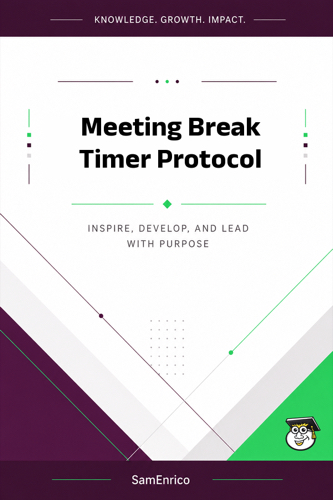
Non-FictionBusiness BriefWellbeing
Meeting Break Timer Protocol
Take a 5-minute break every 90 minutes of meetings
by Song Maida
Take a 5-minute break every 90 minutes of meetings to maintain attention.
Formats
About this book
Free sample
Chapter 1: The Attention Graveyard--–- In a midtown Manhattan conference room on a Tuesday afternoon, fourteen highly paid knowledge workers sat trapped in the third hour of a quarterly strategy review. The agenda promised “breakthrough decisions.” The reality was different. By minute 170, three people were silently checking email under the table, two were doodling, one had visibly stopped blinking, and the CEO—who had called the meeting—was reading the same pie chart for the fourth time. When the facilitator finally asked, “Does anyone have any objections to the proposed marketing shift?” every single person nodded yes. Not because they agreed.
Because they were too exhausted to disagree. The decision was made, documented, and then, two weeks later, quietly reversed at a cost of $47,000 in wasted work.No one in that room was lazy. No one was incompetent. They were simply human. And their humanity had run headlong into a myth—the myth that marathon meetings produce marathon results.This book exists because that myth is bankrupting our attention, degrading our decisions, and burning out our workforce one unnecessary 90-minute block at a time.
But before we can fix the problem, we have to name it. And the name is this: we have built a meeting culture that treats the human brain as if it were a hard drive—always on, endlessly available, and infinitely capable of switching tasks without penalty. The science says otherwise. And the science is merciless.The Industrial Hangover To understand why we meet the way we meet, we have to go back to a factory floor in 1911. Frederick Winslow Taylor, the father of scientific management, published The Principles of Scientific Management, and with it, he gave birth to an idea that has never quite died: that work is a linear, physical process where longer hours equal more output.
In a steel mill, this was true. If a worker pushed a lever for ten hours instead of eight, ten percent more steel was produced. The body was the bottleneck. Fatigue was simply a matter of muscle endurance.But knowledge work is not steel production. Knowledge work runs…
This is the end of the free sample. Get the eBook to keep going. Buy now
Contents
- Chapter 1
- Chapter 2
- Chapter 3
- Chapter 4
- Chapter 5
- Chapter 6
- Chapter 7
- Chapter 8
- Chapter 9
- Chapter 10
- Chapter 11
- Chapter 12
Details
- Author
- Song Maida
- Publisher
- SamEnrico
- Language
- English
- Genre
- Non-Fiction, Business Brief, Wellbeing
- Released
- 2026-06-07
- Pages (approx.)
- 104
- Available as
- eBook, Audiobook

Read better in the ZLOADR app
Your eBooks on your phone or tablet. Sign in with your SamEnrico account and start reading.
More by Song Maida
 Home Renovation Couple StressSong Maida$11.99
 Bob Dylan Rolling Stone StorySong Maida$11.99
 Job Search Routine GuideSong Maida$11.99
 Personal Branding for Fitness ProsSong Maida$11.99
 Scripting for Smoking CessationSong Maida$11.99
 House Majority Whip OperationsSong Maida$11.99
 Time Blocking for Night OwlsSong Maida$11.99
 The Emperor's Waltz: Franz Joseph and the Golden Age of ViennaSong Maida$11.99
 The Vanishing of Princess Sita: A Custody War Across BordersSong Maida$11.99
 Aggregatum Group Shallot: Harvesting, Curing & Storage GuideSong Maida$11.99
 How to Produce Dj CD PlayersSong Maida$11.99
 How to Become a Hat-forming-machine OperatorSong Maida$11.99
You may also like
 Hong Kong Handover 1997Dunn Johnnie$11.99
 Zumba For Postnatal Recovery CourseNeal Christian$11.99
 Zumba for BeginnersLadner Nikia$11.99
 YouTube Comment Mining GuideHumes Pandora$12.99
 Worry Box MeditationCarlin Rudy$11.99
 Workplace Stress MeditationNguyen Lynn$11.99
 Workplace Stress and Sleep RepairHawley Ivory$11.99
 Workplace Perfectionism CureDelaney Jeffry$11.99
 Workplace Injustice Anger GuideWallen Isabelle$11.99
 Work Addiction and Burnout LinkGreenwood Ester$11.99
 Women in Yoga and WellnessBeattie Galina$11.99
 Women in Stand Up ComedyChun Evangeline$11.99