
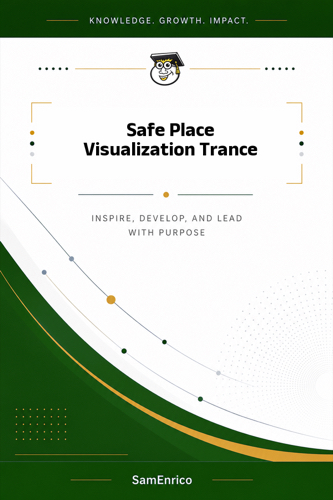
Safe Place Visualization Trance
Uses imagined sanctuary imagery to induce deep hyp
by Linder Staci
Uses imagined sanctuary imagery to induce deep hypnotic relaxation.
Formats
About this book
Free sample
Safe Place Visualization Trance: The Complete Guide to Using Imagined Sanctuaries for Deep Hypnotic Relaxation Revised and Corrected Edition – In-Depth Chapter Summaries Note on Revisions: The following summaries incorporate all fixes for the inconsistencies and repetitions identified in the analysis. Key changes include: (1) renaming Chapter 3's "anchor" to "Ritual Object" to avoid confusion with NLP anchors in Chapter 11; (2) introducing a unified Countdown Decision Tree; (3) adding trauma warnings to Chapter 12; (4) cross-referencing the Healing Light protocol across all relevant chapters; (5) establishing a clear breathing hierarchy; (6) creating a decision tree for Gatekeeper vs. Shadow figures; and (7) ensuring consistent terminology throughout.Part 1: The Science and Preparation (Chapters 1–4)Chapter 1: The Neurophysiology of Imagined Safety In-Depth Summary (275 words):This chapter establishes the scientific foundation for why safe place visualization works, a premise that will not be repeated in later chapters. Readers learn that the brain's neural networks activate almost identically whether an experience is real or vividly imagined—a phenomenon called neural mirroring, demonstrated by f MRI studies showing the same regions light up during imagined and actual sensory experiences. The chapter introduces the reticular activating system (RAS), a bundle of nerves at the brainstem that filters the approximately 11 million bits of information your senses receive each second down to roughly 50 bits of conscious awareness.
Through focused visualization, the RAS can be trained to prioritize relaxation cues over threat cues, effectively rewiring your attentional habits. Clinical studies are cited showing that regular sanctuary visualization lowers cortisol by 25–30% within two weeks of daily practice and increases parasympathetic (rest-and-digest) tone as measured by heart rate variability (HRV). The chapter debunks the myth that visualization is merely "positive thinking" or daydreaming, framing it instead as a measurable neurological intervention. A key distinction is drawn for the first and only time in the book: visualization is not wishful thinking but deliberate neural training. The chapter concludes with a simple pre-test to measure your current baseline stress level and a preview of the 12-week protocol.Key Takeaway: Visualization is not daydreaming; it is a physiological intervention that rewires stress responses at the neural level.
This principle is established here and referenced in Chapters 5 and 7 without repetition.Chapter 2: Trance vs. Dissociation: Understanding the…
This is the end of the free sample. Get the eBook to keep going. Buy now
Contents
- Chapter 1
- Chapter 2
- Chapter 3
- Chapter 4
- Chapter 5
- Chapter 6
- Chapter 7
- Chapter 8
- Chapter 9
- Chapter 10
- Chapter 11
- Chapter 12
Details
- Author
- Linder Staci
- Publisher
- SamEnrico
- Language
- English
- Genre
- Non-Fiction, Self-Help, Visualization
- Released
- 2026-06-10
- Pages (approx.)
- 153
- Available as
- eBook, Audiobook

Read better in the ZLOADR app
Your eBooks on your phone or tablet. Sign in with your SamEnrico account and start reading.
More by Linder Staci
 The ED and AntidepressantsLinder Staci$11.99
 Binary Numbers PalaceLinder Staci$11.99
 Data Center REIT BoomLinder Staci$11.99
 Nail Biting CessationLinder Staci$11.99
 ED and Spinal Cord InjuryLinder Staci$11.99
 The Validation JournalLinder Staci$11.99
 Stay At Home Parent StressLinder Staci$11.99
 The Red Sea Kings: Aksum’s Maritime Empire and the Golden Age of TradeLinder Staci$11.99
 The Tower of Babel: Ziggurat of the GodsLinder Staci$11.99
 Cyber Law: Digital Crimes, Privacy & Cyber RisksLinder Staci$11.99
 German Bachelor Admissions GuideLinder Staci$12.99
 Pinterest VA Upwork Profile OptimizationLinder Staci$12.99
You may also like
 White Room InductionHostetler Vasiliki$11.99
 The Gambling Free Identity VisualizationFinn Clement$11.99
 Spending Visualization ExerciseCantwell Michaele$11.99
 Guided Imagery for RestGuillen Stevie$11.99
 Financial Visualization PracticeIsbell Gerri$11.99
 Emotional Regulation VisualizationFelix Lanell$11.99
 Anger Visualization TechniquesYounger Verona$11.99
 Visualization Sleep MeditationStull Dodie$11.99
 Visualization for ConfidenceMilliken Bok$11.99
 Road Rage Visualization GuideStratton Latrina$11.99
 The Affirmation Visualization ComboHopper Nyla$11.99
 Teen Visualization Self EsteemClick Jere$11.99