
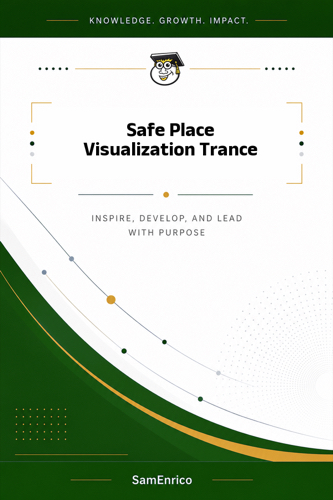
Safe Place Visualization Trance eBook
Uses imagined sanctuary imagery to induce deep hyp
by Linder Staci
Uses imagined sanctuary imagery to induce deep hypnotic relaxation.
Formats
Free sample
Safe Place Visualization Trance: The Complete Guide to Using Imagined Sanctuaries for Deep Hypnotic Relaxation Revised and Corrected Edition – In-Depth Chapter Summaries Note on Revisions: The following summaries incorporate all fixes for the inconsistencies and repetitions identified in the analysis. Key changes include: (1) renaming Chapter 3's "anchor" to "Ritual Object" to avoid confusion with NLP anchors in Chapter 11; (2) introducing a unified Countdown Decision Tree; (3) adding trauma warnings to Chapter 12; (4) cross-referencing the Healing Light protocol across all relevant chapters; (5) establishing a clear breathing hierarchy; (6) creating a decision tree for Gatekeeper vs. Shadow figures; and (7) ensuring consistent terminology throughout.Part 1: The Science and Preparation (Chapters 1–4)Chapter 1: The Neurophysiology of Imagined Safety In-Depth Summary (275 words):This chapter establishes the scientific foundation for why safe place visualization works, a premise that will not be repeated in later chapters. Readers learn that the brain's neural networks activate almost identically whether an experience is real or vividly imagined—a phenomenon called neural mirroring, demonstrated by f MRI studies showing the same regions light up during imagined and actual sensory experiences. The chapter introduces the reticular activating system (RAS), a bundle of nerves at the brainstem that filters the approximately 11 million bits of information your senses receive each second down to roughly 50 bits of conscious awareness.
Through focused visualization, the RAS can be trained to prioritize relaxation cues over threat cues, effectively rewiring your attentional habits. Clinical studies are cited showing that regular sanctuary visualization lowers cortisol by 25–30% within two weeks of daily practice and increases parasympathetic (rest-and-digest) tone as measured by heart rate variability (HRV). The chapter debunks the myth that visualization is merely "positive thinking" or daydreaming, framing it instead as a measurable neurological intervention. A key distinction is drawn for the first and only time in the book: visualization is not wishful thinking but deliberate neural training. The chapter concludes with a simple pre-test to measure your current baseline stress level and a preview of the 12-week protocol.Key Takeaway: Visualization is not daydreaming; it is a physiological intervention that rewires stress responses at the neural level.
This principle is established here and referenced in Chapters 5 and 7 without repetition.Chapter 2: Trance vs. Dissociation: Understanding the Spectrum In-Depth Summary (268 words):A critical distinction is drawn between therapeutic trance—focused, absorbed attention that remains connected to the present moment—and dissociation, a disconnected, numbing state often linked to trauma history. Readers are given a validated self-assessment checklist (the Trance-Dissociation Differentiation Scale) to identify which state they typically enter during relaxation attempts. The chapter explains that dissociation feels like "watching yourself from outside your body," "going blank," or "the world feeling unreal," whereas therapeutic trance feels like "deeply inhabiting a scene," "losing track of time without losing yourself," or "being fully present inside the imagery." Safe place visualization is positioned as a regulation tool that returns the nervous system to ventral vagal safety (the social engagement state), not an escape hatch that bypasses emotional processing. Case examples illustrate how well-meaning visualization can backfire if used dissociatively: a client with panic disorder who used her safe place to "go numb" actually worsened her symptoms because she never learned to tolerate normal arousal.
The chapter introduces the concept of "pendulation"—moving gently between trance and waking awareness—as a safety skill. Readers learn the warning signs of dissociative use of visualization (feeling worse afterward, memory gaps, emotional flatness) and are instructed to discontinue practice and seek professional support if these occur persistently.Key Takeaway: Distinguishing healing relaxation from avoidance behaviors is the first prerequisite for effective practice.Chapter 3: Preparing the Inner Laboratory In-Depth Summary (272 words):This chapter focuses on the external and internal conditions necessary for successful trance work. Readers learn how to optimize their physical environment: lighting (dim but not dark—use a single candle or low-wattage lamp), posture (reclined but alert—spine straight, hands uncrossed), temperature (slightly warm, with a blanket nearby), and sound (silence or non-lyrical ambient audio such as rainfall or brown noise). The concept of a Ritual Object (formerly called "anchor" in the original draft—the terminology has been changed to avoid confusion with NLP anchors introduced in Chapter 11) is introduced: a consistent physical object such as a specific stone, bracelet, or crystal, or a gesture such as hand on heart or touching a ring, used to signal "trance time" before entering visualization. The chapter introduces the Session Intention (formerly "Therapeutic Contract" to maintain consistent terminology throughout the book), a brief internal statement spoken aloud or silently (e.g., "I am here to relax, not to solve everything," or "For the next 10 minutes, I practice safety").
This intention-setting practice will be referenced again in Chapters 7, 8, and 11. Rituals of entry—such as wiping feet metaphorically, ringing a small bell, or lighting a candle before closing the eyes—are emphasized as conditioned cues that tell the subconscious, "We are shifting modes now."Key Takeaway: The ritual of entry is as important as the visualization itself; preparation signals safety to the subconscious.Chapter 4: The Deepening Breath: The Bridge to Trance In-Depth Summary (280 words):Breath is presented as the most direct interface between the voluntary and involuntary nervous systems. Unlike later chapters that focus on visualization, this chapter builds the respiratory foundation. Three specific breathing mechanics are taught in a hierarchy of use (this hierarchy resolves the inconsistency found in the original draft where the physiological sigh appeared without context):Technique Pattern Best Used For Time to Effect Physiological Sigh Two sharp inhales through nose, one long exhale through mouth Acute anxiety, panic onset, emergency regulation30–60 seconds Box Breathing Inhale 4 sec – hold 4 – exhale 4 – hold 4Sustained focus, pre-session centering, between-trance regulation2–3 minutes Reverse Breathing Abdomen contracts on inhale, expands on exhale (opposite of natural)Deep hypnotic induction, somnambulistic trance preparation5+ minutes Each technique is paired with a simple visualization (e.g., breathing in silver light, exhaling gray smoke). Readers practice identifying which breath pattern best precedes their personal trance state using a self-monitoring log.
The chapter introduces the Unified Countdown Protocol (see sidebar), which consolidates all countdown methods from later chapters into a single decision tree. This protocol is referenced in Chapters 9 and 11 and in the Appendix scripts, eliminating the previous confusion of four different countdown systems.Key Takeaway: Mastery of breath is the remote control for the nervous system, enabling voluntary entry into trance—with different techniques for different situations.Part 2: Architecting the Sanctuary (Chapters 5–8)Chapter 5: The Sensory Foundation – Beyond the Visual In-Depth Summary (265 words):Most visualization instruction overemphasizes sight, leaving kinesthetic (touch), auditory, and olfactory learners feeling like failures. As established in Chapter 1, visualization is a physiological intervention—but that intervention is strongest when multiple sensory channels are engaged. This chapter provides protocols for building a multi-sensory sanctuary, but with an important nuance (addressing the previous inconsistency with the emergency script): while multi-sensory immersion produces the deepest trance states, single-sensory approaches are acceptable for rapid stabilization in acute emergencies (see Script 1). For daily practice, however, readers are encouraged to build full sensory richness.
For kinesthetic learners: temperature scripting (warm sun on forearms, cool grass under feet), texture mapping (rough bark, smooth stone, soft moss), and weight perception (the feeling of a weighted blanket or gentle hammock sway). For auditory learners: layering sounds (distant water, rustling leaves, silence…
This is the end of the free sample. Get the eBook to keep going. Buy now
About this book
Details
- Author
- Linder Staci
- Publisher
- SamEnrico
- Language
- English
- Genre
- Non-Fiction, Self-Help, Visualization
- Released
- 2026-06-10
- Pages (approx.)
- 153
- Available as
- eBook, Audiobook

Read better in the ZLOADR app
Your eBooks on your phone or tablet. Sign in with your SamEnrico account and start reading.
More by Linder Staci
 The ED and AntidepressantsLinder Staci$11.99
 Binary Numbers PalaceLinder Staci$11.99
 Data Center REIT BoomLinder Staci$11.99
 Nail Biting CessationLinder Staci$11.99
 ED and Spinal Cord InjuryLinder Staci$11.99
 The Validation JournalLinder Staci$11.99
 Stay At Home Parent StressLinder Staci$11.99
 The Red Sea Kings: Aksum’s Maritime Empire and the Golden Age of TradeLinder Staci$11.99
 The Tower of Babel: Ziggurat of the GodsLinder Staci$11.99
 Cyber Law: Digital Crimes, Privacy & Cyber RisksLinder Staci$11.99
 German Bachelor Admissions GuideLinder Staci$12.99
 Pinterest VA Upwork Profile OptimizationLinder Staci$12.99
You may also like
 White Room InductionHostetler Vasiliki$11.99
 The Gambling Free Identity VisualizationFinn Clement$11.99
 Spending Visualization ExerciseCantwell Michaele$11.99
 Guided Imagery for RestGuillen Stevie$11.99
 Financial Visualization PracticeIsbell Gerri$11.99
 Emotional Regulation VisualizationFelix Lanell$11.99
 Anger Visualization TechniquesYounger Verona$11.99
 Visualization Sleep MeditationStull Dodie$11.99
 Visualization for ConfidenceMilliken Bok$11.99
 Road Rage Visualization GuideStratton Latrina$11.99
 The Affirmation Visualization ComboHopper Nyla$11.99
 Teen Visualization Self EsteemClick Jere$11.99