
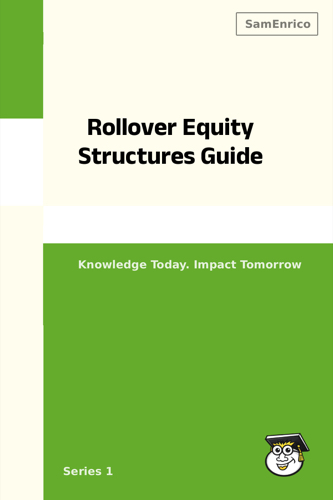
Non-FictionCapital & Valuation RegisterRollover Equity
Rollover Equity Structures Guide eBook
Model founder, management, and sponsor rollover wi
Model founder, management, and sponsor rollover with vesting schedules.
Formats
Free sample
Chapter 1: The $10 Million Mistake--The email arrived on a Tuesday afternoon. Sarah had been waiting for this moment for three years. After countless due diligence requests, management presentations, and sleepless nights negotiating the definitive agreement, her company was sold. The purchase price: $50 million in cash. Her share: $39 million after taxes.
She signed the papers, wired the funds to her wealth management account, and celebrated what she believed was the perfect exit.Eighteen months later, the private equity firm that bought her company sold it to a strategic buyer for $120 million. The management team she had handpicked, the same people who stayed behind when she cashed out, shared in the upside. Her co-founder, Mike, who had rolled 40 percent of his proceeds into the new entity, walked away with $67 million after taxes. He paid zero tax at the original closing. He worked two more years, helped grow EBITDA by 50 percent, and collected his second check while Sarah watched from the sidelines.The difference between Sarah and Mike was not luck.
It was not skill. It was a single structural decision made during the final week of negotiations: whether to take all cash or roll equity into the buyer's holding company. Sarah took the cash because she wanted to be "safe." Mike rolled because he understood something most founders never learn until it is too late.This chapter exists to ensure you are not Sarah.The Liquidity Myth That Costs Founders Millions There is a pervasive belief in entrepreneurial circles that taking all cash at closing is the ultimate victory. The logic seems sound: cash is liquid, cash is certain, and cash cannot be diluted or taken away by a future down round. Founders who have spent years bootstrapping, grinding through payroll crises, and surviving near-death experiences often cannot imagine leaving a single dollar on the table.
The fear is visceral. What if the private equity firm runs the company into the ground? What if the earn-out never pays? What if the second exit never comes?These fears are not irrational. Private equity sponsors do fail.
Earn-outs do go unpaid. Second exits do sometimes yield less than the first. But the data tells a different story than the fear. According to a study of over 1,200 private equity-backed exits between 2010 and 2022, founders who rolled at least 30 percent of their proceeds into the new entity had a median total wealth outcome 2.7 times higher than those who took all cash at closing. The reason is simple: when you roll equity, you become a co-owner of the future growth, not a former owner of the past.The liquidity myth is seductive because it feels like safety.
But safety has a price. Immediate cash triggers full capital gains tax at the closing rate, which for most high earners is 20 percent federal plus the 3.8 percent Net Investment Income Tax, plus state taxes that can add another 5 to 13 percent. In California, for example, the combined rate approaches 37 percent. On a $50 million exit, that is nearly $18.5 million in taxes paid immediately. That money is gone.
It is not working for you in the next transaction. It is not compounding. It is in the hands of the IRS.More importantly, taking all cash signals something to the sponsor that founders rarely consider. When you refuse to roll equity, you are telling the buyer that you do not believe in the future of the business. You are saying, "I want my money and I want out." Sponsors hear this loud and clear.
And they act accordingly. The founder who cashes out completely is often replaced within six to twelve months by an operating partner from the sponsor's network. Why would a sponsor keep a founder who has no skin in the game? The answer is they would not, and they do not.What Is a Rollover Equity Structure, Exactly?Before going further, a clear definition is necessary because confusion about the term itself is one of the primary reasons founders make bad decisions. A rollover occurs when a founder, executive, or existing shareholder exchanges their current equity in the target company for new equity in the acquiring entity.
No cash changes hands for the portion that is rolled. Instead of receiving a wire transfer for $10 million, you receive shares in the holding company that now owns your former business.This exchange is not a sale for tax purposes if structured correctly under Section 351 of the Internal Revenue Code, a topic covered in depth in Chapter 8. For now, understand that the rollover is a tax-deferred exchange. You are not cashing out. You are trading one set of shares for another.
The IRS treats this as a continuation of your investment, not a realization event. That means you pay zero tax at closing on the rolled portion.Here is a concrete example to ground the concept. Suppose your company is being acquired for $100 million. You own 40 percent, so your share of the proceeds is $40 million. You have two choices.
First, you can take all $40 million in cash. You will pay approximately $9.5 million in federal taxes (assuming 23.8 percent combined rate) plus state taxes, leaving you with roughly $30 million after taxes. Second, you can roll 50 percent of your proceeds into the new entity. That means you take $20 million in cash now and exchange the other $20 million for equity in the buyer's holding company. Your tax bill on the $20 million cash portion is approximately $4.75 million.
The rolled $20 million pays no tax at closing. You now own a meaningful piece of the new entity alongside the private equity sponsor.If the sponsor later sells the business for $200 million, and your rolled equity has maintained its proportional ownership (assuming no dilution, which is covered in Chapter 7), your second check could be $40 million before taxes. You will pay long-term capital gains tax on that $40 million at the then-prevailing rate. Your total after-tax wealth across both exits will almost certainly exceed what you would have had by taking all cash upfront.The Alignment Imperative: Why Sponsors Demand Skin in the Game Private equity sponsors are not charities. They are not in the business of making founders rich out of generosity.
Sponsors raise capital from institutional investors like pension funds, endowments, and insurance companies. Those investors expect returns of 20 percent or more per year. To generate those returns, sponsors need to acquire companies, improve their operations, grow their earnings, and sell them at a higher multiple within three to seven years.This business model has a vulnerability: management. The sponsor does not run the portfolio company day to day. The existing management team does.
If that management team walks away immediately after closing, the sponsor is left with an empty ship. No one knows the customers, the suppliers, the hidden operational issues, or the cultural dynamics that keep the business running. The sponsor could install their own operating partners, but that takes time, money, and often fails.The solution is rollover equity. By requiring founders and key executives to roll a portion of their proceeds into the new entity, the sponsor aligns incentives. You only get paid on the second exit if the business performs.
Your rolled equity vests over time, typically three to five years, which means you cannot simply take the money and…
This is the end of the free sample. Get the eBook to keep going. Buy now
About this book
Details
- Author
- Jorgenson Bret
- Publisher
- SamEnrico
- Language
- English
- Genre
- Non-Fiction, Capital & Valuation Register, Rollover Equity
- Released
- 2026-06-07
- Pages (approx.)
- 151
- Available as
- eBook, Audiobook

Read better in the ZLOADR app
Your eBooks on your phone or tablet. Sign in with your SamEnrico account and start reading.
More by Jorgenson Bret
 Mindfulness Pain Acceptance GuideJorgenson Bret$11.99
 Lactose Intolerance Workplace GuideJorgenson Bret$11.99
 Tab Hoarding Recovery CourseJorgenson Bret$11.99
 Bariatric Surgery Support Person HandbookJorgenson Bret$11.99
 The Last Dance of the Soviet CosmonautsJorgenson Bret$11.99
 The Mechanical Mind of Charles Babbage: The First AI PioneerJorgenson Bret$11.99
 Live In CaregiverJorgenson Bret$11.99
 AI Financial Data Reconciliation GuideJorgenson Bret$12.99
 Proposal Language TranslationJorgenson Bret$12.99
 Understanding Cdg Syndrome Type 2Jorgenson Bret$17.99
 How to Start a Postcards (plain) Business (Beginners Guide)Jorgenson Bret$11.99
You may also like
 Hong Kong Handover 1997Dunn Johnnie$11.99
 Zumba For Postnatal Recovery CourseNeal Christian$11.99
 Zumba for BeginnersLadner Nikia$11.99
 YouTube Comment Mining GuideHumes Pandora$12.99
 Worry Box MeditationCarlin Rudy$11.99
 Workplace Stress MeditationNguyen Lynn$11.99
 Workplace Stress and Sleep RepairHawley Ivory$11.99
 Workplace Perfectionism CureDelaney Jeffry$11.99
 Workplace Injustice Anger GuideWallen Isabelle$11.99
 Work Addiction and Burnout LinkGreenwood Ester$11.99
 Women in Yoga and WellnessBeattie Galina$11.99
 Women in Stand Up ComedyChun Evangeline$11.99