
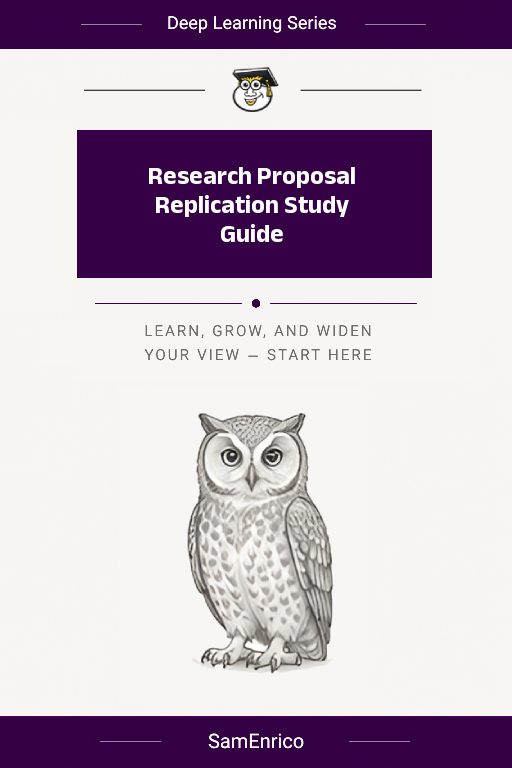
Research Proposal Replication Study Guide eBook
Justify direct or conceptual replication by showin
Justify direct or conceptual replication by showing theoretical importance and methodological improvements.
Formats
Free sample
Chapter 1: The Permission Slip--When I first proposed a replication study for my dissertation, my advisor looked at me like I had suggested we burn down the department’s copy machine and dance around the ashes. “That’s not original,” she said. “You need to find something new.” I nodded, walked back to my office, and spent the next six weeks inventing a study that no one would ever replicate because it was too complicated, too expensive, and frankly not very interesting. I collected the data, ran the analyses, found a p-value just below .05, wrote it up, and graduated. And then I never thought about that study again.That is not science.
That is a ritual.Somewhere along the way, academic research stopped being about discovering truth and started being about producing novelty. We reward the shiny, the surprising, the counterintuitive—preferably with a p-value that sparkles. We punish the mundane, the confirmatory, the act of checking someone else’s work. A graduate student who proposes to replicate a famous study is told they lack ambition. A faculty member who publishes a replication is told they lack impact.
And so the cycle continues: novel study after novel study, each one a fresh start, each one pretending that nothing came before it that needed verifying.This book exists because that cycle is broken.The replication crisis of the 2010s did not happen because a few bad actors faked their data. It happened because the incentive structure of science systematically discouraged the one activity that separates science from storytelling: checking your work. When a hundred studies were re-run in the early 2010s, only about forty percent produced the same results. Think about that. If a surgeon told you that your operation had a forty percent chance of working, you would find another surgeon.
If a bridge builder told you that forty percent of their bridges stayed standing, you would not drive across. But in psychology, medicine, economics, and even some corners of physics, we have been publishing findings with a success rate that would get any other profession sued into oblivion.The good news is that the crisis is over. Not because everything is fixed—it isn’t—but because the conversation has shifted. Replication is no longer a dirty word. Major journals now publish replication studies.
Funding agencies set aside money for replication projects. And most importantly, the best graduate programs now teach replication as a core skill, not a shameful backup plan for students who couldn’t come up with an original idea.But there is a gap between knowing that replication matters and knowing how to propose one.You can believe with every fiber of your being that replication is important. You can be convinced that checking previous work is the highest form of scientific integrity. But when you sit down to write your proposal—whether for a thesis, a dissertation, a grant, or a Registered Report—you will face the same question that I faced fifteen years ago: How do I justify this without sounding like I’m accusing the original authors of fraud? How do I make a replication sound important?
How do I convince my committee, my reviewers, or my funding agency that I am not just copying someone else’s homework?That is what this chapter answers.We are going to start with a radical reframe. Then we will walk through the actual history of the replication crisis—not the scare story you have heard, but the genuine opportunity it created. Then we will give you the exact language to defend replication to skeptics. And finally, we will lay out the complete roadmap for the rest of this book so you know exactly where you are going.Let me be clear about something before we go any further. I am not going to tell you that replication is easy.
It is not. It is often harder than original research because you have to navigate missing materials, uncooperative original authors, statistical challenges, and reviewers who still remember the bad old days when replication meant you had nothing new to say. But I am going to tell you that replication is worth it. And by the end of this book, you will have every tool you need to propose one with confidence.The Radical Reframe: Replication as Verification, Not Attack Most early-career researchers approach replication the way a cat approaches a bathtub: with suspicion, fear, and a plan to escape at the first opportunity. This is not your fault.
You have been trained to believe that science progresses through novel discoveries—that each study should reveal something the world has never seen before. Replication, by this logic, is a failure of imagination.That logic is backwards.Science does not progress through novelty. Science progresses through verification. A novel finding that no one can replicate is not a discovery; it is a rumor. A boring finding that replicates reliably is not boring; it is a foundation.
The reason you can board an airplane without calculating the lift coefficients yourself is not because aeronautical engineers are endlessly creative. It is because the laws of aerodynamics have been verified thousands of times. The reason your doctor prescribes antibiotics for bacterial infections is not because some researcher published a surprising result in 1945 and everyone just ran with it. It is because the effect of antibiotics on bacteria has been replicated in millions of patients across decades.Novelty is exciting. Verification is how we build things that do not collapse.The replication crisis revealed that many of our most exciting findings were actually buildings made of cardboard.
They looked impressive from the outside, but when someone leaned on them—when a replication study applied the same methods to a new sample—they folded. The researchers had not cheated. In most cases, they had simply been lucky. Small samples, flexible analyses, and publication bias had combined to produce a literature full of effects that were never really there in the first place.You are not attacking those researchers by proposing a replication. You are helping them.
You are doing the work that should have been done a decade ago: checking whether the cardboard building can support weight. If it can, great. The field has a verified finding. If it cannot, also great. The field can stop investing resources in a dead end.This reframe is not just philosophical.
It is practical. When you write your proposal, you will need to convince reviewers that you are not a vandal. You are a quality control inspector. And quality control is not an insult to the manufacturer; it is the only reason any of us trust what we buy.The Replication Crisis: A Short History You Actually Need to Know You have heard about the replication crisis. Everyone has.
But most of what you have heard is either oversimplified or just wrong. Let me give you the three things you actually need to know, because they will appear in your proposal’s justification section.First, the crisis was discovered by people trying to defend science, not destroy it.In 2011, a psychologist named Uri Simonsohn published a statistical technique for detecting data fraud. He was not trying to embarrass anyone.…
This is the end of the free sample. Get the eBook to keep going. Buy now
About this book
Details
- Author
- Santana Rosalee
- Publisher
- SamEnrico
- Language
- English
- Genre
- research, Student's Shortcut
- Released
- 2026-05-30
- Pages (approx.)
- 147
- Available as
- eBook, Audiobook

Read better in the ZLOADR app
Your eBooks on your phone or tablet. Sign in with your SamEnrico account and start reading.
More by Santana Rosalee
 The Trance Depth Scale WorkbookSantana Rosalee$11.99
 The Anti Imposter ManifestoSantana Rosalee$11.99
 The Balloon Release TechniqueSantana Rosalee$11.99
 Anti Dilution Provisions DatabaseSantana Rosalee$11.99
 Anger In LGBTQ CouplesSantana Rosalee$11.99
 The Restaurant Chef Stress ManualSantana Rosalee$11.99
 Pet Loss For BuddhistsSantana Rosalee$11.99
 OCD and AutismSantana Rosalee$11.99
 Gov Mayor Master GuideSantana Rosalee$11.99
 The Bone Orchard's Guardian: The Tale of the AdzeSantana Rosalee$11.99
 The Silk Road of Code: Al-Kashi’s Mathematical Legacy in Central AsiaSantana Rosalee$11.99
 Screams in the Sky: The I-35W Bridge Collapse and the Amusement Park That Wasn'tSantana Rosalee$11.99
You may also like
 Scientific Research On TM GuideMartens Nathanial$11.99
 Research Proposal Methodology Section MasteryPauley Debroah$11.99
 Research Proposal Appendix CompilationRaines Tyisha$11.99
 Academic Researcher Distraction GuideFord Virgil$11.99
 TM Research and ScienceCovert Nicki$11.99
 Social Anxiety Research ReviewRoberge Cole$11.99
 Research Proposal Significance Section GuideBock Tory$12.99
 Research Proposal Reviewer PsychologyLugo Tawanda$11.99
 Research Proposal Research Questions DesignLara Robbi$11.99
 Research Proposal References and CitationsPatten Shanice$11.99
 Research Proposal Mixed Methods DesignCameron Omega$11.99
 Research Proposal Data Management PlanAnderson Roberto$12.99