
Non-FictionHealth & WellnessRMD
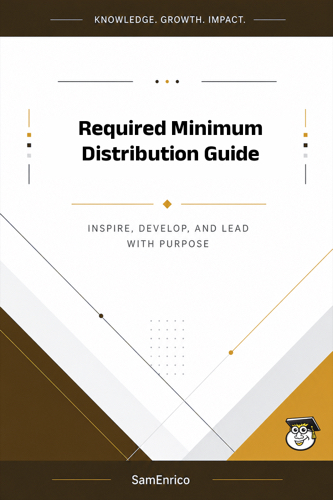
Required Minimum Distribution Guide eBook
Calculate and withdraw RMDs from IRAs starting at
by Jacobs Mabel
Calculate and withdraw RMDs from IRAs starting at 73.
Formats
Free sample
Chapter 1: The Birthday Trap--–- The letter arrived on a Tuesday, three weeks after Harold turned 73. He almost threw it away, mistaking it for junk mail. But the words “URGENT: IRS Notice” caught his eye. Harold had done everything right for forty years—maxed out his 401(k), contributed to his IRA, listened to his financial advisor. Now the government was telling him he owed $12,000 in penalties.
Not for cheating on his taxes. Not for hiding money offshore. For doing nothing at all.Harold’s story is not unique. In 2025 alone, the IRS assessed more than $800 million in RMD penalties against retirees who simply didn’t know the rules. Some were wealthy.
Most were not. Almost all of them had one thing in common: they thought they had more time.This chapter is about the single most dangerous moment in your retirement—the six-month window surrounding your 73rd birthday. It’s about deadlines that contradict common sense, rules that punish inaction, and the strange logic of a tax code that forces you to take money you may not need. By the end of this chapter, you will know exactly when your RMD clock starts, how to avoid the “first-year double trap,” and why April 1st is the most deceptive date in retirement planning.The Age That Keeps Changing (And Why It Matters)Before 2020, the RMD starting age was 70½. The SECURE Act 1.0 moved it to 72.
Then the SECURE Act 2.0, passed in late 2022, moved it again to 73 for anyone born between 1951 and 1959. For those born in 1960 or later, the age will eventually rise to 75, though that provision does not take effect until 2033.If this feels confusing, you are not alone. Financial advisors report that nearly half of their clients over 70 cannot correctly state their RMD starting age. Some still believe it is 70½. Others have heard “72” but don’t realize the law changed again.
A small but worrying number believe Roth IRAs require RMDs (they do not, as you’ll recall from the Introduction).Here is the only date you need to remember for this chapter: the year you turn 73.That is your trigger year. Not January 1st of that year. Not your birthday specifically, in terms of the exact day. The IRS cares about the calendar year in which your 73rd birthday falls.Consider two retirees:Margaret was born on December 15, 1952. She turns 73 on December 15, 2025.James was born on January 5, 1953.
He turns 73 on January 5, 2026.Margaret’s trigger year is 2025. James’s trigger year is 2026. Despite being born only three weeks apart, their RMD deadlines are nearly a full year apart. This quirk of the calendar has enormous consequences for tax planning, as you will see in the next section.The Takeaway: Find your birth year. If you were born between 1951 and 1959, your RMD start age is 73.
Write down the calendar year you will turn 73. That is your trigger year.The Two Deadlines That Confuse Everyone Most people assume that if you turn 73 in a given year, you must take your RMD by December 31st of that year. That assumption is half right and half catastrophically wrong.Here is the actual rule:Deadline #1 (Your First RMD): April 1st of the year following the year you turn 73.Deadline #2 (All Subsequent RMDs): December 31st of each year.Let us return to Margaret, born December 15, 1952, who turns 73 in 2025.Her first RMD (for the 2025 tax year) is due by April 1, 2026.Her second RMD (for the 2026 tax year) is due by December 31, 2026.Her third RMD (for the 2027 tax year) is due by December 31, 2027.Now look closely at the gap between April 1, 2026 and December 31, 2026. That is only nine months. If Margaret delays her first RMD until the April 1 deadline, she will have to take two RMDs in the same calendar year (2026)—one by April 1 and another by December 31.
This is called the “double RMD trap,” and it pushes many retirees into a higher tax bracket unexpectedly.James, born January 5, 1953, has a different calendar:He turns 73 in 2026.His first RMD (for 2026) is due by April 1, 2027.His second RMD (for 2027) is due by December 31, 2027.Notice that James has a full year between his first RMD deadline (April 1, 2027) and his second RMD deadline (December 31, 2027). He is less likely to fall into the double trap, simply because his birthday falls early in the year.The Rule of Thumb: If your birthday falls in the second half of the year (July through December), you are at higher risk of the double RMD trap. If your birthday falls in the first half (January through June), you have more breathing room. Regardless of your birthday, the safest strategy is to take your first RMD by December 31st of the year you turn 73—not April 1st of the following year. This avoids the double trap entirely.The Accounts That Play (And The One That Doesn’t)Not every retirement account requires RMDs.
Understanding which accounts are subject to the rules is the first step toward compliance.Accounts That Require RMDs The following account types are fully subject to RMD rules starting at age 73:Traditional IRA. This is the most common RMD account. Whether you funded it with pre-tax dollars or made deductible contributions, the IRS considers this money “uncle Sam’s share” until you withdraw it. Every Traditional IRA you own—including Rollover IRAs, Inherited Traditional IRAs (with special rules covered in Chapter 11), and SEP IRAs—requires its own RMD calculation, though you can aggregate them for withdrawal.SEP IRA. The Simplified Employee Pension IRA works exactly like a Traditional IRA for RMD purposes.
The fact that your employer contributed to it does not change the rules. You must begin withdrawals at 73.SIMPLE IRA. The Savings Incentive Match Plan for Employees IRA is another employer-sponsored plan that converts to a Traditional IRA for RMD purposes. Same rules, same deadlines.401(k) Plans. This includes standard 401(k)s, Roth 401(k)s (with the exception noted below), Solo 401(k)s for the self-employed, and any variations like profit-sharing plans.
However, there is a major exception for 401(k)s that you will read about in Chapter 9: if you are still working for the employer sponsoring the plan and you own less than 5% of the company, you can delay RMDs from that plan until you retire. This exception does NOT apply to IRAs or to old 401(k)s from previous employers.403(b) Plans. Commonly used by non-profit organizations, teachers, and hospital employees. The rules mirror 401(k)s exactly, including the “still working” exception.Thrift Savings Plan (TSP). The federal government’s retirement plan.
TSPs require RMDs starting at 73, with one important nuance: the TSP does not allow aggregation with IRAs. You must take your TSP RMD separately from any IRA RMDs.The One Account That Is Completely Exempt Roth IRA. This is the single most powerful exception in the RMD rules. Roth IRAs have no RMDs during the owner’s lifetime. None.
Zero. The money can sit and grow tax-free for your entire life, and you never have to withdraw a penny.Why? Because you already paid taxes on the money when you contributed it. The IRS has no deferred tax to collect. This is why financial advisors often recommend Roth conversions (covered in Chapter 6) as a strategy to eliminate future RMDs.A critical…
This is the end of the free sample. Get the eBook to keep going. Buy now
About this book
Details
- Author
- Jacobs Mabel
- Publisher
- SamEnrico
- Language
- English
- Genre
- Non-Fiction, Health & Wellness, RMD
- Released
- 2026-06-06
- Pages (approx.)
- 151
- Available as
- eBook, Audiobook

Read better in the ZLOADR app
Your eBooks on your phone or tablet. Sign in with your SamEnrico account and start reading.
More by Jacobs Mabel
 Zoom Call DistractionsJacobs Mabel$11.99
 Voice Actor Roommate Audition TalesJacobs Mabel$11.99
 Teen Voice Finding GuideJacobs Mabel$11.99
 Stimulant Post Acute WithdrawalJacobs Mabel$11.99
 Gambling Addiction MedicationJacobs Mabel$11.99
 Holiday Grief After Pregnancy LossJacobs Mabel$11.99
 Sleep and Long Term RegulationJacobs Mabel$11.99
 The Night the Sky Burned: The 2017 Grenfell Tower InfernoJacobs Mabel$11.99
 How to Produce Mortars and PestlesJacobs Mabel$11.99
 A Collector's Handbook to the Renault 5Jacobs Mabel$11.99
 Pop Up Retail for Streetwear Brands GuideJacobs Mabel$12.99
 Freemium Usage Caps for Slow NetworksJacobs Mabel$12.99
You may also like
 Hong Kong Handover 1997Dunn Johnnie$11.99
 Zumba For Postnatal Recovery CourseNeal Christian$11.99
 Zumba for BeginnersLadner Nikia$11.99
 YouTube Comment Mining GuideHumes Pandora$12.99
 Worry Box MeditationCarlin Rudy$11.99
 Workplace Stress MeditationNguyen Lynn$11.99
 Workplace Stress and Sleep RepairHawley Ivory$11.99
 Workplace Perfectionism CureDelaney Jeffry$11.99
 Workplace Injustice Anger GuideWallen Isabelle$11.99
 Work Addiction and Burnout LinkGreenwood Ester$11.99
 Women in Yoga and WellnessBeattie Galina$11.99
 Women in Stand Up ComedyChun Evangeline$11.99