
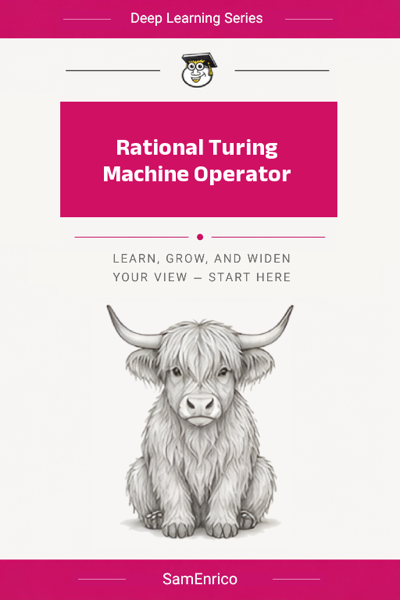
Non-FictionInformativeEducational
Rational Turing Machine Operator
A Coursebook on Rational Turing Machine Operator
A Coursebook on Rational Turing Machine Operator
Formats
About this book
Free sample
Chapter 1: The Hooter’s Judgment...--–- In the summer of 1951, a graduate student at the University of Manchester pressed a sequence of brass switches, listened to a brief, sharp buzz from a loudspeaker, and then watched a row of neon bulbs flicker in a pattern that had never appeared before. The machine was the Manchester Electronic Computer Mark II, the first stored-program computer to operate continuously in a university setting. The sound was its "hooter"—an audible alarm designed to signal that the machine had reached a predetermined state. The graduate student had just witnessed something the machine's designers had not anticipated: a state that was neither a correct halt, nor a hardware fault, nor a logical error, but something in between. In that moment, the modern concept of the rational operator was born—not in the abstract mathematics of Turing's 1936 paper, but in the physical, noisy, error-prone reality of a human being trying to decide what had just happened and what to do next.This chapter dismantles a persistent myth: that the "rational operator" is a product of modern computer science, artificial intelligence, or game theory.
The truth is stranger and more instructive. The first rational operators were human beings working with machines that crashed routinely, gave inconsistent results, and required constant judgment calls about whether a given output was trustworthy. Their tools were not Bayesian priors or utility functions but switches, lights, paper tape, and the fallible human mind. Yet their problems were identical to those faced by today's AI system administrators: limited information, bounded time, high stakes, and no guarantee that the next computation would succeed.We begin with a historical reconstruction of Turing's own work as a hands-on operator at Manchester, drawing directly from his 1951 Programmers' Handbook for the Manchester Electronic Computer. From this foundation, we extract the first systematic framework for rational operation—a framework that predates Herbert Simon's work on bounded rationality by nearly a decade and anticipates modern resource-bounded decision theory.
The chapter concludes with a set of principles that will serve as touchstones throughout this book.The Myth of the Lone Mathematician…
This is the end of the free sample. Get the eBook to keep going. Buy now
Contents
- Chapter 1
- Chapter 2
- Chapter 3
- Chapter 4
- Chapter 5
- Chapter 6
- Chapter 7
- Chapter 8
- Chapter 9
- Chapter 10
- Chapter 11
- Chapter 12
Details
- Author
- Mallory Sidney
- Publisher
- SamEnrico
- Language
- English
- Genre
- Non-Fiction, Informative, Educational
- Released
- 2026-05-08
- Pages (approx.)
- 131
- Available as
- eBook, Audiobook

Read better in the ZLOADR app
Your eBooks on your phone or tablet. Sign in with your SamEnrico account and start reading.
More by Mallory Sidney
 Two Part Tariff EconomicsMallory Sidney$11.99
 Aging with Dignity WorkbookMallory Sidney$11.99
 The American Idol ContestantsMallory Sidney$11.99
 The Rhythms of the Unknown: Mansa Musa's Golden Caravan and the Birth of African Musical DiplomacyMallory Sidney$11.99
 How to Become a Magazine SupervisorMallory Sidney$11.99
 Personal Development Success StoriesMallory Sidney$12.99
 How to Produce Acupuncture SuppliesMallory Sidney$11.99
You may also like
 Hong Kong Handover 1997Dunn Johnnie$11.99
 Zumba For Postnatal Recovery CourseNeal Christian$11.99
 Zumba for BeginnersLadner Nikia$11.99
 YouTube Comment Mining GuideHumes Pandora$12.99
 Worry Box MeditationCarlin Rudy$11.99
 Workplace Stress MeditationNguyen Lynn$11.99
 Workplace Stress and Sleep RepairHawley Ivory$11.99
 Workplace Perfectionism CureDelaney Jeffry$11.99
 Workplace Injustice Anger GuideWallen Isabelle$11.99
 Work Addiction and Burnout LinkGreenwood Ester$11.99
 Women in Yoga and WellnessBeattie Galina$11.99
 Women in Stand Up ComedyChun Evangeline$11.99