
Non-FictionInformativeEducational
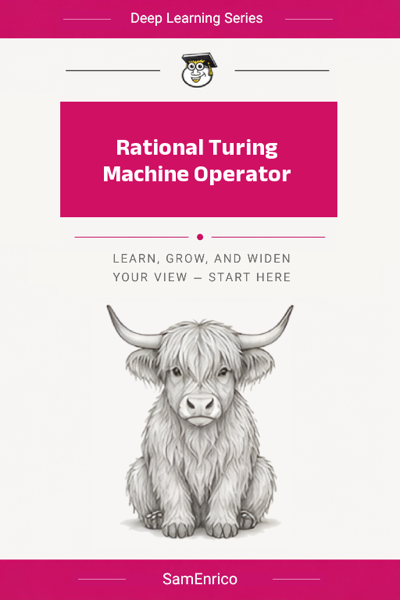
Rational Turing Machine Operator eBook
A Coursebook on Rational Turing Machine Operator
A Coursebook on Rational Turing Machine Operator
Formats
Free sample
Chapter 1: The Hooter’s Judgment...--–- In the summer of 1951, a graduate student at the University of Manchester pressed a sequence of brass switches, listened to a brief, sharp buzz from a loudspeaker, and then watched a row of neon bulbs flicker in a pattern that had never appeared before. The machine was the Manchester Electronic Computer Mark II, the first stored-program computer to operate continuously in a university setting. The sound was its "hooter"—an audible alarm designed to signal that the machine had reached a predetermined state. The graduate student had just witnessed something the machine's designers had not anticipated: a state that was neither a correct halt, nor a hardware fault, nor a logical error, but something in between. In that moment, the modern concept of the rational operator was born—not in the abstract mathematics of Turing's 1936 paper, but in the physical, noisy, error-prone reality of a human being trying to decide what had just happened and what to do next.This chapter dismantles a persistent myth: that the "rational operator" is a product of modern computer science, artificial intelligence, or game theory.
The truth is stranger and more instructive. The first rational operators were human beings working with machines that crashed routinely, gave inconsistent results, and required constant judgment calls about whether a given output was trustworthy. Their tools were not Bayesian priors or utility functions but switches, lights, paper tape, and the fallible human mind. Yet their problems were identical to those faced by today's AI system administrators: limited information, bounded time, high stakes, and no guarantee that the next computation would succeed.We begin with a historical reconstruction of Turing's own work as a hands-on operator at Manchester, drawing directly from his 1951 Programmers' Handbook for the Manchester Electronic Computer. From this foundation, we extract the first systematic framework for rational operation—a framework that predates Herbert Simon's work on bounded rationality by nearly a decade and anticipates modern resource-bounded decision theory.
The chapter concludes with a set of principles that will serve as touchstones throughout this book.The Myth of the Lone Mathematician The popular image of Alan Turing is dominated by two scenes: the solitary mathematician cracking the Enigma code at Bletchley Park, and the tragic figure of the persecuted genius. Both images obscure a more relevant figure for our purposes: Turing as a practical engineer and programmer. After the war, Turing moved to the University of Manchester to work on the Mark I and Mark II computers. He was not merely a theoretician advising from afar. He wrote actual code—in machine language, by hand—and he operated the machine himself.The Manchester Mark II was not a gentle machine.
Its primary memory consisted of a magnetic drum that spun at 3,000 revolutions per minute, with read/write heads that sometimes failed to align. Its secondary memory was paper tape. Its central processing unit used vacuum tubes that burned out regularly. A single program run could fail for any of a dozen reasons: a transient magnetic dropout, a misaligned paper tape reader, a tube on the verge of failure, or a genuine logic error in the code. The operator's job was to determine, after each failure, which cause was most likely and what to do next.This was the birth of the rational operator: a resource-bounded agent forced to make decisions under severe uncertainty with real consequences.
If the operator misdiagnosed a hardware fault as a software bug, they might waste hours debugging correct code. If they misdiagnosed a bug as a hardware fault, they might reboot the machine and lose the only evidence of a subtle logical error. And if they could not decide at all, the machine would sit idle, computing nothing.The Hooter and the Console: The First Human-Machine Interface The Manchester Mark II featured two primary output devices: a row of neon bulbs (the "console lights") and a loudspeaker (the "hooter"). The hooter was not a simple error alarm. It was programmable.
The operator could set the machine to trigger the hooter when the program reached a specific memory address or a specific state. In modern terms, the hooter was an early form of software breakpoint—but unlike a modern debugger, it did not stop the machine. It simply announced that something interesting had happened.The rational operator had to interpret the hooter's sound in context. A single short buzz might mean "normal checkpoint reached." A series of irregular buzzes might mean "something strange is happening." No buzz at all might mean the machine had halted silently—or that the program had entered an infinite loop that never triggered any output.Turing's handbook advised operators to treat the hooter not as a deterministic signal but as a probabilistic one. He wrote: "Listen to the hooter.
If it sounds at regular intervals, the machine is cycling correctly. If the intervals become irregular, suspect a fault in the magnetic drum. If the hooter sounds continuously, the program has likely entered a loop." This was not a formal algorithm but a heuristic—a practical rule of thumb that worked well enough given the operator's bounded time and attention.The console lights provided a more detailed but slower signal. Each light corresponded to a bit in the accumulator or an instruction register. By watching the pattern of lights, an experienced operator could read the contents of memory in real time—if they could process the pattern quickly enough.
But human visual processing is limited. Turing's handbook noted that operators could reliably identify only about four bits at a glance; anything more required writing down the pattern on paper. Here we see the first explicit recognition of bounded working memory in the context of computation.Turing's Four Programming Principles Turing's 1951 handbook contained a section titled "Programming Principles" that is remarkable for its prescience. It listed four steps that every programmer should follow. Read in the context of this book, these steps appear not merely as software engineering advice but as a complete framework for rational operation under bounded resources.Principle 1: Make a plan.
Before writing a single instruction, the operator should write down a high-level description of what the program is supposed to achieve. This plan should include: the input format, the expected output, the maximum allowable time, and the memory constraints. Turing emphasized that the plan should be written in ordinary English, not in machine code. Why? Because the plan is not for the machine; it is for the human operator.
The plan serves as a reference point for later debugging. If the machine does something unexpected, the operator can ask: "Does this behavior violate the plan, or did I make a mistake in the plan itself?"Principle 2: Break the problem down. The plan should be decomposed into subproblems no larger than what a single human can hold in working memory. Turing suggested that each subproblem should be representable in no more than four to five instructions. This is a remarkably modern insight: it anticipates the concept of "chunking" in cognitive psychology and the notion of "modular programming" in software engineering.
The operator's bounded rationality dictates the granularity of decomposition.Principle 3: Program the subroutines. For each subproblem, write a subroutine that…
This is the end of the free sample. Get the eBook to keep going. Buy now
About this book
Details
- Author
- Mallory Sidney
- Publisher
- SamEnrico
- Language
- English
- Genre
- Non-Fiction, Informative, Educational
- Released
- 2026-05-08
- Pages (approx.)
- 131
- Available as
- eBook, Audiobook

Read better in the ZLOADR app
Your eBooks on your phone or tablet. Sign in with your SamEnrico account and start reading.
More by Mallory Sidney
 Two Part Tariff EconomicsMallory Sidney$11.99
 Aging with Dignity WorkbookMallory Sidney$11.99
 The American Idol ContestantsMallory Sidney$11.99
 The Rhythms of the Unknown: Mansa Musa's Golden Caravan and the Birth of African Musical DiplomacyMallory Sidney$11.99
 How to Become a Magazine SupervisorMallory Sidney$11.99
 Personal Development Success StoriesMallory Sidney$12.99
 How to Produce Acupuncture SuppliesMallory Sidney$11.99
You may also like
 Hong Kong Handover 1997Dunn Johnnie$11.99
 Zumba For Postnatal Recovery CourseNeal Christian$11.99
 Zumba for BeginnersLadner Nikia$11.99
 YouTube Comment Mining GuideHumes Pandora$12.99
 Worry Box MeditationCarlin Rudy$11.99
 Workplace Stress MeditationNguyen Lynn$11.99
 Workplace Stress and Sleep RepairHawley Ivory$11.99
 Workplace Perfectionism CureDelaney Jeffry$11.99
 Workplace Injustice Anger GuideWallen Isabelle$11.99
 Work Addiction and Burnout LinkGreenwood Ester$11.99
 Women in Yoga and WellnessBeattie Galina$11.99
 Women in Stand Up ComedyChun Evangeline$11.99