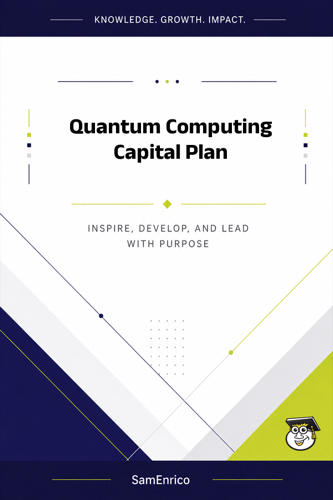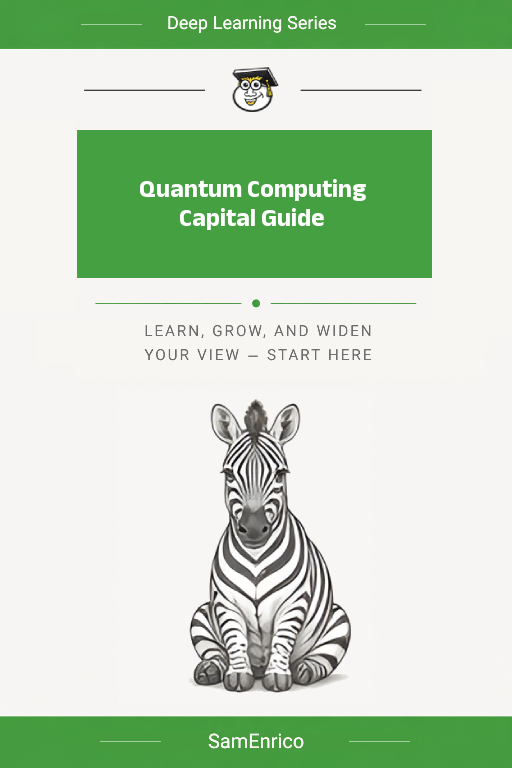
Quantum Computing Capital Guide eBook
Analyze hardware development, algorithm research,
Analyze hardware development, algorithm research, and cloud access platform investment strategies.
Formats
Free sample
Chapter 1: The Last Kilometer--–- In the spring of 2027, a quantitative analyst at a mid-sized hedge fund named Maya Chen did something that would have been impossible three years earlier. She logged into her firm’s AWS account, navigated to a quantum computing service, and ran a portfolio optimization job that simultaneously considered 1,200 assets, thirty-seven risk factors, and four regulatory constraints. The job took forty-seven seconds of quantum processing time and cost 14.60.Theclassicalsupercomputerthatherfirmhadleasedfor14.60. The classical supercomputer that her firm had leased for 14.60.Theclassicalsupercomputerthatherfirmhadleasedfor2.4 million per year would have required an estimated three weeks to complete the same calculation with lower confidence bounds. Maya did not understand how the quantum computer worked—not really—but she understood the output.
She rebalanced her firm’s flagship fund, generating a 9.4 percent return in the next quarter while the broader market returned 2.1 percent. Her boss asked her what she had done differently. She said, “I used the quantum thing.” He said, “Good. Do it again.”This story, which I have lightly disguised to protect proprietary information, is not an outlier. It is the canary in the coal mine of the largest technological and financial transition since the commercialization of the internet.
And yet, as I write this in late 2026, fewer than one percent of professional investors—including venture capitalists, private equity partners, and pension fund allocators—can answer the three questions that Maya Chen answered instinctively: which quantum hardware is reliable enough for production, which algorithms actually deliver economic value today, and which cloud platform provides the most cost-effective access. The purpose of this book is to transform you from a spectator of the quantum revolution into an allocator of capital within it. But before we discuss valuations, due diligence, or portfolio construction, we must first confront a brutal truth: most of what you have heard about quantum computing is either wrong, outdated, or deliberately misleading.The Quantum Information Asymmetry Every transformative technology goes through a phase that venture capitalists call “the trough of disillusionment.” The internet had its trough in 2000–2002, when Pets.com collapsed and broadband penetration stalled at fifteen percent. Artificial intelligence had its trough in the late 1980s, after the collapse of the Lisp machine market, and again in the late 2010s before the transformer architecture revived it. Quantum computing entered its first trough around 2019–2020, when Google’s “quantum supremacy” claim was challenged by classical simulations, and IBM responded by redefining the goalposts.
But unlike the internet or AI, quantum computing is now emerging from its trough with something those earlier technologies lacked: a clear, monetizable path that does not require full fault tolerance.Here is the information asymmetry that this book exploits. Most financial media and sell-side research still frame quantum computing as a ten-to-twenty-year horizon technology. They focus on Shor’s algorithm breaking RSA encryption, or large-scale quantum chemistry simulations that require millions of physical qubits. Both of those are real, and both are distant. But between today and that distant future lies a commercially viable intermediate zone: the Noisy Intermediate-Scale Quantum, or NISQ, era.
In the NISQ era, quantum computers have fifty to one thousand qubits, each qubit is noisy, and error correction is partial or absent. Conventional wisdom says NISQ machines are useless for real work. That conventional wisdom is wrong.The evidence is already public, though scattered. In 2023, a team at IBM used a 127-qubit processor to simulate a magnetic material’s properties at a level of accuracy that matched experimental data, outperforming classical approximations for certain correlation functions. In 2024, researchers at Quantinuum ran a hybrid quantum-classical workflow that optimized a supply chain routing problem for a major logistics firm, reducing fuel costs by an estimated seven percent in simulation.
In 2025, a consortium of pharmaceutical companies using Ion Q’s trapped-ion hardware screened a library of ten thousand candidate molecules for a specific protein binding affinity, identifying three candidates that classical methods had missed. These are not laboratory curiosities. These are production-adjacent workloads that generated measurable economic value.The problem is not that quantum computing lacks use cases. The problem is that the use cases are fragmented across different hardware modalities, algorithm families, and cloud platforms. No single analyst covers all three dimensions.
Hardware specialists understand gate fidelities and coherence times but cannot read a balance sheet. Algorithm researchers understand VQE and QAOA but have never evaluated a cloud API’s pricing model. Financial analysts understand discounted cash flows and multiples but cannot distinguish a trapped-ion from a superconducting qubit. This book sits at the intersection. It will teach you to audit a quantum company’s stack the same way a venture capitalist audits a startup’s financial statements: with skepticism, with metrics, and with a clear framework for separating signal from noise.Why “The Last Kilometer”?The title of this chapter refers to a concept from infrastructure economics: the last kilometer problem.
In telecommunications, the last kilometer—the connection between the backbone network and the end user—is the most expensive, most complex, and most value-dense segment of the entire system. You can build a transatlantic fiber optic cable for hundreds of millions of dollars, but if you cannot connect that cable to individual homes and businesses, the investment generates zero revenue. The same principle applies to quantum computing. The hardware is the backbone. The algorithms are the switching stations.
But the last kilometer is the cloud platform and software stack that connects quantum processors to paying customers. And that last kilometer is where the investment opportunity is most misunderstood.Most investors, when they first encounter quantum computing, fixate on the hardware. Which company has the most qubits? Which modality—superconducting, trapped ions, photonics—will ultimately win? These are important questions, but they are also the most crowded and most speculative.
The venture capital market has already poured billions into hardware startups. Valuations are high, timelines are uncertain, and the risk of technological obsolescence—for example, photonics leapfrogging superconducting—is real. The asymmetric opportunity, as we will develop throughout this book, lies not in picking the winning hardware but in owning the interfaces that work with any hardware. The cloud platforms that aggregate multiple qubit types. The software compilers that translate algorithms between hardware backends.
The algorithm libraries that deliver value on NISQ machines today and will scale to fault-tolerant machines tomorrow. These are the last kilometer investments.Consider the parallel with classical computing. In the 1980s, the most exciting companies were hardware manufacturers: Intel, AMD, Motorola. Investing in them was spectacularly profitable if you picked the right one. But the more predictable, more diversified, and ultimately more valuable investments were in the interfaces: Microsoft’s operating system (which ran on any Intel-compatible processor), Cisco’s networking equipment (which connected any brand of computer), and later AWS’s cloud infrastructure (which rented compute by the hour regardless of underlying hardware).
The hardware companies competed on specifications; the interface companies profited from the competition. Quantum computing is following the same arc, but compressed into a shorter timeline. The hardware battle will be decided in the next five to seven years. The interface battle will last for decades.What This Chapter Covers Before we dive into the technical details—hardware modalities in Chapter 2, cryogenics in Chapter 3, algorithms…
This is the end of the free sample. Get the eBook to keep going. Buy now
About this book
Details
- Author
- Mccullough Taneka
- Publisher
- SamEnrico
- Language
- English
- Genre
- Non-Fiction, Forecast & Outlook, Quantum Finance
- Released
- 2026-06-01
- Pages (approx.)
- 145
- Available as
- eBook, Audiobook

Read better in the ZLOADR app
Your eBooks on your phone or tablet. Sign in with your SamEnrico account and start reading.
More by Mccullough Taneka
 Return to Office Anger GuideMccullough Taneka$11.99
 PTSD Trance GroundingMccullough Taneka$11.99
 Teen Sleep Needs GuideMccullough Taneka$11.99
 Nonprofit Worker Worth GuideMccullough Taneka$11.99
 The Hearthstone Card Pack AddictionMccullough Taneka$11.99
 The Siege of Chitradurga: Tipu Sultan's Last StandMccullough Taneka$11.99
 Asbestos Abatement WorkerMccullough Taneka$11.99
 Marketing AI Ethics GuideMccullough Taneka$12.99
 Understanding Microsomia Hemifacial Radial DefectsMccullough Taneka$17.99
 How to Start a Bullion Broker on Own Account Business (Beginners Guide)Mccullough Taneka$11.99