
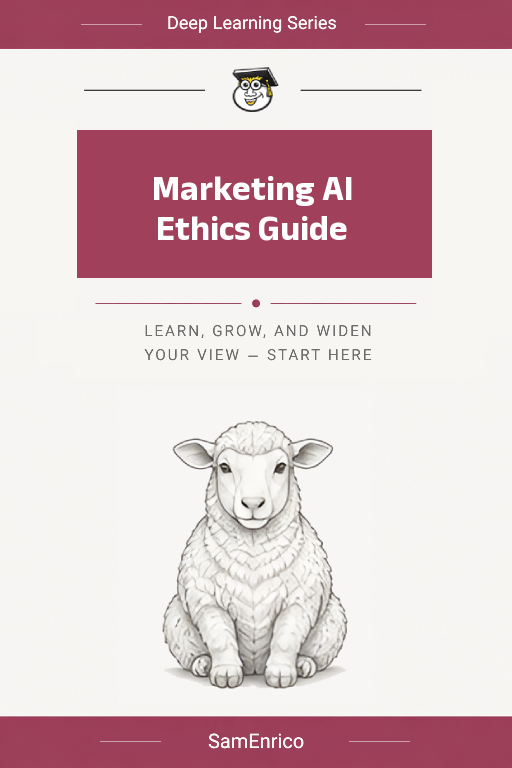
Non-FictionAI OperatorAI Ethics
Marketing AI Ethics Guide
Navigate disclosure and authenticity when using ge
Navigate disclosure and authenticity when using generative AI for marketing content production.
Formats
About this book
Free sample
Chapter 1: The Authenticity Gap--Marketing leaders are making a dangerous bet. They are betting that consumers either cannot tell the difference between human-made and AI-generated content, or that they simply do not care. Every day, in boardrooms and marketing departments around the world, executives sign off on campaigns that use generative AI to produce images, video, copy, and voice—often with no disclosure, no watermark, and no second thought about whether the consumer has a right to know.The problem is not that these executives are malicious. The problem is that they are operating on assumptions that have not been tested against reality. They see the efficiency gains—a 50% reduction in production time, a 70% cut in creative costs—and they assume that what is good for the bottom line must also be acceptable to the customer.
This assumption is not just wrong. It is dangerously wrong.This chapter introduces the concept that will serve as the foundation for every ethical decision in this book: the Authenticity Gap. The Authenticity Gap is the widening chasm between what brands produce efficiently with generative AI and what consumers actually trust. It is measured not in dollars or engagement metrics, but in the slow, silent erosion of brand equity that occurs when consumers sense—often without being able to articulate it—that something about a brand's communication feels off, hollow, or deceptive.Understanding the Authenticity Gap requires us to first understand two seemingly contradictory facts about how consumers perceive AI-generated content. These facts are not actually contradictory; they are two sides of the same coin.
But failing to appreciate both will lead marketing teams down a path of costly mistakes.The Two Faces of Consumer Skepticism Let us start with the first fact. When consumers do not know that content is AI-generated, they still experience a subconscious decline in trust. This is not a theory. It is a measured, replicable phenomenon. Biometric studies have shown that viewers spend less time looking at AI-generated images than human-created ones, even when they cannot identify which is which.
Eye-tracking data reveals that consumers linger less on synthetic faces, their pupils dilate less (a marker of emotional engagement), and…
This is the end of the free sample. Get the eBook to keep going. Buy now
Contents
- Chapter 1
- Chapter 2
- Chapter 3
- Chapter 4
- Chapter 5
- Chapter 6
- Chapter 7
- Chapter 8
- Chapter 9
- Chapter 10
- Chapter 11
- Chapter 12
Details
- Author
- Mccullough Taneka
- Publisher
- SamEnrico
- Language
- English
- Genre
- Non-Fiction, AI Operator, AI Ethics
- Released
- 2026-06-01
- Pages (approx.)
- 141
- Available as
- eBook, Audiobook

Read better in the ZLOADR app
Your eBooks on your phone or tablet. Sign in with your SamEnrico account and start reading.
More by Mccullough Taneka
 Return to Office Anger GuideMccullough Taneka$11.99
 PTSD Trance GroundingMccullough Taneka$11.99
 Teen Sleep Needs GuideMccullough Taneka$11.99
 Nonprofit Worker Worth GuideMccullough Taneka$11.99
 The Hearthstone Card Pack AddictionMccullough Taneka$11.99
 The Siege of Chitradurga: Tipu Sultan's Last StandMccullough Taneka$11.99
 Asbestos Abatement WorkerMccullough Taneka$11.99
 Quantum Computing Capital GuideMccullough Taneka$12.99
 Understanding Microsomia Hemifacial Radial DefectsMccullough Taneka$17.99
 How to Start a Bullion Broker on Own Account Business (Beginners Guide)Mccullough Taneka$11.99
You may also like
 Hong Kong Handover 1997Dunn Johnnie$11.99
 Zumba For Postnatal Recovery CourseNeal Christian$11.99
 Zumba for BeginnersLadner Nikia$11.99
 YouTube Comment Mining GuideHumes Pandora$12.99
 Worry Box MeditationCarlin Rudy$11.99
 Workplace Stress MeditationNguyen Lynn$11.99
 Workplace Stress and Sleep RepairHawley Ivory$11.99
 Workplace Perfectionism CureDelaney Jeffry$11.99
 Workplace Injustice Anger GuideWallen Isabelle$11.99
 Work Addiction and Burnout LinkGreenwood Ester$11.99
 Women in Yoga and WellnessBeattie Galina$11.99
 Women in Stand Up ComedyChun Evangeline$11.99