
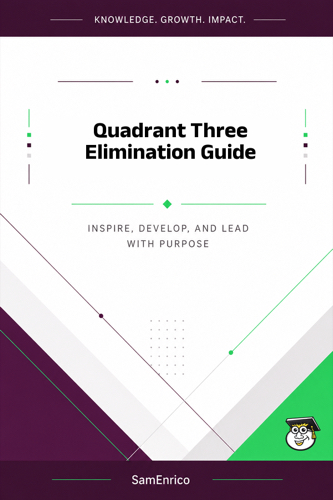
Non-FictionSelf-HelpDelegation
Quadrant Three Elimination Guide eBook
Delegates or deletes urgent but unimportant tasks.
by Hamlin Alexa
Delegates or deletes urgent but unimportant tasks.
Formats
Free sample
Chapter 1: The 5:00 PM Lie--–- The clock reads 5:00 PM. You close your laptop. Your email inbox is empty—for the first time all day. You answered every Slack message. You attended every meeting.
You cleared the deck.And yet.You sit in your chair for an extra moment, staring at the wall, because something feels wrong. You are exhausted—the kind of bone-deep tired that comes from a day of sprinting. But when you ask yourself what did I actually accomplish today? the answer is a hollow, terrifying whisper: Nothing that matters.The project that would have moved the needle on your annual goal? Unstarted.
The strategic plan that could have saved your team twenty hours a week? Still in your head. The conversation with your spouse about next year's vacation? You forgot to have it. Again.You spent the entire day fighting fires.
And not one of those fires was yours.This is the 5:00 PM Lie. It is the daily ritual of the modern knowledge worker—the exhausted collapse at the end of a day that produced nothing of lasting value. And the cruelest part of the lie is this: you feel productive. You were busy. You were responsive.
You were helpful. You were, by every measure that matters to an inbox, a good employee.But you were not effective. And the gap between feeling busy and being effective is where Quadrant 3 lives.The Invention That Changed Everything (And That You’ve Probably Forgotten)In 1989, Stephen Covey published The 7 Habits of Highly Effective People. Hidden inside that book—buried between habit 2 (begin with the end in mind) and habit 4 (think win-win)—was a simple diagram that has since become the single most useful tool in time management history. It was called the Eisenhower Matrix, though Covey popularized it under a different name: the Four Quadrants.The matrix asks two questions about every task in your life:Is this important?
(Does it align with my long-term values, goals, and mission?)Is this urgent? (Does it demand my attention right now?)Cross these two questions, and you get four boxes:Quadrant 1 (Important & Urgent): Crises, deadlines, fires. Do these now.Quadrant 2 (Important & Not Urgent): Planning, relationship-building, deep work, exercise, learning. Schedule these.Quadrant 3 (Not Important & Urgent): Interruptions, other people's emergencies, low-value meetings, most email. Delegate or delete these.Quadrant 4 (Not Important & Not Urgent): Time-wasting, doom-scrolling, busywork.
Eliminate these.This book exists for one reason and one reason only: almost everyone spends almost all of their time in Quadrant 3.Not Quadrant 1—real crises are actually quite rare. Most people do not work in emergency rooms or on bomb squads. Quadrant 1 takes up maybe 5-10% of a typical knowledge worker's week.Not Quadrant 2—the important but not urgent work is the work that actually changes lives, grows careers, and builds legacies. But it never screams for attention. It sits quietly, waiting to be scheduled, and gets endlessly pushed aside.Not Quadrant 4—most people are not lazy.
They are not watching Netflix at their desks. They are working. Hard.Quadrant 3 is where high-achieving, conscientious, responsible people go to die by a thousand small cuts. Quadrant 3 is the fake fire. The urgent email that isn't actually important.
The meeting that could have been an email. The request from a colleague who failed to plan. The "quick question" that takes twenty minutes. The emergency that is an emergency only for someone else.Quadrant 3 feels productive. It feels like work.
It feels like you are doing something. But at the end of the day, you have climbed a ladder that was leaning against the wrong wall. You are exhausted. And nothing important is done.The Anatomy of a Fake Fire Let me tell you about a woman named Priya.Priya is a senior marketing director at a mid-sized software company. She is smart, capable, and universally liked.
She is also drowning. When I met her, she was working sixty-hour weeks and falling further behind every month.I asked her to keep a time log for one week. (We will do the same exercise in Chapter 2, so get ready.) By Wednesday, the pattern was unmistakable.On Tuesday at 10:17 AM, Priya received a Slack message from a colleague in sales: "Hey, can you hop on a quick call? Need your thoughts on something." No context. No agenda.
No indication of urgency.Priya, being a good colleague and a responsible person, replied within two minutes: "Sure, give me five."The "quick call" lasted twenty-two minutes. It turned out the sales colleague wanted feedback on a slide deck for a client presentation—a deck Priya had never seen before, about a product she didn't manage, for a client she didn't know. She spent fifteen of those minutes getting up to speed. She spent the remaining seven minutes saying things like "that looks fine" and "I trust your judgment."The call ended. Priya returned to the strategic campaign she had been building.
But she didn't really return. She spent the next eleven minutes context-switching: re-reading her notes, reorienting herself, remembering where she had left off.Total cost of the "quick call": 33 minutes. Total value delivered: essentially zero. The sales colleague could have asked anyone—or simply trusted his own judgment.This is a fake fire. It felt urgent because it was a direct request from a human being, delivered in real time, with social pressure to respond.
But it was not important. It did not move Priya's goals forward. It did not matter to her performance, her team, or her career.And it happened eleven more times that week.Why Fake Fires Feel So Real If fake fires are so clearly fake, why do we keep running toward them? Why does every ping, buzz, and pop demand our immediate attention?The answer is not technological. It is psychological.
And understanding this psychology is the first step toward liberation.The Dopamine Loop of Rescue Every time you respond to a request—every time you answer an email, clear a notification, or say "yes" to a meeting—your brain releases a small amount of dopamine. This is the same neurotransmitter involved in addiction, gambling, and social media scrolling. Your brain is wired to seek novelty, closure, and social approval. And every completed task, no matter how trivial, provides a tiny hit of all three.The cruel trick is that Quadrant 2 tasks—the important, non-urgent work—rarely provide this hit. Writing a strategic plan does not trigger a dopamine spike.
Spending an hour on deep work does not give you the satisfaction of closing a tab. These activities are reward-delayed. They pay off in weeks or months, not seconds.Quadrant 3 tasks, by contrast, are reward-immediate. You answer an email → you close it → you feel a tiny sense of accomplishment. You attend a meeting → you check it off your calendar → you feel productive.
You respond to a Slack message → you see the "seen" receipt → you feel connected.Over time, your brain learns that Quadrant 3 feels good—even though it produces nothing of value. You become addicted to the motion, not the progress.The Fear of Appearing Incompetent There is a second psychological driver, and it is even more powerful than dopamine. Most people say yes to Quadrant…
This is the end of the free sample. Get the eBook to keep going. Buy now
About this book
Details
- Author
- Hamlin Alexa
- Publisher
- SamEnrico
- Language
- English
- Genre
- Non-Fiction, Self-Help, Delegation
- Released
- 2026-06-10
- Pages (approx.)
- 135
- Available as
- eBook, Audiobook

Read better in the ZLOADR app
Your eBooks on your phone or tablet. Sign in with your SamEnrico account and start reading.
More by Hamlin Alexa
 The Silence MethodHamlin Alexa$11.99
 Rolling Hills RunHamlin Alexa$11.99
 Flow in DrivingHamlin Alexa$11.99
 Dog Beach Romp CalmHamlin Alexa$11.99
 Stress Jaw Clenching TMJHamlin Alexa$11.99
 Affirmations for Social AnxietyHamlin Alexa$11.99
 Gymnast's Hypnosis GuideHamlin Alexa$11.99
 The Secret Sauce: How a 1950s Gas Station Became a Fast Food GiantHamlin Alexa$11.99
 Blood & Silk: The Opium Cartel’s Last Stand in 19th-Century ChinaHamlin Alexa$11.99
 Western Gorillas: SubspeciesHamlin Alexa$11.99
 A Collector's Handbook to the Wolseley EightHamlin Alexa$11.99
 How to Produce Plant and Animal OilHamlin Alexa$11.99
You may also like
 Hong Kong Handover 1997Dunn Johnnie$11.99
 Zumba For Postnatal Recovery CourseNeal Christian$11.99
 Zumba for BeginnersLadner Nikia$11.99
 YouTube Comment Mining GuideHumes Pandora$12.99
 Worry Box MeditationCarlin Rudy$11.99
 Workplace Stress MeditationNguyen Lynn$11.99
 Workplace Stress and Sleep RepairHawley Ivory$11.99
 Workplace Perfectionism CureDelaney Jeffry$11.99
 Workplace Injustice Anger GuideWallen Isabelle$11.99
 Work Addiction and Burnout LinkGreenwood Ester$11.99
 Women in Yoga and WellnessBeattie Galina$11.99
 Women in Stand Up ComedyChun Evangeline$11.99