
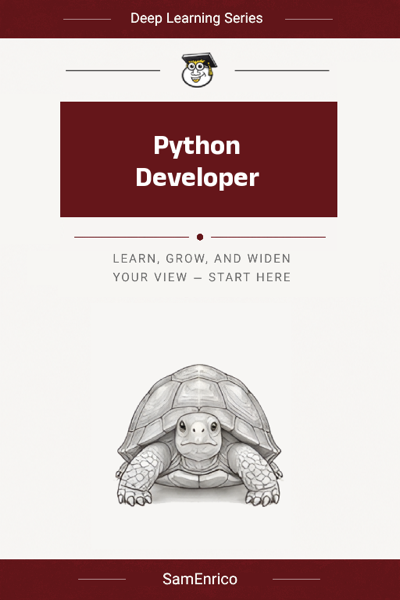
Non-FictionInformativeEducational
Python Developer eBook
A Coursebook on Python Developer
A Coursebook on Python Developer
Formats
Free sample
Chapter 1: The Workspace Frontier--–- Every journey into software development begins not with a line of code, but with a decision: where will you build? For too many beginners, that decision is an afterthought—they open any text editor, type a few lines, run the script, and call it a day. That approach works for a single afternoon, but it crumbles the moment a project grows beyond fifty lines, the moment you need to find a bug introduced six hours ago, or the moment you want to share your work with another human being. This chapter is not about Python syntax alone; it is about the professional habitat in which Python thrives. You will install an Integrated Development Environment (IDE) that catches mistakes as you type, configure linters that enforce community standards, and understand the difference between exploratory scripting and production-grade execution. By the final project, you will have built a system diagnostic tool that queries your operating system directly—not because that tool is glamorous, but because it proves you can make Python talk to the machine beneath it.Why Your Environment Matters More Than You Think Imagine learning carpentry with a rusty hammer and a warped workbench. You could still drive nails, but every action would require extra effort, and the results would look amateurish. Programming is no different. The difference between a struggling beginner and a productive developer is often not raw talent—it is tooling. Professional Python developers do not guess about indentation, misspell variable names, or forget to close files. They use tools that automate those checks so their brains can focus on logic, architecture, and problem-solving.In this chapter, you will establish three layers of your development environment. First, you will install Visual Studio Code (VS Code) , a free, cross-platform editor that dominates modern Python development. Second, you will add linters—specifically ruff and pylint—that scan your code for errors, style violations, and even performance issues before you run the program. Third, you will learn the two different ways Python executes code: script mode (saving and running .py files) and interactive mode (the REPL, or Read-Eval-Print Loop). These are not academic distinctions; they shape how you debug, experiment, and eventually deploy applications.Installing Visual Studio Code and the Python Extension Start by navigating to code.visualstudio.com and downloading the version for your operating system—Windows, mac OS, or Linux. The installation process is straightforward, but pay attention to two checkboxes during setup (on Windows: "Add to PATH" and "Register code as an editor for supported file types"). These options allow you to open VS Code from your terminal later, a habit that saves hundreds of clicks over a career.Once VS Code launches, you will see a welcome screen. Do not skip the next step: installing the Python extension published by Microsoft. Click the Extensions icon on the left sidebar (it looks like four squares) or press Ctrl+Shift+X. Search for "Python" and select the one with over 90 million installs. This extension provides Intelli Sense (autocomplete), syntax highlighting, debugging, and crucially, integration with linters.Configuring Linters for Real-Time Feedback Linters are automated critics. They read your code as you type and underline problems before you ever press Ctrl+F5 to run the program. This chapter configures two complementary linters: ruff (extremely fast, modern, and increasingly the industry standard) and pylint (more verbose, excellent for teaching style rules).Open the terminal within VS Code by selecting Terminal > New Terminal from the menu or pressing Ctrl+`. You will install both linters using pip, Python's package installer. Type:bash Copy Downloadpip install ruff pylint If you see a warning about pip not being found, refer to the appendix on Python installation. Once installed, configure VS Code to use them. Open the Command Palette (Ctrl+Shift+P), type "Preferences: Open Settings (JSON)", and add the following lines:json Copy Download{
"python.linting.enabled": true, "python.linting.pylint Enabled": true, "python.linting.ruff Enabled": true, "python.linting.lint On Save": true }Save the file. Now, intentionally write a broken line: print("Hello world" (missing the closing parenthesis). VS Code underlines it in red immediately. Hover over the underline, and you will see an error message: "Syntax Error: unexpected EOF while parsing." This instant feedback is the first pillar of professional development.Script Mode vs. Interactive Mode: Two Ways to Think Python offers two distinct execution modes, and beginners who fail to learn both often struggle with debugging. Script mode means writing Python code in a .py file and running the entire file at once. This is how production code executes—deployed servers, data pipelines, and desktop applications all run as scripts. Interactive mode (the REPL) means typing one line at a time and seeing results immediately. This is how data scientists explore datasets, how debuggers test hypotheses, and how beginners learn syntax without saving files.To experience both, create a new file in VS Code: File > New File, then File > Save As, naming it first_script.py. Type:python Copy Downloadname = input("What is your name? ") print(f"Hello, {name}!")Save the file. To run it in script mode, click the triangular "Run" button at the top right of the VS Code window, or open the terminal and type python first_script.py. The entire program executes from top to bottom.Now open a REPL. In the same VS Code terminal, type python (or python3 on mac OS/Linux) and press Enter. You will see >>> prompts. Type:python Copy Download>>> name = input("What is your name? ") >>> print(f"Hello, {name}!")Each line executes independently. If you make a mistake, you can retype just that line. This interactivity is invaluable for testing small ideas. When you finish, type exit() to leave the REPL.The key insight: use the REPL for exploration and experimentation; use script mode for anything you want to save or share. Most professional workflows involve both—writing a few lines in the REPL to test a function, then copying the working version into a script file.Variables, Dynamic Typing, and Memory References Python is a dynamically typed language. That means you never declare a variable's type explicitly; the interpreter infers it from the value you assign. In VS Code, create a new script called variables_demo.py and type:python Copy Download# Python infers types automatically age = 32 # int price = 19.99 # float name = "Ada" # str is_valid = True # bool Behind the scenes, Python creates a variable name that references an object in memory. Think of variables as sticky notes attached to values, not boxes containing values. When you write age = 32, Python creates an integer object 32 somewhere in memory, then attaches the label age to it. When you write age = 33, Python creates a new integer object 33 and reattaches the label. The old 32 becomes eligible for garbage collection.To visualize this, use Python's id() function, which returns the memory address of an object:python Copy Downloadx = 100 print(id(x)) # prints a number like 140736501432784 x = 200 print(id(x)) # prints a different number You can also see reference counts conceptually. If you assign y = x, both labels point to the same object. Python's garbage collector automatically deletes objects when their reference count drops to zero. You do not need to manage memory manually, but understanding references helps debug…
This is the end of the free sample. Get the eBook to keep going. Buy now
About this book
Details
- Author
- Halstead Herschel
- Publisher
- SamEnrico
- Language
- English
- Genre
- Non-Fiction, Informative, Educational
- Released
- 2026-05-04
- Pages (approx.)
- 158
- Available as
- eBook, Audiobook

Read better in the ZLOADR app
Your eBooks on your phone or tablet. Sign in with your SamEnrico account and start reading.
More by Halstead Herschel
 Chunking Legal Cases GuideHalstead Herschel$11.99
 The Memory Palace FallacyHalstead Herschel$11.99
 Secoya Ayahuasca CuracaHalstead Herschel$11.99
 Lifestyle Counseling NaturopathyHalstead Herschel$11.99
 The Prostate Hormone Therapy GuideHalstead Herschel$11.99
 The Jade Phoenix and the Celestial WeaverHalstead Herschel$11.99
 How to Become a Static BalancerHalstead Herschel$11.99
 Understanding ScleromyxedemaHalstead Herschel$17.99
 Cross Border Franchising Your Brand GuideHalstead Herschel$12.99
 Media Generations GuideHalstead Herschel$12.99
You may also like
 Hong Kong Handover 1997Dunn Johnnie$11.99
 Zumba For Postnatal Recovery CourseNeal Christian$11.99
 Zumba for BeginnersLadner Nikia$11.99
 YouTube Comment Mining GuideHumes Pandora$12.99
 Worry Box MeditationCarlin Rudy$11.99
 Workplace Stress MeditationNguyen Lynn$11.99
 Workplace Stress and Sleep RepairHawley Ivory$11.99
 Workplace Perfectionism CureDelaney Jeffry$11.99
 Workplace Injustice Anger GuideWallen Isabelle$11.99
 Work Addiction and Burnout LinkGreenwood Ester$11.99
 Women in Yoga and WellnessBeattie Galina$11.99
 Women in Stand Up ComedyChun Evangeline$11.99