
Non-FictionStudent's ShortcutEditing
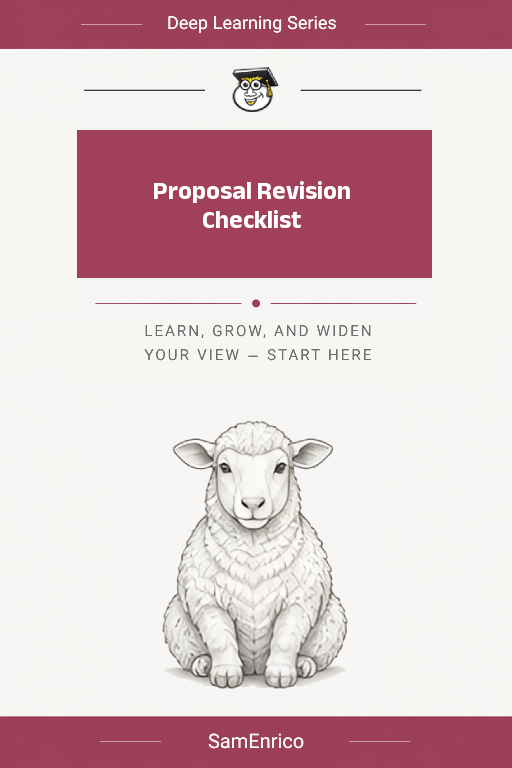
Proposal Revision Checklist
Self edit grad research proposals using comprehens
by Casey Nettie
Self edit grad research proposals using comprehensive revision checklists. Check alignment, clarity, feasibility, and formatting before committee submission.
Formats
About this book
Free sample
Chapter 1: The Reverse Audit–- Most graduate students will spend the next six months writing a proposal that their committee will skim in fifteen minutes and reject in thirty seconds. That is not hyperbole. That is the quiet catastrophe of graduate education. You have been taught how to write—how to form sentences, how to cite sources, how to structure a literature review. But no one has taught you how to revise like a forensic auditor.
No one has taught you that the difference between a funded proposal and a rejected one is rarely the quality of the idea. It is the quality of the execution. And execution begins not with writing, but with reverse engineering.This chapter introduces the single most important revision method you will ever learn: the Reverse Engineering Audit. It is a systematic, checklist-driven approach that flips the entire writing process upside down. Instead of starting with your idea and hoping it matches what the committee wants, you start with what the committee wants and rebuild your proposal around it.
This method has been used successfully by doctoral candidates in the humanities, social sciences, and STEM fields. It works because it replaces hope with evidence, and intuition with a rubric.Most students write forward. They have a research idea. They write a draft. They add sections as they think of them.
They revise by reading from top to bottom, tweaking sentences, and hoping the committee will see the brilliance beneath the disorganization. This is called "forward writing," and it fails for a simple reason: you are writing to satisfy your own sense of completion, not the committee's evaluation criteria. The committee does not care about your writing process. They care about whether you have answered their questions in the order they asked them.The Hard Truth About Committee Reading Habits Before you can revise effectively, you need to understand how your proposal will actually be read. Committees do not read like novelists or even like your advisor.
They read like auditors. They have a stack of proposals—sometimes twenty or thirty—and they have limited time. Most committees allocate…
This is the end of the free sample. Get the eBook to keep going. Buy now
Contents
- Chapter 1
- Chapter 2
- Chapter 3
- Chapter 4
- Chapter 5
- Chapter 6
- Chapter 7
- Chapter 8
- Chapter 9
- Chapter 10
- Chapter 11
- Chapter 12
Details
- Author
- Casey Nettie
- Publisher
- SamEnrico
- Language
- English
- Genre
- Non-Fiction, Student's Shortcut, Editing
- Released
- 2026-06-01
- Pages (approx.)
- 133
- Available as
- eBook, Audiobook

Read better in the ZLOADR app
Your eBooks on your phone or tablet. Sign in with your SamEnrico account and start reading.
More by Casey Nettie
 Harvard Extension School Career OutcomesCasey Nettie$11.99
 Police Nonverbal TrainingCasey Nettie$11.99
 The Furniture Off gassing GuideCasey Nettie$11.99
 Burnout and Creative RecoveryCasey Nettie$11.99
 When the Sky Fell: The Navajo Emergence StoryCasey Nettie$11.99
 How to Produce Bicycle ComputersCasey Nettie$11.99
 How to Start a Nonalcoholic Beverage Bar BusinessCasey Nettie$11.99
 Radiology AssistantCasey Nettie$11.99
You may also like
 Hong Kong Handover 1997Dunn Johnnie$11.99
 Zumba For Postnatal Recovery CourseNeal Christian$11.99
 Zumba for BeginnersLadner Nikia$11.99
 YouTube Comment Mining GuideHumes Pandora$12.99
 Worry Box MeditationCarlin Rudy$11.99
 Workplace Stress MeditationNguyen Lynn$11.99
 Workplace Stress and Sleep RepairHawley Ivory$11.99
 Workplace Perfectionism CureDelaney Jeffry$11.99
 Workplace Injustice Anger GuideWallen Isabelle$11.99
 Work Addiction and Burnout LinkGreenwood Ester$11.99
 Women in Yoga and WellnessBeattie Galina$11.99
 Women in Stand Up ComedyChun Evangeline$11.99